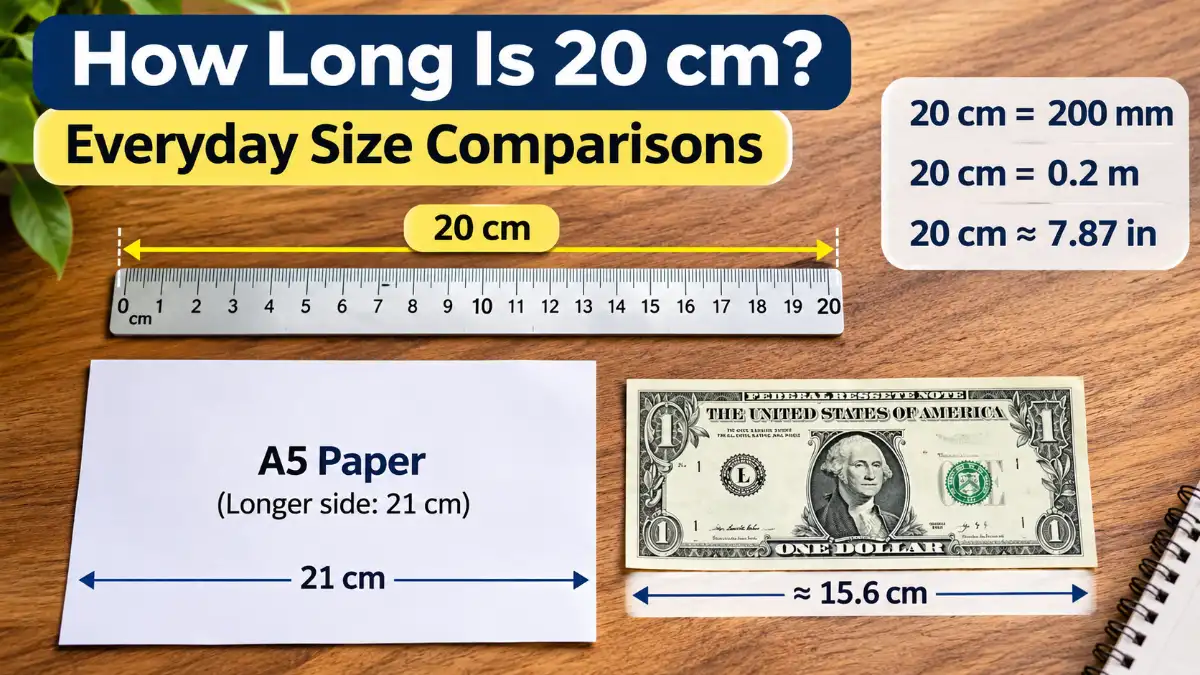
Looking for a 20cm example? A length of 20 centimeters (cm) is the exact distance between the 0 and 20 marks on a metric ruler. It equals 200 millimeters (mm), 0.2 meters, or approximately 7.87 inches. To picture this measurement, think of the longer side of an A5 sheet of paper, which measures 21 cm, just 1 cm longer than 20 cm.
In everyday terms, 20 cm is slightly shorter than 8 inches. A standard US dollar bill, which measures about 15.6 cm long, offers another familiar comparison, although it’s noticeably shorter. These objects can help you judge the length when you don’t have a measuring tool nearby.
What Does 20 cm Look Like Compared to Everyday Objects?
The following three examples show how 20 cm compares with familiar objects. Each provides a different reference, from an exact measurement to a rough everyday estimate.
1. A 20 cm Ruler
A metric ruler with a 20 cm scale provides an exact reference. The distance between the 0 cm and 20 cm marks is precisely 20 centimeters.
However, the ruler’s physical body may extend slightly beyond its numbered markings. For an accurate measurement, follow the printed scale rather than assuming the ruler’s outer edges represent exactly 20 cm.
A standard 30 cm metric ruler also works well. You can identify the required length directly on its centimeter scale. The NIST metric ruler guide explains how centimeter and millimeter markings are used to measure length.
2. The Longer Side of A5 Paper
Standard A5 paper measures 14.8 cm × 21 cm, making its longer edge a convenient reference for 20 cm.
The difference is just 1 cm, or 10 millimeters. If you have an A5 notebook or a sheet of paper, imagine a length slightly shorter than its longer side.
A5 paper follows standardized dimensions under the international paper size system. This makes it a more dependable reference than household objects whose dimensions vary by brand or design.
3. A US Dollar Bill
A standard US dollar bill measures approximately 6.14 inches long, equivalent to about 15.6 cm.
According to the official US currency specifications, modern US banknotes measure 6.14 × 2.61 inches. That makes a dollar bill roughly 4.4 cm shorter than 20 cm.
Although a dollar bill isn’t an especially close match, it’s a familiar object for readers in the United States.
If you place a dollar bill beside a ruler, the remaining distance to the 20 cm mark is a little less than one-third of the bill’s length.
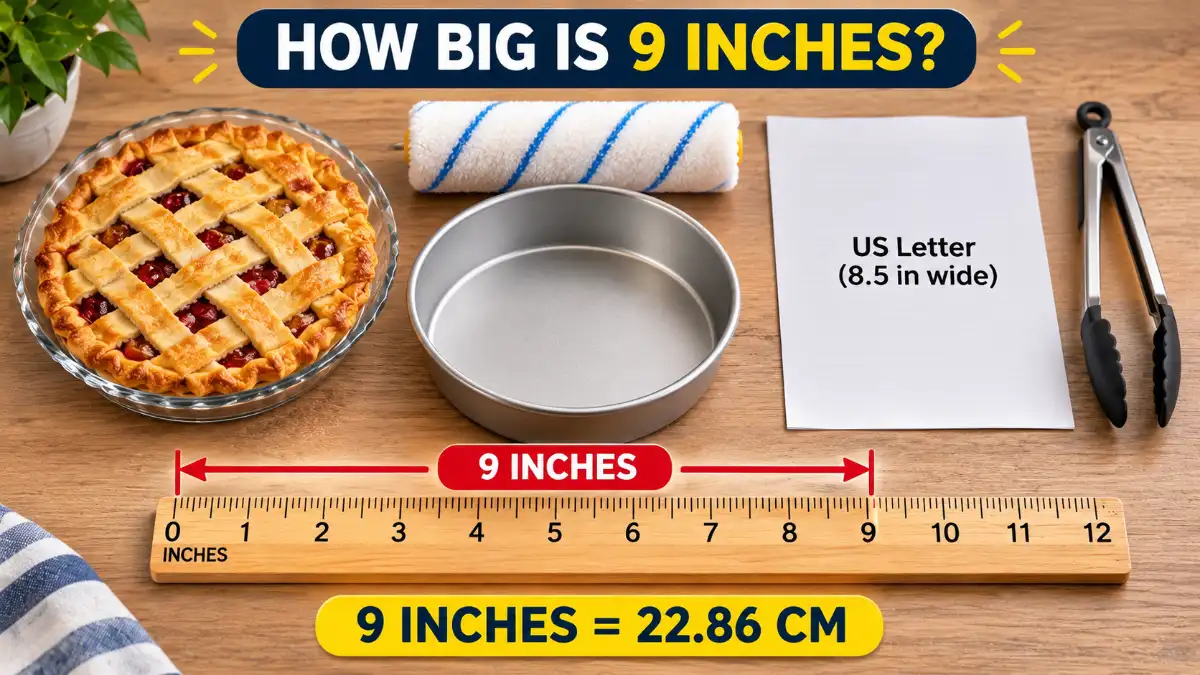
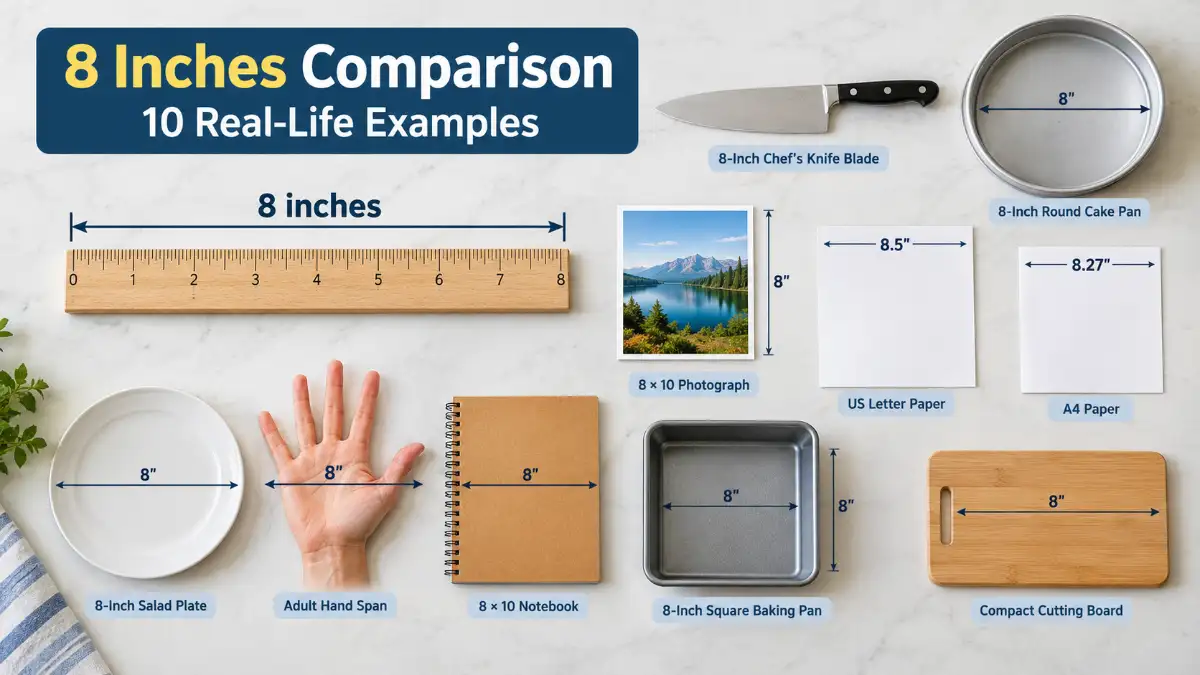
Read Also: 8 Inches Comparison: How Big Is It? 10 Real-Life Examples
How Many Inches, Millimeters, and Meters 20cm Example?
Twenty centimeters can be expressed in several metric and US customary units.
| Measurement Unit | Equivalent to 20 cm |
| Centimeters (cm) | 20 cm |
| Millimeters (mm) | 200 mm |
| Meters (m) | 0.2 m |
| Inches (in) | Approximately 7.87 inches |
| Feet (ft) | Approximately 0.656 feet |
20 cm in Inches
20 cm equals approximately 7.87 inches.
One inch is exactly 2.54 centimeters, as established by the official US measurement definition.
To convert centimeters into inches, divide the centimeter value by 2.54:
20 ÷ 2.54 ≈ 7.874 inches
Rounded to two decimal places, the result is 7.87 inches.
For comparison, 8 inches equals exactly 20.32 cm. This means 20 cm is just 0.32 cm, or 3.2 mm, shorter than 8 inches.
20 cm in Millimeters and Meters
20 cm equals exactly 200 millimeters and 0.2 meters.
Each centimeter contains 10 millimeters, so multiplying 20 by 10 gives 200 mm.
Likewise, one meter contains 100 centimeters. Dividing 20 by 100 gives 0.2 meters.
Both metric conversions are exact, unlike the rounded inch and foot equivalents.
How to Measure 20 cm Accurately
You can measure 20 cm with a ruler or measuring tape. A 30 cm ruler is particularly convenient because its scale extends beyond the required length.
Follow these steps:
- Place the ruler beside the object on a flat surface.
- Align one end of the object with the ruler’s 0 cm mark.
- Keep the ruler straight and parallel to the object’s length.
- Locate the 20 cm mark on the ruler.
- Check whether the opposite end of the object reaches that mark.
If both ends align with the 0 and 20 cm markings, the object’s measured length is exactly 20 cm.
If the zero mark is damaged or difficult to read, start from another numbered position. For example, the distance between the 5 cm and 25 cm marks is also exactly 20 cm.
A metric ruler typically has smaller divisions between the numbered centimeter marks. Each small division represents one millimeter, as explained in this educational guide to reading metric rulers.
A measuring tape works the same way and may be easier to use for objects that cannot be positioned against a rigid ruler.
How to Estimate 20 cm Without a Ruler
When you don’t have a ruler nearby, look for an object with known dimensions.
An A5 sheet of paper is one of the closest practical references. Its longer side measures 21 cm, so a length just 1 cm shorter gives you a reasonable approximation of 20 cm.
You can also use a US dollar bill. At approximately 15.6 cm long, it’s about 4.4 cm shorter than the measurement you’re estimating. This difference is noticeable, so the bill works better as a general size reference than a close match.
Other household items, including toothbrushes, notebooks, and small plates, may have dimensions near 20 cm. Their sizes vary considerably, however, so it’s best not to rely on them for exact measurements.
If you’re cutting materials, checking whether an object will fit, or measuring something for a project, use a ruler or measuring tape rather than relying on visual estimates.
Frequently Asked Questions
1. Is 20 cm the same as 8 inches?
Not exactly. Eight inches equals 20.32 cm, making it 3.2 mm longer than 20 cm. The difference is small enough for an everyday estimate, but it matters when you need a precise measurement.
2. What everyday object is close to 20 cm long?
A standard A5 sheet of paper is a convenient example because its longer edge measures 21 cm, just 1 cm more than 20 cm. For an exact reference, use the distance between the 0 and 20 cm marks on a metric ruler.
3. Is 20 cm longer than a dollar bill?
Yes. A standard US dollar bill measures approximately 15.6 cm long, so 20 cm is about 4.4 cm longer. You can see the difference clearly by placing the bill alongside a ruler.
4. Can I measure 20 cm with a 12-inch ruler?
Yes. A 12-inch ruler is long enough because 12 inches equals 30.48 cm. If the ruler has metric markings, measure directly to 20 cm. Otherwise, use approximately 7.87 inches.
5. How can I tell if an object is longer than 20 cm?
Align one end of the object with the zero mark on a ruler. If the other end extends beyond the 20 cm mark, the object is longer than 20 cm. Without a ruler, you can use the 21 cm longer edge of A5 paper for a rough comparison.