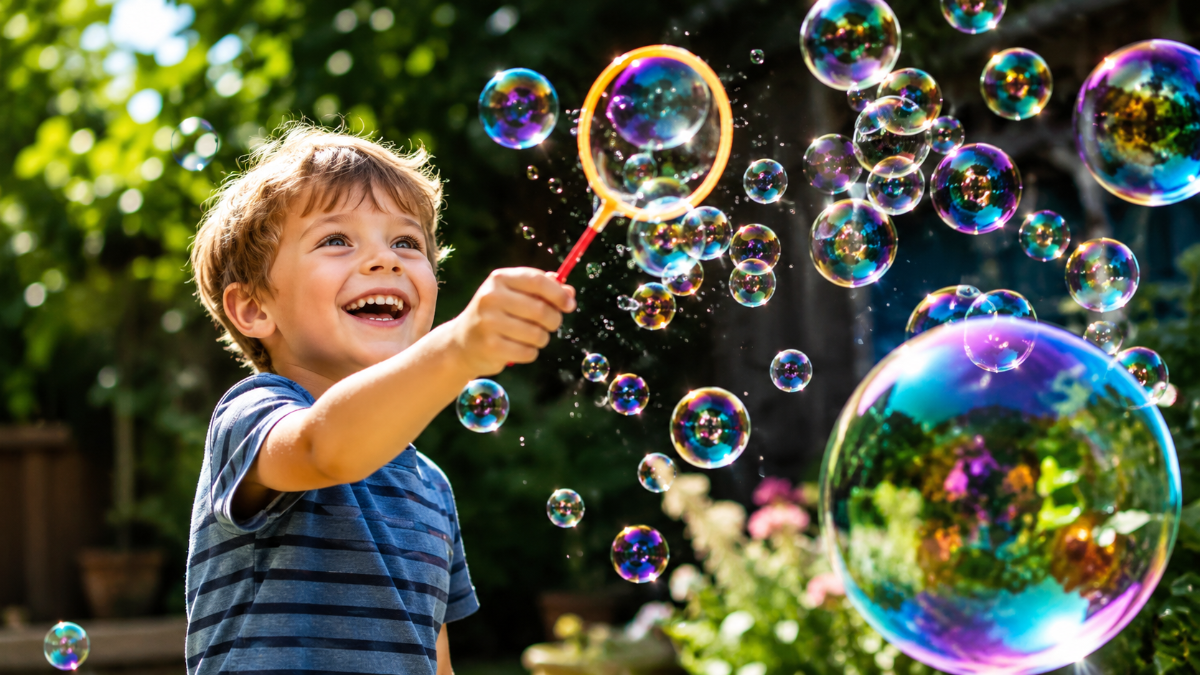
A few drops of dish soap and water are all it takes to create one of the most reliable sources of joy for kids of any age. Whether you’re chasing floating orbs in the backyard, mixing a batch for a birthday party, or exploring the science behind why they’re always round, this guide covers everything you need to make soap bubbles that work-bigger, stronger, and more fun than anything off a store shelf. You’ll find tested bubble solution recipes, step-by-step instructions for giant bubbles, wand options for every skill level, kid-friendly science explanations, and safety guidance for supervising playtime. Each section answers a specific question you’re likely to have, so skip ahead if you already know what you’re looking for.
Why Homemade Bubble Solution Beats Store-Bought
Store-bought solution is convenient, but it’s often diluted, prone to popping quickly, and expensive to replace once a bottle runs dry. A homemade batch costs pennies, uses ingredients most households already have, and can be tuned for either quick, splashy play or long-lasting giant bubbles.
The two ingredients that separate a mediocre mix from a great one are glycerin and sugar. Both slow down water evaporation from the soap film, which is the main reason bubbles pop. A solution without either ingredient will still work, but the results will be smaller and burst faster.
Read More: Chitlins
Core Ingredients and What They Do
| Ingredient | Role | Typical Ratio |
| Dish soap | Creates the soap film, Dawn is widely favored for its stretch | 1 part |
| Water (distilled preferred) | Base liquid, tap water works but distilled reduces mineral interference | 4–6 parts |
| Glycerin | Slows evaporation, strengthens the film | 1 tbsp per cup of soap |
| Sugar (glycerin-free option) | Alternative thickener that also slows evaporation | 1–2 tbsp per cup of soap |
| Corn syrup (optional) | Adds elasticity for bigger, more elastic results | 1/4 cup per batch |
Distilled water is preferred over tap water because minerals can weaken the film, though tap water still produces usable results for casual play.
Homemade Bubble Solution Recipe: Standard Version
This is the most commonly recommended approach, balancing strength and ease of preparation for everyday play.
- Pour 6 cups of water (distilled or tap) into a large, clean container.
- Slowly add 1 cup of liquid dish soap without stirring vigorously-this avoids creating suds that weaken the mixture.
- Add 1 tablespoon of glycerin.
- Optionally, stir in 1/4 cup of light corn syrup for extra durability.
- Stir gently until combined, then let the solution rest for at least a few hours (overnight is ideal) before use.
Letting the mixture rest allows the ingredients to fully bind, which noticeably improves strength compared to using it immediately.
Bubble Solution Recipe Without Glycerin
If you don’t have glycerin on hand, sugar works as an effective substitute and is often already in the kitchen.
- Dissolve 1–2 tablespoons of sugar in 1/2 cup of warm water, stirring until fully dissolved.
- Add 4 cups of room-temperature water.
- Gently mix in 1/2 cup of liquid dish soap (blue Dawn is a popular choice among enthusiasts).
- Let the mixture sit for at least 30 minutes, though a few hours or overnight produces noticeably stronger results.
Undissolved sugar crystals can weaken the film, so make sure the sugar fully dissolves in warm water before adding the soap.
How to Make Giant Soap Bubbles
Giant bubbles require a thicker solution and a different tool than a standard plastic wand. Recipes for giant results typically use more soap and glycerin relative to water, and rest for 24 hours to let the ingredients fully combine.
Giant Bubble Solution
- 1 gallon of distilled water (sun-warmed water often produces better results)
- 12 ounces of regular Dawn dish soap
- 2 ounces of glycerin
- Optional: a small amount of cornstarch for added thickness
Mix gently to avoid foam, then let it rest, loosely covered, for at least 24 hours before use. Stir gently before each session, since some ingredients settle over time.
DIY Giant Bubble Wand
- Cut two wooden sticks (dowels or skewers work well) about 2–3 feet long.
- Cut a length of cotton rope or thick cotton yarn in a roughly 1:2 ratio-for example, one 1-meter piece and one 0.5-meter piece.
- Tie the rope ends to each stick, forming a loop between the two.
- Secure the knots with wire or strong tape so they don’t slip during use.
- Dip the entire rope loop into the solution, let it soak briefly, then slowly pull the sticks apart and walk backward or move with a gentle breeze to form the shape.
Cotton rope is preferred over synthetic yarn because it absorbs and holds more liquid, producing a more even film.
Bubble Wand Options Compared
Different wands produce different sizes and play experiences. Matching the wand to the activity makes the difference between a frustrating afternoon and a magical one.
| Wand Type | Best For | Resulting Size | Skill Level |
| Plastic ring wand | Quick, casual play | Small to medium | Beginner |
| Wire loop (bent coat hanger) | Backyard experimentation | Medium to large | Beginner–Intermediate |
| Cotton rope and sticks | Giant outdoor results | Very large | Intermediate |
| Bubble machine | Continuous small bubbles for parties | Small | Beginner |
| Straw and cup | Simple indoor blowing | Small | Beginner (with supervision) |
For younger children, plastic ring wands or bubble machines minimize spills and mess, while cotton rope wands suit older kids and open outdoor space where giant results can fully form.
The Science Behind Bubbles
A soap bubble is a thin film of water sandwiched between two layers of soap molecules. Each molecule has a water-attracting (hydrophilic) head and a water-repelling (hydrophobic) tail. In the film, the hydrophilic heads face outward toward the air on both sides, while the tails face inward toward the trapped water layer-this structure lets the thin film stretch without immediately breaking apart. They form spheres because a sphere encloses the most volume with the least surface area, and surface tension naturally pulls the film into this lowest-energy shape. That’s also why the result almost always looks round regardless of the wand’s shape.
Simple Bubble Science Experiments for Kids
- Shape test: Use wands of different shapes (square, triangle, star) and observe that the outcome is still round, demonstrating that surface tension-not the wand shape-determines the final form.
- Temperature test: Compare a batch made with cold solution versus one left in a warm spot, and observe differences in how easily each pops.
- Ingredient test: Make two batches-one with glycerin or sugar and one without-and time how long each lasts before popping.
- Freezing test: In near-freezing outdoor temperatures, blow one and watch ice crystals form on its surface, a visual way to introduce states of matter.
These experiments turn ordinary play into an accessible introduction to surface tension, molecular structure, and states of matter, suitable for elementary-age children.
Bubble Activities for Kids
Beyond simply blowing bubbles, several structured activities extend engagement and add developmental value for different age groups.
- Bubble painting: Mix a few drops of food coloring into small cups of solution, blow onto paper, and let the popped shapes create colorful prints-good for fine motor skill practice.
- Bubble tag: Kids try to pop shapes blown by an adult or another child before they touch the ground, encouraging gross motor activity.
- Count and observe: For younger children, counting or describing size and color builds early math and vocabulary skills.
- DIY wand crafting: Letting kids bend pipe cleaners or wire hangers into their own wand shapes adds a creative, hands-on element before play even begins.
- Giant bubble challenge: Older kids can experiment with technique-wand speed, walking versus standing still, wind direction-to see who can create the largest result.
Common Mistakes That Ruin Bubble Solution
- Stirring too vigorously: Create foam and suds that weaken the film instead of strengthening it, stir slowly and gently instead.
- Using the solution immediately: Fresh mixtures often underperform compared to one that has rested for a few hours or overnight.
- Skipping glycerin or sugar entirely: Produces a film that pops almost instantly, especially outdoors in dry or windy conditions.
- Using very cold tap water straight from the tap: Can reduce solubility of the soap, room-temperature or slightly warm water dissolves ingredients more evenly.
- Overfilling a wand and shaking off excess solution too aggressively: Removes too much film and makes it harder to form a complete shape.
Safety Tips for Bubble Play
Bubble solution is generally low-risk, but a few precautions matter, especially with young children.
- Use tear-free, non-toxic dish soap and avoid solutions marketed for industrial or heavy-duty cleaning.
- Supervise children under three closely, since the liquid can be mistaken for a drink or cause slipping if spilled on hard surfaces.
- Rinse hands after extended play, particularly with solutions containing added glycerin or corn syrup, to avoid sticky residue transferring to eyes.
- If a child has sensitive skin or eczema, test a small amount on their skin before extended play, since some dish soaps can irritate with prolonged contact.
- Store leftover solution in a labeled, sealed container out of reach of very young children, and discard batches that have been open for several weeks, since bacterial growth can occur in soap-water mixtures over time.
Storing and Reusing Bubble Solution
Homemade solution can typically be stored in a sealed, labeled container for several weeks without major performance loss, though it should be kept out of direct sunlight and extreme heat, which can degrade the soap and glycerin over time. Giving the container a gentle shake or stir before each use helps redistribute any settled ingredients, particularly in giant recipes that include cornstarch or similar thickeners.
Frequently Asked Questions
Why do my homemade bubbles pop so fast?
Fast-popping usually means the solution lacks a thickening agent like glycerin or sugar, both of which slow water evaporation from the film. Using tap water high in minerals, stirring too aggressively and creating foam, or using the mixture immediately instead of letting it rest can also weaken the outcome. Letting it sit for at least a few hours, ideally overnight, typically produces noticeably longer-lasting results.
What is the best dish soap for making bubbles?
Blue Dawn dish soap is one of the most frequently recommended options among enthusiasts because of its strong stretch and consistent film formation. Other basic liquid dish soaps can work as well, though heavily scented or moisturizing formulas sometimes perform less consistently than plain, concentrated soap.
Can I make a bubble solution without glycerin?
Yes. Sugar dissolved thoroughly in warm water before adding dish soap serves as an effective substitute, slowing evaporation in a similar way. It won’t produce quite as durable a film as glycerin in giant recipes, but it works well for standard backyard play.
How long does homemade bubble solution last before it goes bad?
Stored in a sealed, labeled container away from heat and direct sunlight, homemade solution generally stays usable for several weeks. Performance may decline gradually, and it’s best to discard and remake a batch if it develops an odor or visible cloudiness beyond normal settling.
Why are bubbles always round, even from a square wand?
Surface tension pulls the soap film into the shape that encloses the most volume using the least surface area, which is always a sphere. The wand’s shape only determines how the film is initially stretched before it’s released into the air, once airborne, surface tension reshapes it into a round form.
What’s the best weather for making giant bubbles?
Calm, slightly humid days with little to no wind are ideal, since wind causes premature popping and dry air speeds up evaporation from the film. Early morning or evening, when temperatures are cooler and humidity is often higher, tends to produce more successful results than the middle of a hot, dry afternoon.
Is bubble solution safe if a child accidentally swallows a small amount?
Small accidental tastes of standard dish-soap-based solution are generally not seriously harmful, though they can cause mild stomach upset or an unpleasant taste. Contact a poison control center or pediatrician if a child swallows a large amount or shows symptoms like persistent vomiting, since this guidance is not a substitute for professional medical advice specific to your child.
Why does a giant bubble solution need to sit for 24 hours before use?
Ingredients like glycerin, cornstarch, or other thickening agents used in giant recipes need time to fully dissolve and integrate with the soap and water. Using the mixture immediately after combining often results in a weaker, less elastic film because these components haven’t had time to bind evenly throughout the liquid.
Can I use homemade solution in a bubble machine?
Most homemade mixtures can be used in bubble machines, though very thick giant recipes with added cornstarch or corn syrup may clog the machine’s wheel or nozzle. For machines, a thinner, well-strained solution without heavy thickeners generally flows and performs more reliably.
What household items can double as a bubble wand if I don’t have one?
Bent pipe cleaners, wire coat hangers shaped into a loop, plastic six-pack rings, funnels, and even the rim of a plastic cup can all function as improvised wands. For giant results specifically, two sticks connected by cotton rope or yarn create a simple, effective DIY tool without needing specialized equipment.