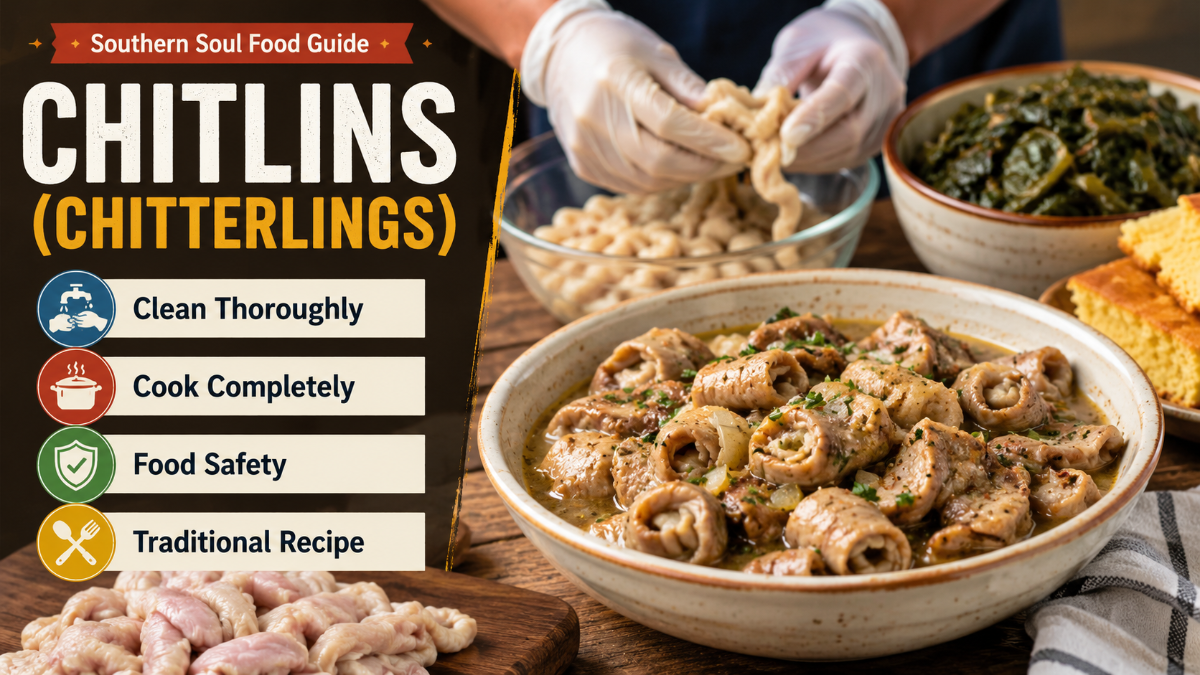
Chitlins, also called chitterlings, are pork intestines-an offal ingredient with a longstanding place in Southern soul food. They require patient cleaning and slow cooking, but when prepared safely, they become tender, richly savory, and especially good with pepper vinegar, greens, cornbread, and other traditional sides.
Quick answer: Boil raw chitlins in plain water for at least 5 minutes before cleaning. Then clean them thoroughly, sanitize the work area, and simmer until tender and at least 160°F internally.fsis.usda+1
What Are Chitlins?
Chitlins are pig intestines, most often sold frozen and sometimes labeled as chitterlings. In Southern cooking, they are cleaned, simmered with aromatics and seasonings, and served in their seasoned cooking broth-or, after simmering, finished by frying.
Their flavor is savory and distinctly pork-forward. Properly cooked chitterlings should be soft and tender with a pleasant chew, not gritty, rubbery, slimy, or overly mushy.
Read More: Purple Flowers
Chitlins vs. Other Offal
| Ingredient | What it is | Typical texture | Common preparation |
| Chitlins | Pork intestines | Tender, slightly chewy | Simmered or fried after simmering |
| Hog maw | Pig stomach | Dense and chewy-tender | Braised or stewed |
| Tripe | Usually beef stomach | Springy, often honeycomb-textured | Simmered in soups or stews |
| Pork stomach | Pig stomach | Firm and meaty | Braised, stewed, or sliced in soup |
Buying Chitlins
Buy from a reputable retailer and keep the package cold or frozen until you are ready to prepare it. “Pre-cleaned” can reduce preparation time, but it does not necessarily mean the product is fully cooked or safe to eat without further cooking.
| Type | Best for | Advantages | Considerations |
| Frozen, uncleaned | Traditional preparation | Often widely available | Requires the most sorting and cleaning |
| Frozen, pre-cleaned | Beginners | Less prep work | Treat as raw unless labeled fully cooked |
| Fresh | Cooking soon after purchase | No thawing needed | Highly perishable, follow package dates |
| Fully cooked | Convenience | Less raw handling | Flavor and texture vary by product |
Plan on about ½ to ¾ pound of raw product per person when serving chitlins as part of a meal with several sides. They lose volume during trimming, cleaning, and cooking.
Food Safety First
Raw chitterlings can carry Yersinia bacteria. The main safety goal is to keep raw juices away from hands, utensils, countertops, produce, and foods that will not be cooked.fsis.usda+1
- Thaw frozen chitlins in the refrigerator.
- Wash hands with soap and warm water before and after handling them.
- Boil raw chitlins in plain water for at least 5 minutes before cleaning.fsis.usda+1
- Keep raw preparation tools separate from ready-to-eat food.
- Wash and sanitize the sink, faucet handles, counters, utensils, and colander after cleaning.
- Cook the finished dish to at least 160°F internally.
Keep children and infant items away from the preparation area. Vinegar, lemon, and baking soda may support a preferred cleaning or flavor routine, but they do not replace safe handling, sanitizing, or complete cooking.
How to Clean Chitlins
Cleaning removes visible debris, excess fat, membrane, and tough or discolored material. Work in small batches so every piece can be inspected closely.
Cleaning Checklist
- Large stockpot
- Colander
- Clean bowl or dedicated sink basin
- Kitchen shears or a small knife
- Disposable gloves, if preferred
- Dish soap, sanitizer, and paper towels
- Food thermometer
How to Clean Chitlins Step by Step
- Pre-boil: Cover raw chitlins with water and boil for at least 5 minutes. Drain carefully.fsis.usda+1
- Cool briefly: Let them cool until safe to handle.
- Inspect each piece: Open folds as needed and remove visible debris, excess fat, and tough membrane.
- Rinse in fresh water: Change the water repeatedly until it remains mostly clear.
- Move to a clean pot: Do not reuse raw-prep equipment until it has been washed and sanitized.
- Clean the kitchen: Wash hands, utensils, surfaces, and sink areas immediately.
Repeated rinsing helps remove material trapped in the folds of the intestine and produces a cleaner-tasting pot liquor. It does not replace thorough cooking.
Why Chitlins Smell and How to Reduce Odor
Chitlins have a naturally assertive aroma because they are intestines with fatty tissue and connective tissue. The smell is usually strongest during cleaning and early cooking, then becomes more savory as the dish simmers with aromatics.
Practical Odor-Reduction Tips
- Trim excess fat carefully during cleaning.
- Rinse thoroughly in several changes of fresh water.
- Use a large pot and avoid overcrowding.
- Maintain a gentle simmer instead of a vigorous boil.
- Cook with onion, celery, garlic, bay leaves, and peppers.
- Use a vent hood, open windows, or cook outdoors when practical.
Some cooks drain and replace the water after an early boil. That can reduce aroma, though it may also create a lighter-flavored broth.
How to Cook Chitlins Until Tender
Chitlins become tender through low, moist heat. Their connective tissue gradually softens during a long simmer, adding body to the broth. A steady simmer generally creates a clearer broth and more even texture than a hard boil.
Southern Chitlins Recipe
Ingredients
- 5 pounds cleaned pork chitlins
- Water or low-sodium broth, enough to cover
- 1 large onion, chopped
- 2 celery stalks, chopped
- 1 green bell pepper, chopped
- 3 garlic cloves, minced
- 2 bay leaves
- 1 teaspoon black pepper
- ½ teaspoon crushed red pepper, optional
- 1 tablespoon apple cider vinegar
- Salt, to taste
- Hot pepper vinegar or hot sauce, for serving
Method
- Place cleaned chitlins in a large stockpot and cover with fresh water or broth.
- Add onion, celery, bell pepper, garlic, bay leaves, black pepper, red pepper, and vinegar.
- Bring the pot to a boil, then lower the heat to a gentle simmer.
- Cook partially covered until the pieces are tender, usually about 3 to 4 hours after cleaning.
- Add hot water as needed to maintain the liquid level.
- Check tenderness after about 3 hours and continue cooking if the pieces are still chewy.
- Confirm the thickest pieces reach at least 160°F.
- Season with salt near the end, when the broth has reduced and the flavor is easier to judge.
Best Seasoning Combinations
| Style | Seasonings |
| Traditional Southern | Onion, celery, garlic, bay leaf, black pepper, red pepper |
| Mild and savory | Onion, garlic, thyme, bay leaf, black pepper |
| Spicy | Garlic, cayenne, crushed red pepper, hot sauce, pepper vinegar |
| Creole-inspired | Onion, celery, bell pepper, garlic, thyme, bay leaf, Creole seasoning |
| Smoky | Smoked turkey or ham hock, onion, garlic, black pepper, vinegar |
Smoked turkey and ham hock add depth, but both can make the broth salty. Taste before adding more salt, bouillon, or seasoning blends.
Chitlins Cooking Methods Compared
| Method | Typical time | Best for | Advantages | Limitations |
| Stovetop simmer | 3–4 hours | Traditional flavor and broth | Best control over seasoning and texture | Requires occasional monitoring |
| Slow cooker | 6–8 hours on low | Hands-off cooking | Gentle, steady heat | Check temperature and tenderness before serving |
| Pressure cooker | About 45–75 minutes under pressure | Faster tenderizing | Considerably reduces cook time | Can soften the texture quickly |
| Instant Pot | Similar to pressure cooking | Smaller batches | Convenient and contained | Capacity may be limited |
| Frying after simmering | A few minutes | Crisp finishing texture | Adds contrast and crunch | Adds oil, never replaces full cooking |
For most beginners, the stovetop method is the easiest way to learn when the texture is right. Pressure cooking is useful when time is limited, but test early so the chitlins do not become overly soft.
Nutritional Value of Chitlins
Nutrition varies with trimming, cooking method, serving size, added fats, smoked meat, and seasonings. Chitlins provide protein but can also be high in fat and cholesterol, sodium can rise substantially when salted broth, bouillon, ham hock, or smoked turkey is used.
A modest serving alongside greens, beans, cabbage, or black-eyed peas can make a more balanced Southern meal. If you need to manage cholesterol, sodium, or dietary fat, consider portion size and the overall recipe rather than the ingredient alone.
Troubleshooting Chitlins
| Problem | Likely cause | What to do |
| Still tough | Not simmered long enough | Continue a gentle simmer and test every 20–30 minutes |
| Rubbery texture | Cooking liquid boiled too hard | Reduce heat to a steady simmer |
| Strong odor | Excess fat, incomplete cleaning, poor ventilation | Trim more fat, rinse thoroughly, and ventilate the kitchen |
| Cloudy broth | Vigorous boiling or residual foam | Simmer gently and skim foam if desired |
| Broth is too salty | Salt or smoked meat added too early | Dilute with unsalted water and avoid adding more salt |
| Broth tastes bland | Too few aromatics or insufficient seasoning | Add onion, garlic, pepper, herbs, and vinegar gradually |
| Pot liquor is greasy | Excess fat remained on the pieces | Trim carefully and skim the surface while cooking |
| Texture is mushy | Cooked past preferred tenderness | Begin checking sooner on the next batch |
| Texture is gritty | Incomplete cleaning | Do not serve, inspect and clean more thoroughly before cooking |
| Leftovers seem dry | Reheated without liquid | Reheat gently with a small amount of cooking broth |
Serving and Storage
Serve chitlins hot with pepper vinegar, hot pepper relish, or hot sauce. Traditional pairings include cornbread, collard greens, mustard greens, cabbage, black-eyed peas, rice, candied yams, and potato salad.
Refrigerate leftovers within 2 hours of cooking, using shallow containers so they cool promptly. Cooked leftovers are generally best used within 3 to 4 days, freeze portions you will not eat within that window.usda+1
FAQs
Are Chitlins and chitterlings the same thing?
Yes. Chitlins is the familiar Southern term for chitterlings. Both usually refer to pork intestines that are cleaned and cooked. Packages may use either name and may be labeled raw, pre-cleaned, pre-cooked, fresh, or frozen. Read the label carefully because pre-cleaned does not necessarily mean fully cooked or ready to eat.
Can you fry Chitlins?
Yes. Fully cooked chitlins can be cut into bite-size pieces, seasoned or lightly breaded, and fried until crisp outside. Frying works best as a finishing method after slow simmering has made the pieces tender. It should not replace the initial pre-boil, cleaning process, or complete cooking needed for safe preparation
Why are my Chitlins still chewy?
They need more gentle cooking time. Intestines contain connective tissue that softens slowly in moist heat, so a low simmer is more effective than aggressive boiling. Check a piece every 20 to 30 minutes once you reach the three-hour mark. They are ready when tender and easy to bite through without becoming mushy.
Can you overcook Chitlins?
Yes. Chitlins can become overly soft or mushy if simmered long past the point of tenderness. Start testing them after about 3 hours, then check regularly. The ideal texture is soft and tender with a little structure remaining. Cooking time varies by product, pot size, heat level, and how thoroughly the pieces were trimmed
What spices work best with Chitlins?
Onion, garlic, black pepper, crushed red pepper, bay leaf, celery, thyme, and bell pepper are traditional choices. Apple cider vinegar or pepper vinegar brings brightness to the table. Add smoked turkey or ham hock for a deeper, smokier pot liquor, or use a Creole-style blend with thyme and bell pepper for a more assertive flavor.
Do Chitlins shrink while cooking?
Yes. They shrink during trimming, cleaning, and simmering as fat renders and moisture is released. That is why a package that looks generous before cooking can yield fewer servings than expected. Planning roughly ½ to ¾ pound of raw product per person is a useful starting point for a meal with several side dishes.
Are pre-cleaned Chitlins safe without washing?
No. Pre-cleaned means some cleaning work may have been done, not that the product is ready to eat. Unless the package clearly says fully cooked, handle it as raw pork. Follow the label directions, prevent cross-contamination, and cook the final dish to at least 160°F internally.
Can dogs eat cooked Chitlins?
Usually, they are not a good choice for dogs. Traditional recipes are rich and may include salt, onion, garlic, hot peppers, and fatty broth, which can be unsuitable or harmful to pets. If you are considering plain, fully cooked pork for a dog, ask a veterinarian first and avoid giving any seasoned portions.
Why are Chitlins sometimes expensive?
Prices can increase because cleaning is labor-intensive, holiday demand is high, and some products are sold pre-cleaned or fully cooked. Availability also varies by region and retailer. A higher-priced package may save preparation time, but safe handling and thorough cooking remain important regardless of the product’s price or label.
How do restaurants prepare Chitlins?
Methods vary, but commercial kitchens should use strict separation between raw and ready-to-eat foods, controlled cooking temperatures, sanitation, and standardized procedures. Restaurants may simmer them in advance until tender, then serve them in seasoned broth or fry portions to order. At home, follow the same basic principles: clean carefully, sanitize thoroughly, and cook completely.