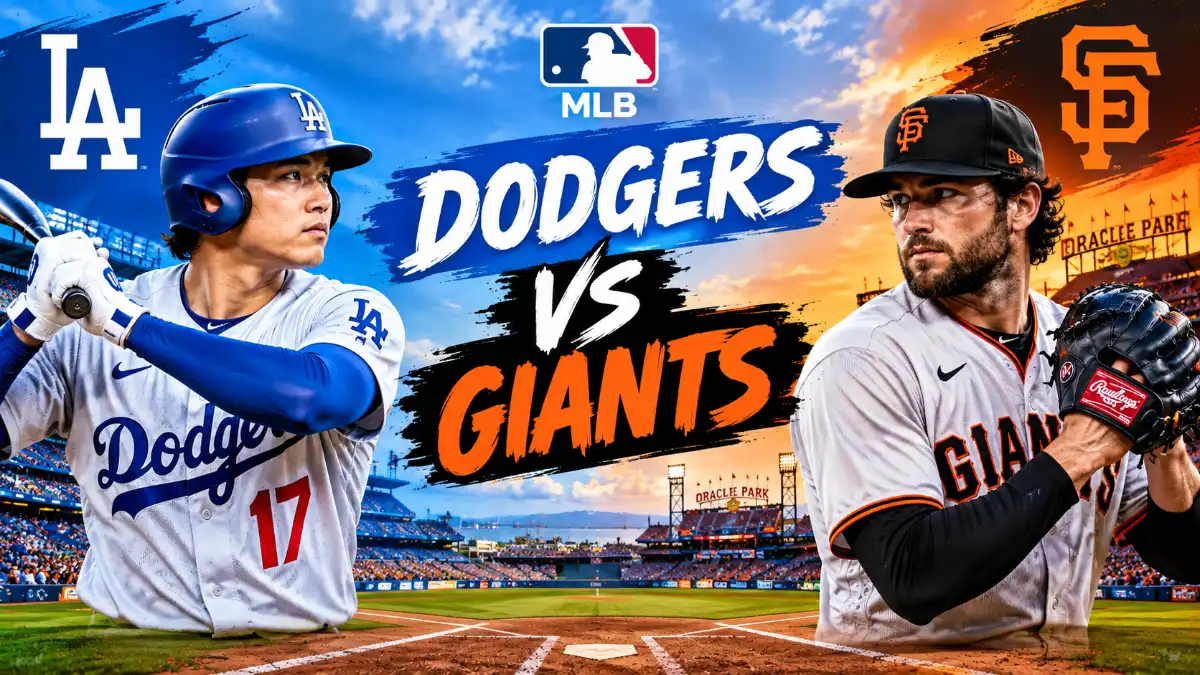
The Dodgers vs Giants rivalry is one of the oldest and most recognizable rivalries in Major League Baseball. It began in New York in the late 19th century, survived both franchises moving to California in 1958, and continues today as an NL West matchup between the Los Angeles Dodgers and San Francisco Giants.
What makes the rivalry exceptional is not simply its age. The teams have repeatedly affected each other’s pennant races, division hopes and postseason ambitions. Bobby Thomson’s famous 1951 home run, the 1962 pennant tiebreaker and the five-game 2021 NLDS are among the defining chapters.
The numbers also show how competitive the rivalry has been. Entering their first 2026 regular-season series in April, MLB reported an extraordinary all-time regular-season mark: 1,288 wins for the Dodgers, 1,288 for the Giants and 17 ties.
Dodgers vs Giants Rivalry at a Glance
| Category | Los Angeles Dodgers | San Francisco Giants |
| Current city | Los Angeles, California | San Francisco, California |
| Historic New York identity | Brooklyn Dodgers | New York Giants |
| League | National League | National League |
| Division | NL West | NL West |
| California era began | 1958 | 1958 |
| Home ballpark | Dodger Stadium | Oracle Park |
| First official postseason series vs. each other | 2021 NLDS | 2021 NLDS |
| 2021 NLDS result | Won 3–2 | Lost 2–3 |
The rivalry’s defining feature is continuity. The cities, stadiums, players and structure of Major League Baseball have changed dramatically, but these two franchises have remained opponents.
Dodgers vs Giants Head-to-Head Record
The historical record illustrates just how close this rivalry has been.
Before the teams opened their 2026 regular-season series in April, MLB listed the all-time matchup at 1,288–1,288 with 17 ties. That means neither franchise held an all-time regular-season advantage at that specific cutoff.
| Comparison | Dodgers | Giants | Context |
| All-time record entering first 2026 regular-season meeting | 1,288 wins | 1,288 wins | 17 ties |
| 2021 regular season | 9 wins | 10 wins | Giants won season series |
| 2021 NLDS | 3 wins | 2 wins | Dodgers advanced |
| 2025 regular season | 9 wins | 4 wins | Dodgers won season series |
The all-time figure should always be accompanied by a cutoff date because every new regular-season matchup changes the totals.
Another important distinction involves the famous 1951 and 1962 tiebreakers. Although those games determined National League pennants, they are statistically considered extensions of the regular season rather than modern postseason series. That is why the 2021 NLDS is recognized as the first official postseason series between the franchises.
How the Dodgers vs Giants Rivalry Started
The rivalry began long before Los Angeles and San Francisco became part of its identity.
The Giants and Brooklyn clubs were competing against each other in New York by the late 19th century. MLB traces the rivalry’s roots to 1889, giving it more than a century of history across two coasts.
Geography naturally intensified the early competition. Brooklyn and Manhattan represented different communities within New York, and repeated National League meetings created a local rivalry with consequences beyond an ordinary regular-season series.
Those origins matter because the modern Dodgers-Giants rivalry is effectively the continuation of the same franchise competition rather than a rivalry invented after the clubs reached California.
From New York to California
The defining transformation occurred after the 1957 season.
The Brooklyn Dodgers relocated to Los Angeles, while the New York Giants moved to San Francisco. Both began their California eras in 1958.
Normally, moving thousands of miles could destroy a geographic rivalry. In this case, moving both clubs preserved it.
The rivalry simply acquired a second geographic identity. Brooklyn versus Manhattan became Southern California versus Northern California.
That unusual continuity is one reason Dodgers-Giants history is difficult to compare with newer divisional rivalries. The same two franchises have shared meaningful competition in two completely different regions of the United States.
The 1951 “Shot Heard ’Round the World”
One game did more than almost any other to define the early rivalry.
In 1951, the New York Giants staged a remarkable late-season comeback to catch Brooklyn and force a three-game playoff for the National League pennant.
After the teams split the first two games, everything came down to Game 3 at the Polo Grounds on October 3.
Brooklyn carried a 4–1 advantage into the bottom of the ninth inning. The Giants began a comeback, narrowing the score before Bobby Thomson stepped to the plate against Ralph Branca.
Thomson hit a walk-off three-run home run.
The Giants won 5–4 and captured the National League pennant.
The play became known as the “Shot Heard ’Round the World” and remains one of baseball’s defining historical moments. MLB notes that the Giants had trailed the Dodgers by 13½ games on August 11 before completing their comeback.
Its importance to the rivalry is difficult to overstate. The Giants did not merely defeat Brooklyn; they ended their rival’s season in one of the most dramatic ways possible.
The 1962 Pennant Tiebreaker
Remarkably, the franchises produced another three-game pennant tiebreaker only 11 years later—this time in California.
The Dodgers and Giants finished the scheduled 1962 regular season tied, requiring three additional games to determine the National League champion.
San Francisco dominated Game 1, winning 8–0.
Los Angeles responded with an 8–7 victory in Game 2.
That created another winner-take-all Game 3.
The Dodgers led 4–2 entering the ninth inning, but San Francisco scored four runs and won 6–4, earning a trip to the World Series.
The similarities with 1951 were remarkable: three-game tiebreaker, National League pennant at stake and a decisive Giants comeback.
These games also explain an apparent historical oddity. Despite 1951 and 1962 feeling like playoff series, they are counted as part of the regular season under MLB’s historical classification.
The Marichal-Roseboro Incident
Not every memorable rivalry moment should be celebrated.
On August 22, 1965, tensions escalated dramatically during a game at Candlestick Park involving Giants pitcher Juan Marichal, Dodgers catcher John Roseboro and Dodgers pitcher Sandy Koufax.
After a sequence of brushback pitches and rising tension, a confrontation between Marichal and Roseboro turned violent. Marichal struck Roseboro with his bat, triggering a benches-clearing incident.
MLB’s historical account notes that Marichal was suspended and fined. The story also had a more humane ending: Marichal and Roseboro eventually reconciled and became friends later in life.
The incident remains part of rivalry history, but it is better understood as evidence of how dangerously intense sports competition can become rather than something to romanticize.
More Games That Changed the Rivalry
The 1951 and 1962 tiebreakers are the most famous early chapters, but the rivalry has repeatedly influenced postseason races.
1978: Mike Ivie’s Grand Slam
On May 28, 1978, Giants pinch-hitter Mike Ivie hit a grand slam against Don Sutton with San Francisco trailing 3–1. The Giants eventually won 6–5 at Candlestick Park.
1982: Giants Eliminate the Dodgers
The Giants entered the final weekend of 1982 fighting with the Dodgers and Braves in the NL West race.
San Francisco’s own postseason hopes disappeared, but the Giants still had an opportunity to damage Los Angeles.
On the final day, Joe Morgan hit a go-ahead three-run homer as San Francisco defeated Los Angeles 5–3, eliminating the Dodgers from the division race.
1993: Dodgers Return the Favor
Eleven years later, Los Angeles delivered its own season-ending blow.
The 1993 Giants won an extraordinary 103 games but entered their final game needing to stay with Atlanta in the NL West race.
The Dodgers defeated San Francisco 12–1. The Giants finished one game behind the 104-win Braves and missed the postseason.
Few examples better illustrate the rivalry’s spoiler dynamic: even when one club cannot achieve its own postseason objective, preventing its rival from advancing can become enormously significant.
1997: Brian Johnson’s Walk-Off
Another major divisional confrontation came in September 1997.
San Francisco entered a crucial series against Los Angeles chasing the division lead. Brian Johnson’s 12th-inning walk-off home run gave the Giants a 6–5 victory and moved them into a tie for first place. San Francisco eventually won the NL West.
Famous Players in Dodgers-Giants History
The longevity of the rivalry means that many generations of baseball stars have participated in it.
For the Giants, major names associated with different eras include:
- Willie Mays
- Willie McCovey
- Juan Marichal
- Barry Bonds
- Madison Bumgarner
- Buster Posey
The Dodgers side has featured figures such as:
- Jackie Robinson
- Duke Snider
- Sandy Koufax
- Don Drysdale
- Fernando Valenzuela
- Clayton Kershaw
The importance of these players extends beyond individual statistics. Rivalries gain continuity when new stars inherit the competitive expectations established by previous generations.
Modern Dodgers vs Giants Rivalry
Modern MLB has changed significantly from the days of three-game pennant tiebreakers, but the basic competitive relationship remains.
Both franchises play in the NL West, so their games can directly affect the same divisional race.
Modern rivalry moments have also created new personalities and storylines.
Madison Bumgarner’s confrontations with Dodgers hitters became part of the rivalry during the 2010s. One memorable episode occurred in 2019 after Max Muncy homered into McCovey Cove and exchanged words with Bumgarner.
Yet no modern season demonstrated the rivalry’s competitive potential better than 2021.
The Incredible 2021 NL West Race
The 2021 Dodgers vs Giants race produced one of the strongest seasons in the history of both franchises.
San Francisco finished 107–55.
Los Angeles finished 106–56.
Despite winning 106 games, the Dodgers finished one game behind their rivals. The Giants secured the division on the final day of the regular season.
San Francisco also won the regular-season matchup between the teams, 10–9.
But the rivalry had one more chapter to produce.
Dodgers vs Giants 2021 NLDS
The teams met in the 2021 National League Division Series, marking their first official postseason series against each other.
That distinction can initially seem strange because the franchises had already played famous pennant tiebreakers in 1951 and 1962. Those older tiebreakers, however, are classified as regular-season games.
The 2021 NLDS went the full five games:
| Game | Winner | Score |
| Game 1 | Giants | 4–0 |
| Game 2 | Dodgers | 9–2 |
| Game 3 | Giants | 1–0 |
| Game 4 | Dodgers | 7–2 |
| Game 5 | Dodgers | 2–1 |
San Francisco took a 2–1 series lead, putting Los Angeles one loss from elimination.
The Dodgers responded by winning Game 4 and forcing a decisive Game 5 at Oracle Park.
Los Angeles won 2–1, taking the series three games to two and advancing to the NLCS. MLB’s postseason history recognizes it as the first postseason series between the Dodgers and Giants.
For two franchises that had spent more than a century affecting each other’s seasons, a five-game first postseason matchup was a fitting addition to the rivalry.
Dodgers vs Giants in 2026
The 2026 season presents a very different competitive picture from 2021.
As of games completed through September 3, 2026, Los Angeles is 83–57 and leads the NL West. MLB’s current playoff picture lists the Dodgers as the NL West team in postseason position.
San Francisco, meanwhile, entered September far behind Los Angeles in the division. Because MLB standings change daily, these figures should be treated as a dated snapshot rather than permanent statistics.
The season also began with a remarkable historical coincidence. Before their first 2026 regular-season meeting, the franchises’ all-time series was exactly tied at 1,288 wins apiece with 17 ties.
That statistical balance helps explain why a rivalry lasting this long remains difficult to define by simply declaring one franchise historically dominant over the other.
Dodger Stadium vs Oracle Park
The rivalry now has two distinctly California settings.
Dodger Stadium
Dodger Stadium has been the Dodgers’ permanent home since 1962. Its longevity means that generations of Giants teams have played rivalry games there.
A Dodgers home series brings the matchup into Southern California and connects today’s games with more than six decades of West Coast rivalry history.
Oracle Park
Oracle Park is the Giants’ modern home in San Francisco.
Its waterfront setting creates a dramatically different baseball environment from Dodger Stadium. McCovey Cove has also become part of modern rivalry lore, particularly through home runs hit into the water beyond right field.
Together, the ballparks reinforce the rivalry’s modern California identity while the franchise histories preserve its New York origins.
Why Are the Dodgers and Giants Rivals?
The Dodgers and Giants are rivals because their competition began when both franchises played in New York, survived their simultaneous move to California in 1958, and has repeatedly affected pennants, division championships and postseason advancement.
Several factors keep the rivalry important:
- More than a century of history: Its roots extend to the 19th century.
- Two geographic eras: The rivalry moved from New York to California.
- Same-division competition: Both teams play in the NL West.
- Extraordinary competitive balance: Entering their first 2026 regular-season meeting, the all-time series stood at exactly 1,288 wins each.
- Pennant-deciding games: The 1951 and 1962 tiebreakers became landmark moments.
- Modern postseason history: The Dodgers defeated the Giants in their first official playoff series in 2021.
- Spoiler games: Each franchise has ended or damaged the other’s postseason hopes in memorable seasons.
That combination of longevity and consequence separates the matchup from an ordinary divisional series.
Read More: St. Christopher
Dodgers vs Giants Rivalry Timeline
| Year | Rivalry Milestone |
| 1889 | Early Giants-Brooklyn competition establishes the rivalry’s roots |
| 1951 | Bobby Thomson’s “Shot Heard ’Round the World” wins the pennant for the Giants |
| 1958 | Dodgers and Giants begin their California eras |
| 1962 | Giants win another three-game NL pennant tiebreaker |
| 1965 | Marichal-Roseboro confrontation becomes an infamous rivalry incident |
| 1982 | Giants eliminate Dodgers from NL West race on final day |
| 1993 | Dodgers defeat Giants on final day, helping end San Francisco’s postseason hopes |
| 1997 | Brian Johnson’s walk-off helps Giants catch Dodgers in NL West race |
| 2021 | Giants win 107 games and Dodgers win 106 |
| 2021 | Dodgers defeat Giants 3–2 in their first official postseason series |
| 2026 | Rivalry enters first regular-season meeting tied 1,288–1,288 all time |
The timeline demonstrates something raw totals cannot: different generations of fans have experienced their own defining Dodgers-Giants moments.
Who Has the Edge in the Dodgers vs Giants Rivalry?
There is no useful answer without defining the timeframe.
If the question concerns the historical regular-season series, MLB reported that the clubs entered their first 2026 regular-season matchup in a perfect 1,288–1,288 tie, along with 17 ties.
If the question concerns their only official postseason series, Los Angeles has the advantage because it won the 2021 NLDS, 3–2.
If the question concerns individual seasons, the answer changes. San Francisco won the 2021 regular-season series 10–9, while Los Angeles won the 2025 season series 9–4.
The most accurate approach is therefore to specify all-time, postseason or single-season record rather than treating them as interchangeable statistics.
Frequently Asked Questions
1. When did the Dodgers vs Giants rivalry begin?
The rivalry’s roots extend to 1889, when both franchises were based in New York. Brooklyn and the Giants subsequently became long-term National League opponents. The competition continued after both clubs relocated to California following the 1957 season, making it one of the rare major American sports rivalries to maintain its identity after both participants moved across the country.
2. What is the Dodgers vs Giants all-time record?
Entering their first regular-season meeting of 2026, MLB reported an exact tie: Dodgers 1,288 wins, Giants 1,288 wins, with 17 ties. Because the clubs continue playing each other, an all-time head-to-head figure should always include a cutoff date.
3. Why did both teams move from New York to California?
The Dodgers relocated from Brooklyn to Los Angeles and the Giants moved from New York to San Francisco after the 1957 season. Both began playing in California in 1958. From a rivalry perspective, the crucial result was that both franchises moved west at the same time, allowing their established competition to continue in a new geographic setting.
4. What was the “Shot Heard ’Round the World”?
It was Bobby Thomson’s walk-off three-run home run for the New York Giants against Brooklyn on October 3, 1951. The homer completed a ninth-inning comeback in the deciding game of a three-game National League pennant tiebreaker and gave the Giants a 5–4 victory. It remains one of the most famous plays in MLB history.
5. What happened between the Dodgers and Giants in 1962?
The teams required another three-game tiebreaker to determine the National League pennant. They split the first two games before the Dodgers led 4–2 entering the ninth inning of Game 3. San Francisco scored four runs in the ninth, won 6–4 and advanced to the World Series.
6. Have the Dodgers and Giants played each other in the postseason?
Yes. Their first official postseason matchup was the 2021 NLDS, which Los Angeles won three games to two. The 1951 and 1962 pennant tiebreakers are classified statistically as regular-season games, which explains why they do not count as earlier postseason series.
7. Who won the 2021 Dodgers vs Giants season series?
San Francisco won the 2021 regular-season series 10–9. The Giants also finished the season with 107 victories compared with 106 for Los Angeles, giving San Francisco the NL West title. Los Angeles then reversed the result in October by defeating San Francisco in five games in the NLDS.
8. Are the Dodgers and Giants in the same division?
Yes. Both play in the National League West. Their shared division is important because head-to-head games can directly influence the same division race and postseason positioning. It also guarantees that the historic rivalry continues through regular-season meetings rather than relying on occasional interleague scheduling.
9. Where do Dodgers vs Giants games take place?
Dodgers home games are played at Dodger Stadium in Los Angeles, while Giants home games are played at Oracle Park in San Francisco. These two venues represent the rivalry’s modern West Coast identity, replacing the New York settings associated with the Brooklyn Dodgers and New York Giants.
10. Is Dodgers vs Giants still a major MLB rivalry?
Yes. Competitive intensity naturally changes from season to season, but the underlying rivalry remains significant because of its history, NL West connection and repeated high-stakes games. The 2021 season offered a particularly strong modern example: the clubs won 107 and 106 games, respectively, before meeting in a five-game NLDS.