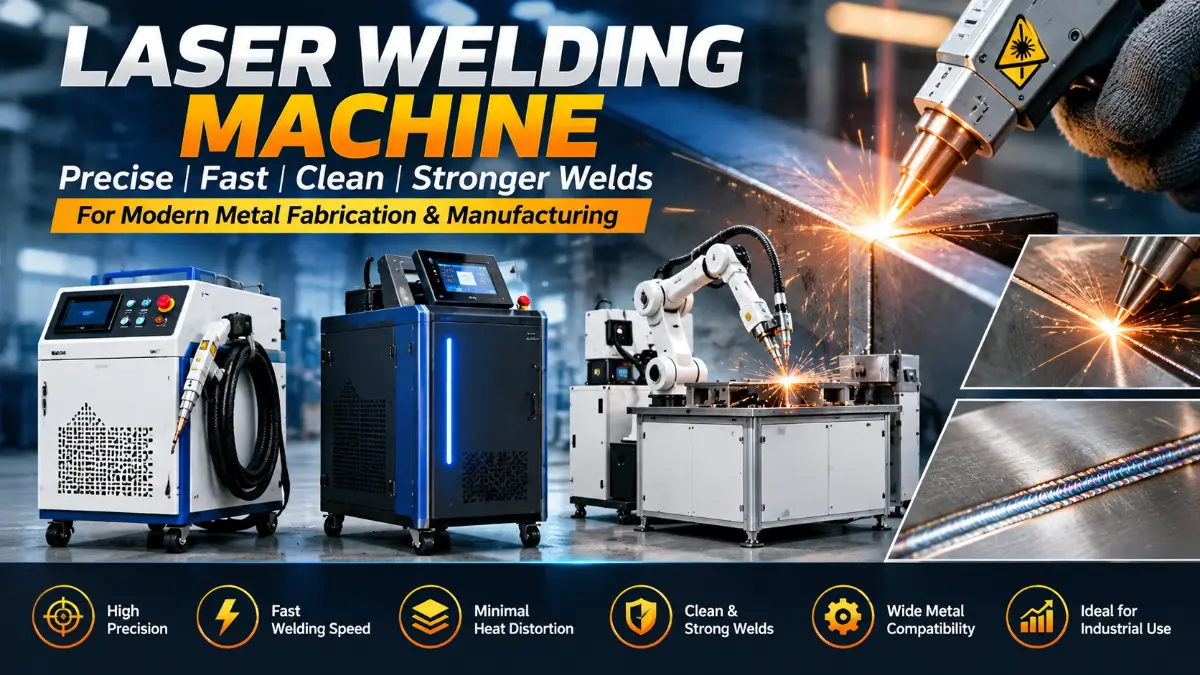
A laser welding machine is a high-precision welding device that uses a concentrated laser beam to join metal components by melting their surfaces. It offers fast welding speeds, narrow weld seams, reduced heat distortion, and consistent results compared with many traditional welding methods.
Laser welding machines are commonly used for stainless steel, carbon steel, aluminum, and titanium. They are available in handheld, fiber laser, automatic, and robotic configurations.
In 2026, handheld laser welding machines can cost approximately $3,000 to $15,000 or more in the United States, depending on their power, features, manufacturer, and cooling system.
What Is a Laser Welding Machine?
A laser welding machine joins materials using focused light energy rather than a conventional electric welding arc.
The concentrated laser beam heats a small area until the material melts. As the molten metal cools, it forms a welded joint.
Unlike some traditional welding processes, laser welding can operate without filler material, although certain applications require filler wire or shielding gas.
According to TWI’s explanation of laser welding, the technology supports high-speed welding of thin materials and deep, narrow welds in thicker components.
How Does a Laser Welding Machine Work?
The welding process begins when a laser source produces a powerful beam of light. Optical components focus this beam onto the joint between two materials.
The concentrated energy melts the metal, forming a weld pool that solidifies into a strong connection.
The process involves five main stages:
- Preparation: Clean and align the metal surfaces.
- Laser generation: Produce the beam using the laser source.
- Beam focusing: Direct concentrated energy onto the joint.
- Metal melting: Form a controlled molten weld pool.
- Solidification: Allow the molten material to cool and create the weld.
Laser welding uses two primary operating modes: conduction welding for relatively shallow welds and keyhole welding for deeper penetration.
Types of Laser Welding Machines
Fiber Laser Welding Machine
Fiber laser welders are widely used for metal fabrication. They offer efficient energy delivery, high precision, and compatibility with automated manufacturing.
Handheld Laser Welding Machine
Handheld models allow trained operators to move the welding head manually. They are useful for sheet metal fabrication, custom metalworking, and industrial repairs.
Automatic Laser Welding Machine
Automatic machines use programmed movements to produce repeatable welds, making them suitable for continuous manufacturing.
Robotic Laser Welding Machine
Robotic systems combine laser welding equipment with industrial robots for high-volume production, including automotive manufacturing.
Pulsed Laser Welding Machine
Pulsed machines release laser energy in controlled bursts. They are suitable for precision components, jewelry repairs, and specialized applications.
Laser Welding Machine Price in 2026
Laser welding machine prices depend on laser power, cooling technology, accessories, supplier support, and manufacturing quality.
| Machine | Example listed price (USD) |
| OMTech 1000W fiber welder | $3,599.99 |
| TEKKA 1500W configuration | $4,512 |
| TEKKA 2000W configuration | $6,433 |
| Everlast RedSabre 1500 | $8,499 |
| Everlast RedSabre 2000 | $12,499 |
These are reported supplier-listed prices or configurations from October 2026, not universal market averages. Availability, shipping, taxes, and final quotations may differ.
Automated and robotic systems may cost substantially more because of their additional machinery and integration requirements.
Laser Welding Machine Power Selection
Choosing the correct laser power is essential for quality welding.
| Laser power | Typical applications |
| 700–1000W | Thin metal sheets and lighter fabrication |
| 1200–1500W | General sheet metal production |
| 2000W | More demanding fabrication and thicker joints |
| 3000W | Higher-power industrial welding |
These are broad application categories, not guaranteed material-thickness ratings. Welding capability depends on metal type, joint design, travel speed, filler wire, and equipment specifications.
Higher power does not automatically produce better results. Buyers should test their actual materials before selecting equipment.
7 Benefits of a Laser Welding Machine
- High precision: Concentrated energy produces accurate welds with narrow seams.
- Fast processing: Laser welding can significantly increase production speed.
- Reduced distortion: Localized heating limits damage to surrounding materials.
- Clean appearance: Proper settings can minimize spatter and finishing work.
- Automation support: Laser systems integrate effectively with robotic equipment.
- Material flexibility: Suitable equipment can weld stainless steel, aluminum, titanium, and other metals.
- Consistent weld quality: Controlled parameters support repeatable industrial production.
These advantages are especially useful for manufacturers producing large quantities of precision components.
Disadvantages of Laser Welding Machines
Laser welding equipment has several limitations.
The initial purchase price can be significantly higher than basic MIG or TIG equipment. Precise joint alignment is often necessary, and reflective materials such as aluminum can present additional processing challenges.
Maintenance, operator training, cooling equipment, ventilation, and protective enclosures also increase ownership costs.
High-powered laser systems present serious eye, skin, and fire hazards without appropriate safety controls.
Laser Welding Machine Applications
Laser welding technology supports several industries.
| Industry | Applications |
| Automotive | Battery assemblies and vehicle components |
| Aerospace | Precision metal components |
| Electronics | Small connections and metal housings |
| Medical | Surgical instruments and medical devices |
| Jewelry | Metal repairs and fine joining |
| Metal fabrication | Stainless steel and sheet metal products |
Its precision and automation capabilities make it valuable for both specialized manufacturing and industrial production.
Read Also: Allen Wrench: Sizes, Types, Uses, and How to Choose the Right Hex Key
Laser Welding vs. MIG and TIG Welding
| Feature | Laser | MIG | TIG |
| Precision | Very high | Moderate–high | High |
| Welding speed | Often very fast | Generally fast | Generally slower |
| Heat distortion | Usually lower | Often higher | Varies |
| Equipment cost | High | Generally lower | Generally lower |
| Automation | Excellent | Common | Available |
Laser welding is ideal for precision manufacturing, while MIG welding is often more economical for general fabrication. TIG welding remains useful where careful manual control is required.
Laser Welding Machine Operating and Maintenance Costs
The purchase price is only part of the total investment.
Operating expenses may include electricity, shielding gas, filler wire, cooling-system servicing, protective lenses, maintenance, and replacement parts.
Costs also depend on machine utilization and production volume.
Regularly inspect optical components, cooling systems, cables, and safety interlocks. Follow the manufacturer’s service schedule to maintain welding quality and equipment reliability.
How to Choose the Best Laser Welding Machine
Before purchasing equipment, consider material compatibility, welding thickness, laser output, cooling requirements, available electrical supply, and production volume.
Check warranty coverage, spare-parts availability, local technical support, and included accessories.
A reliable supplier should provide material-specific welding demonstrations and clear documentation.
Compare total ownership costs rather than choosing a machine solely because it has the lowest advertised price.
Laser Welding Machine Safety Guidelines
High-powered handheld laser welders are generally Class 4 devices, capable of causing severe eye injuries, burns, and fires through direct or reflected laser radiation.
The OSHA laser hazard guidance explains these risks.
Operators should use properly engineered beam containment, access controls, interlocks, suitable wavelength-rated protective equipment, and effective fume extraction.
The OSHA laser safety technical manual provides additional workplace control recommendations.
Only trained and authorized personnel should operate these machines. Protective eyewear alone does not make an uncontrolled laser welding environment safe.
Frequently Asked Questions
1. What is a laser welding machine used for?
A laser welding machine joins metal components using concentrated laser energy. It is commonly used in automotive manufacturing, electronics, medical equipment production, jewelry, and metal fabrication.
2. How much does a laser welding machine cost?
In 2026, some handheld laser welders are listed at approximately 3,000–15,000 or more. Costs vary with power, configuration, supplier, and included accessories.
3. Is laser welding better than MIG welding?
Laser welding often delivers higher speed and lower distortion for suitable precision applications. MIG welding can be more economical and forgiving for general fabrication.
4. Can a laser welding machine weld aluminum?
Yes. Compatible laser welding machines can weld aluminum, but its reflectivity and thermal conductivity require carefully selected equipment and process settings.
5. Is laser welding safe for beginners?
Laser welding requires specialist training and controlled working conditions. Beginners should never operate high-powered laser welding machines without qualified supervision and appropriate safety systems.
Conclusion
A laser welding machine offers precision, speed, consistent weld quality, and excellent automation potential for modern metal fabrication.
However, selecting the right system requires evaluating laser power, material compatibility, operating costs, safety requirements, and supplier support.