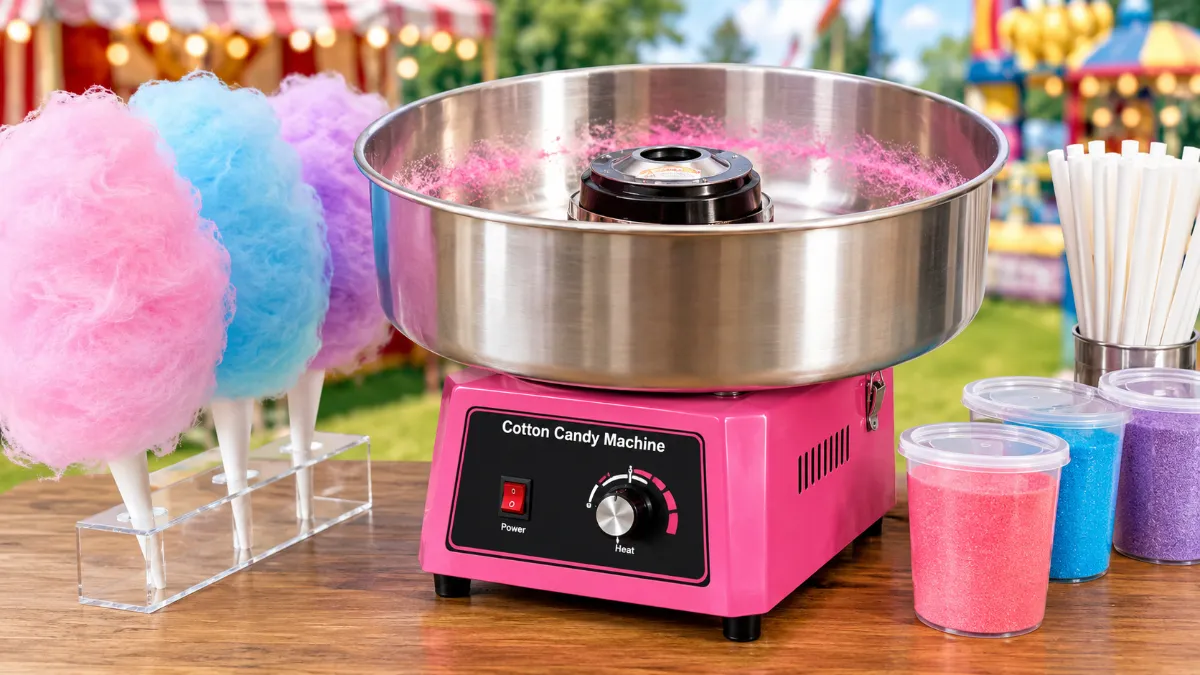
A Cotton Candy Machine is a fun and practical machine that transforms sugar into a light, fluffy treat enjoyed by children and adults alike. From home birthday parties to food festivals and commercial events, cotton candy makers are popular because they offer a simple way to prepare a colorful dessert on demand.
Choosing the right cotton candy maker depends on how frequently you plan to use it, how many servings you need, and your available budget. This guide explains how these machines operate, which features matter most, how to make cotton candy, and what to know before buying one.
What Is a Cotton Candy Maker?
A cotton candy maker is a kitchen or commercial appliance that converts heated sugar into thin strands. These strands cool rapidly and collect around a cone or stick, creating the familiar fluffy candy.
Most machines use a motor-driven spinning head and a heating element to produce the sugar threads. Household models are designed for occasional use, whereas commercial equipment is generally built for higher demand and more frequent operation.
Cotton candy makers are commonly used at birthday celebrations, school functions, fairs, amusement parks, food stalls, and community events.
How Does a Cotton Candy Maker Create Fluffy Sugar?
The machine uses heat and centrifugal force to turn melted sugar into delicate threads.
First, sugar is placed in the designated spinning head. The heating element melts it, and the rotating head pushes the melted sugar through tiny openings. As the sugar leaves these openings, it cools and forms fine strands.
The operator collects the strands by moving a paper cone or suitable stick around the collection bowl. Repeated rotation builds up the candy into a fluffy serving.
The final texture depends on the machine’s temperature, the sugar used, environmental humidity, and the operator’s technique.
Different Cotton Candy Maker Designs
Compact Electric Models
Compact machines are suitable for families, small gatherings, and occasional home use. They usually require less storage space and are relatively easy to transport.
However, their output may be limited, so they might not be ideal for serving large crowds quickly.
Heavy-Duty Commercial Models
Commercial cotton candy makers are intended for businesses and frequent event use. Depending on the model, they may offer stronger motors, larger bowls, and more durable construction.
Before choosing one, review the manufacturer’s stated production capacity and recommended operating cycle.
Portable Cotton Candy Machines
Portable machines are convenient for people who attend parties, fairs, or outdoor events. Lightweight construction makes transportation easier, although some compact models sacrifice production speed or bowl size.
Automatic Cotton Candy Equipment
Automatic equipment may include preset controls or mechanisms that reduce manual work. These machines can be useful in specialized commercial settings, but they often require more careful consideration of maintenance, cleaning, and purchase costs.
What to Look for Before Buying a Cotton Candy Machine
Selecting equipment based only on appearance or price can lead to disappointment. Consider these factors before making a purchase.
- Output capacity: Choose a model that can meet your expected demand.
- Construction quality: Durable materials are valuable when the machine will be used frequently.
- Heating consistency: Reliable heating supports more consistent sugar production.
- Bowl dimensions: A sufficiently large bowl makes collecting the strands easier.
- Cleaning process: Removable, washable components can simplify cleanup.
- Electrical requirements: Confirm the machine is compatible with your power supply.
- Safety design: Look for a stable base, protective features, and clear instructions.
- Warranty coverage: Check the warranty period and availability of replacement parts.
- Storage and transport: Consider weight, dimensions, and whether a carrying case or cart is necessary.
Reading product reviews and checking seller policies can also help you compare different models.
How Much Does a Cotton Candy Maker Cost?
Cotton candy maker prices vary according to brand, capacity, construction, and features. Small household machines are generally less expensive than professional equipment.
| Model category | Typical positioning | Suitable for |
| Entry-level electric maker | Lower-cost option | Occasional home use |
| Mid-range model | Moderate investment | Family events and parties |
| Commercial equipment | Higher investment | Food stalls and regular events |
| Cart-mounted machine | Depends on equipment | Mobile vending and festivals |
| Automated equipment | Highly variable | Specialized commercial operations |
These categories describe relative price levels rather than fixed prices. Check current local listings for actual costs, shipping, taxes, and warranty details.
Read Also: Laser Welding Machine: Complete Guide to Types, Prices, Benefits, and Uses in 2026
Which Sugar Is Best for Cotton Candy?
The correct sugar depends on the machine’s design and manufacturer recommendations.
Granulated sugar: Many traditional machines can use ordinary white granulated sugar.
Prepared cotton candy sugar: Some products are formulated specifically for cotton candy makers and may include flavoring or coloring.
Colored sugar: Approved colored sugar can help create visually attractive servings for themed parties.
Flavored sugar: Strawberry, blue raspberry, and other flavors may be available in ready-to-use products.
Do not assume every machine supports every sugar product. Avoid adding liquid ingredients or unapproved powders because they can interfere with heating, cause clumping, or leave residue.
Step-by-Step Guide to Making Cotton Candy
Making cotton candy becomes easier with practice. Follow these general steps while observing the instructions supplied with your machine.
- Set the appliance on a stable, level surface.
- Assemble the bowl and spinning head correctly.
- Ensure the equipment is clean and completely dry.
- Switch on the machine and allow it to preheat for the specified period.
- Add the recommended amount of suitable sugar.
- Wait for fine sugar strands to appear around the bowl.
- Hold a paper cone or suitable stick upright and rotate it gently to gather the strands.
- Continue collecting the strands until the desired serving size is reached.
- Serve the candy promptly to preserve its light texture.
Keep hands, clothing, and utensils away from the moving spinning head. Allow hot components to cool fully before cleaning.
Creative Ways to Serve Cotton Candy
Cotton candy can be adapted for different celebrations and occasions.
- Birthday parties: Use colors that match the party theme.
- School celebrations: Offer individual portions with suitable food-handling practices.
- Weddings and special events: Coordinate the candy’s colors with the event decoration.
- Carnivals and fairs: Serve freshly prepared portions on paper cones.
- Dessert decorations: Use a small amount of cotton candy as a finishing touch on suitable desserts immediately before serving.
Cotton candy absorbs moisture easily, so prepare it close to serving time whenever possible.
Can a Cotton Candy Maker Be Used for Business?
A cotton candy maker can support a small vending or event business if there is sufficient customer demand. Potential opportunities include birthday parties, local festivals, fairs, markets, and private functions.
Before investing, estimate the cost of sugar, cones, packaging, electricity, transportation, equipment maintenance, labor, and any event or business fees.
For example, selling 80 servings at a fixed price generates gross revenue equal to 80 multiplied by the price per serving. Net profit will be lower after all operating expenses are deducted.
Check local licensing, food-safety, and business requirements before selling food commercially. A machine alone does not guarantee sales or profitability.
Cleaning and Storing Your Equipment
Proper maintenance can help extend the life of your cotton candy maker.
- Switch off and unplug the appliance after use.
- Wait until all hot components have cooled.
- Remove sugar residue according to the manufacturer’s cleaning instructions.
- Wash approved removable components and dry them thoroughly.
- Keep the motor, plug, and electrical parts away from water.
- Inspect the power cord and machine components before each use.
- Store the appliance in a dry, clean location.
Never immerse electrical components in water or dismantle the machine while it is connected to power.
Common Problems and Their Solutions
Why Does the Machine Produce Very Little Cotton Candy?
Possible causes include insufficient preheating, blocked openings, unsuitable sugar, or an incorrect operating procedure. Switch off and unplug the machine, let it cool, and follow the manufacturer’s troubleshooting guidance.
Why Does the Sugar Become Sticky?
High humidity and moisture can cause cotton candy to lose its fluffy texture. Keep sugar and equipment dry, and serve the finished candy promptly.
Why Does Sugar Build Up Inside the Machine?
Excess residue can result from incorrect ingredients, unsuitable operating conditions, or inadequate cleaning. Use only recommended ingredients and clean the machine after it has cooled.
Why Is the Machine Vibrating or Making Unusual Noise?
An uneven surface, loose parts, or a mechanical issue may be responsible. Turn off the appliance and stop using it if the noise or vibration continues.
Frequently Asked Questions
1. Is a cotton candy maker suitable for beginners?
Yes. Many household models are designed for straightforward operation. Read the manual carefully and supervise children throughout the process.
2. Can I make different flavors with one machine?
Many machines can prepare different flavors when used with compatible flavored sugar. Follow the manufacturer’s recommendations and clean the equipment as instructed when changing ingredients.
3. How should cotton candy be stored?
Place prepared cotton candy in a clean, airtight container and keep it away from humidity. Its texture may still deteriorate over time, so fresh preparation is preferable.
4. Should I buy a home or commercial cotton candy maker?
Choose a home model for occasional family use. Consider commercial equipment if you expect frequent use, larger crowds, or regular vending operations.
5. Is a cotton candy maker difficult to maintain?
Routine maintenance is generally manageable when you clean the approved components, prevent moisture from entering electrical parts, and follow the manufacturer’s instructions.
Final Thoughts
A cotton candy maker can be a useful addition to a home kitchen, party setup, or small event business. The best option depends on your intended use, production requirements, budget, and available storage space.
Compare several models before purchasing, check their safety instructions, and select equipment that is easy to operate and maintain. With suitable ingredients and proper care, you can prepare attractive cotton candy for a wide range of occasions.