Analyzing reviews of competitors is the systematic process of examining customer feedback about rival businesses to identify recurring strengths, weaknesses, and competitive opportunities. Rather than reading reviews for general impressions, a rigorous competitor review analysis scores each recurring theme by frequency, severity, recency, and competitor response – turning scattered feedback into a prioritized, actionable dataset for competitor research and positioning decisions.
This guide provides that full framework: a defined opportunity-score formula with a worked calculation, a completed tracking template, a strengths-vs-weaknesses matrix, and the bias considerations that keep conclusions honest.
A quick distinction worth holding onto throughout this guide: opportunity tells you how strategically valuable a problem may be, while confidence tells you how strongly the available evidence supports that conclusion. A theme can score high on opportunity and still need more validation before you act on it.
How to Analyze Reviews of Competitors: The Framework
A reliable competitor review analysis process moves through eight stages: collect, clean, categorize, score, compare, validate, prioritize, act.
1. Collect
Start with three to five direct competitors as a practical baseline for your competitor research, adjusting based on how much review volume each one actually has. Pull reviews from platforms where your specific audience researches purchases.
A useful stopping signal: if you can read through 15–20 consecutive reviews without finding a new theme, you’ve likely reached practical saturation for that platform and competitor. This is a working heuristic for when to stop collecting, not a statistical representativeness threshold – low-volume competitors still require extra caution and, ideally, a second data source before findings are treated as reliable.
2. Clean
Remove duplicates, spam, and reviews unrelated to the actual experience. Flag review dates, since older reviews may describe a version of the product that’s since changed.
3. Categorize
Sort each review into a theme (pricing, onboarding, support, reliability) separately from sentiment. A 3-star review can still point to a specific, fixable issue.
4. Score
Convert themes into comparable numbers using the opportunity-score formula below.
5. Compare
Lay findings from multiple competitors side by side to see which weaknesses are market-wide versus specific to one rival.
6. Validate
Cross-check high-scoring findings against a second source before committing resources to act on them.
7. Prioritize
Rank by opportunity score, then filter by confidence – a high-opportunity, low-confidence finding needs validation before it drives strategy, not immediate action.
8. Act
Route each prioritized, sufficiently validated finding to the team that owns it.
The Opportunity Score Formula
Rate each theme on five factors using a 1–10 scale, then average them. This is a proposed scoring framework designed to make competitor analysis reviews reproducible and comparable – it is not an industry-validated or peer-reviewed standard, and the thresholds below should be treated as practical starting bands rather than fixed benchmarks.
Read More: Bubbles
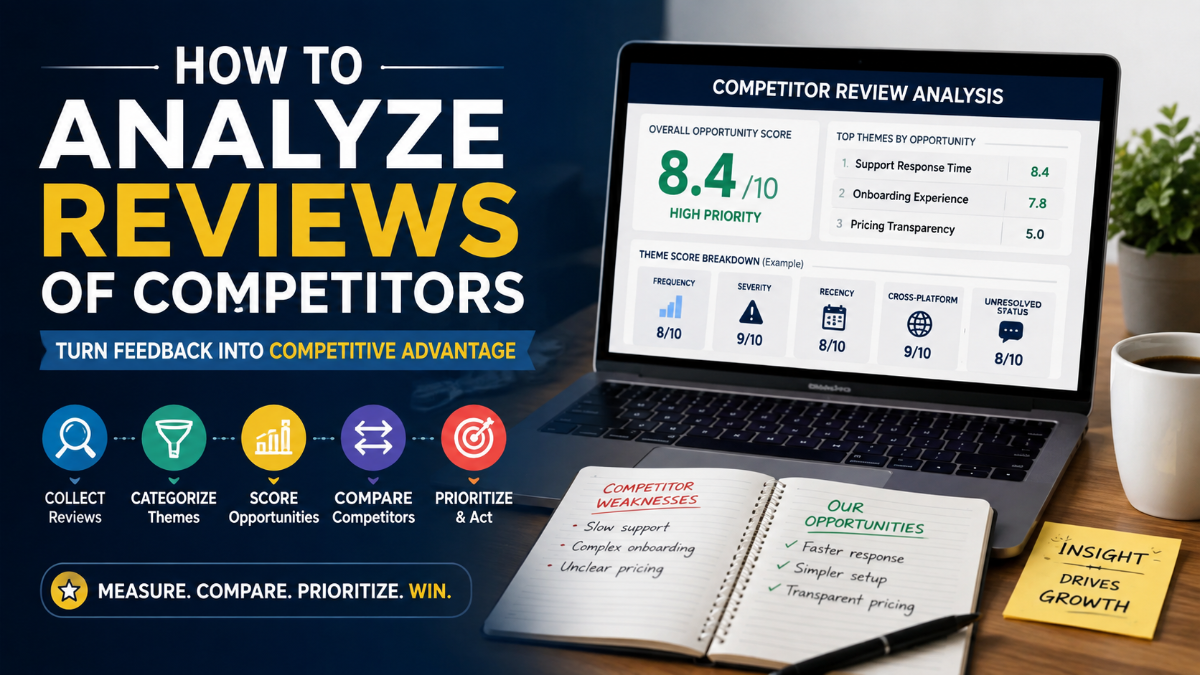
Opportunity Score = (Frequency + Severity + Recency + Cross-Platform Confirmation + Unresolved Status) ÷ 5
| Factor | Score 1–3 | Score 4–7 | Score 8–10 |
| Frequency | Mentioned in under 10% of reviews | Mentioned in 10–25% of reviews | Mentioned in over 25% of reviews |
| Severity | Minor annoyance, doesn’t affect purchase decision | Causes noticeable friction | Described as a deal-breaker or reason for switching |
| Recency | Mostly mentioned over a year ago | Mixed old and recent | Concentrated in the last 3–6 months |
| Cross-platform confirmation | Confirmed on fewer platforms than are actually relevant to the category | Confirmed on most relevant available platforms | Confirmed on all relevant available platforms for that competitor |
| Unresolved status | Competitor has visibly fixed it | Acknowledged without a clear fix | No acknowledgment or response |
On cross-platform scoring: score this relative to how many platforms are actually meaningful for that competitor’s category, not against a fixed count like three. A local service business with only Google and Yelp as relevant platforms can still score 8–10 if the theme appears on both, a SaaS company with five relevant platforms available needs confirmation across most of them to earn the same score. Penalizing a niche business for lacking platforms it was never likely to have reviews on would distort the model.
A score of 8–10 signals a high-priority opportunity under this framework – confidence in that finding should be assessed separately using the reliability indicators below, since a high score built on a thin evidence base still needs validation before you act on it.
Worked Example: From Raw Reviews to a Calculated Score
Analyzing 25 reviews of a competing project-management software tool across G2 and Trustpilot (the two most relevant platforms for this category) surfaces two recurring themes.
Theme 1: Slow customer support response
| Factor | Score | Basis |
| Frequency | 8/10 | Mentioned in 9 of 25 reviews (36%) |
| Severity | 9/10 | Six reviewers explicitly tied it to a renewal decision |
| Recency | 8/10 | Five of the nine mentions are from the last four months |
| Cross-platform confirmation | 9/10 | Confirmed on both relevant platforms (G2 and Trustpilot) |
| Unresolved status | 8/10 | Public replies are generic apologies with no stated fix |
Opportunity Score = (8 + 9 + 8 + 9 + 8) ÷ 5 = 8.4 – high priority. With nine supporting reviews across two platforms and a four-month recency window, this would qualify as High confidence under this guide’s proposed reliability framework, making it a reasonable basis for a support-response commitment in your own positioning – though it’s still worth confirming against a third data point, such as your own competitive win/loss notes, before finalizing that decision.
Theme 2: UI button placement complaint
| Factor | Score | Basis |
| Frequency | 3/10 | Mentioned in 4 of 25 reviews (16%, isolated) |
| Severity | 2/10 | No reviewer linked it to a purchase or churn decision |
| Recency | 2/10 | All four mentions predate a subsequent interface redesign |
| Cross-platform confirmation | 3/10 | Appears on one of the two relevant platforms only |
| Unresolved status | 2/10 | Competitor shipped a redesign that appears to address it |
Opportunity Score = (3 + 2 + 2 + 3 + 2) ÷ 5 = 2.4 – low priority, likely already resolved.
Reliability: Measuring Confidence Separately From Opportunity
A high opportunity score doesn’t automatically mean high certainty. Track a separate confidence indicator based on:
- Number of reviews supporting the theme
- Number of relevant platforms confirming it
- Time span covered by the supporting reviews
- Reviewer diversity across customer segments or use cases
- Consistency of how reviewers describe the issue
Label each finding High, Medium, or Low confidence under this framework. In the worked example, theme 1’s 8.4 opportunity score paired with nine reviews across two platforms and four months of consistent complaints would be classified as High confidence by these criteria. A theme scoring similarly high on opportunity but based on only two reviews from a single week would warrant Medium or Low confidence and further validation before action.
Comparing Competitor Reviews Across a Market
Score each competitor’s themes using the same formula, then compare side by side to support a broader competitor comparison:
| Theme | Competitor A | Competitor B | Competitor C | Market-wide? |
| Support response time | 8.4 (High) | 5.2 (Medium) | 3.1 (Low) | No – differentiation opportunity |
| Onboarding complexity | 7.8 (High) | 8.1 (High) | 7.5 (High) | Yes – category-wide weakness |
| Pricing transparency | 3.4 (Low) | 7.6 (High) | 5.0 (Medium) | No – differentiation opportunity |
A theme scoring high across every competitor signals a category-wide gap worth anchoring core positioning around. A theme high for only one rival is a narrower opportunity specific to that comparison.
Strengths-vs-Weaknesses Matrix
Competitor weaknesses are only half the picture – reviews also reveal what customers already value, setting the baseline your own offering needs to meet.
| Theme | Competitor strength | Competitor weakness | Your current position | Opportunity |
| Support response | – | Slow, unresolved (8.4) | Faster average response time | Lead with this in positioning |
| Core feature reliability | Consistently praised as stable | – | Comparable reliability | Match, don’t over-claim differentiation |
| Onboarding | – | Widely criticized (7.8, market-wide) | Simpler setup flow | Strong differentiation opportunity |
Where a competitor’s strength is also a category expectation, treat it as table stakes to match rather than a real point of differentiation.
Choosing the Right Platforms for Competitor Feedback Analysis
Platform choice shapes what kind of insight you get, since reviewer populations can vary by category and market.
| Platform | Often best for | Typical insight | Limitation |
| Google Business Profile | Local and service businesses | Staff behavior, speed, reliability | Can skew toward extreme experiences |
| Yelp | Local and hospitality, depending on market | Service quality, consistency | Coverage density varies by region |
| Trustpilot | E-commerce and subscription services | Delivery, billing, refund experience | Some categories may attract incentivized reviews |
| G2 / Capterra | B2B software | Feature depth, implementation, support | Reviewer seniority and use case vary widely |
| Amazon | Physical products | Product quality, packaging, fulfillment | Hard to isolate product issues from fulfillment issues |
| Reddit and forums | Unstructured, candid opinions | Detailed, specific experiences | Self-selecting, not statistically representative |
Bias and Reliability Limits
Reviews are customer-generated evidence, not a scientifically representative survey of every customer a business has served. Key limitations to keep in mind: self-selection bias (strong experiences get reviewed more than average ones), extreme-rating clustering at 1-star and 5-star, platform-specific skew, recency effects (a spike may reflect a temporary issue rather than a permanent one), small-sample risk, and manipulated or incentivized reviews – clusters of generic five-star reviews posted close together are a common warning sign.
Competitor Review Tracking Template
| Competitor | Platform | Date | Rating | Theme | Sentiment | Frequency | Severity | Recency | Response | Opportunity Score | Confidence | Action |
| Competitor A | G2 | Apr 2026 | 2★ | Support speed | Negative | 36% | 9 | 8 | Unresolved | 8.4 | High | Test a support-response SLA |
| – | – | – | – | – | – | – | – | – | – | – | – | – |
Duplicate the blank row for each additional theme you track in your competitor analysis reviews.
Competitor Review Analysis: Common Mistakes and Best Practices
- Treating raw complaints counts as the whole story: frequency without severity, recency, and resolution status produces misleading priorities.
- Ignoring positive reviews: they reveal the baseline experience customers expect, which you need to match, not just beat.
- Skipping validation: check high-opportunity findings against a second source before acting, especially when confidence is Medium or Low.
- Assuming legal clarity by default: the legal and contractual treatment of review analysis varies by jurisdiction and platform terms of service, so this should be checked for your specific activity rather than assumed.
Validating AI-Assisted Review Analysis
AI tools can accelerate sentiment scoring and theme extraction, but sentiment models can misclassify sarcasm, mixed reviews, and domain-specific phrasing. Run AI categorization on the full set, manually review a sample of the output, identify misclassifications, adjust category definitions, then re-run and compare before trusting the results at scale.
Quick-Pass Method: Competitor Feedback Analysis in 30 Minutes
This is a rapid-screening sample for a fast initial read, not the recommended final sample size – use the saturation heuristic above when doing a full analysis.
- Choose three competitors relevant to your current decision.
- Select the one or two platforms most relevant to your category.
- Collect the 20–30 most recent reviews per competitor as a quick screen.
- Remove duplicates and irrelevant entries.
- Tag each review by theme.
- Score frequency and severity for the top three recurring themes.
- Check recency and note competitor response.
- Compare the top theme across all three competitors.
- Flag the highest-scoring finding for full validation before acting on it.
A Note on Sources
This guide separates three types of claims: general review-behavior patterns (such as self-selection and rating-extreme bias) drawn from broader research on online review behavior, the scoring framework and formula, which is a practical methodology proposed in this guide rather than an empirically validated model, and illustrative examples, such as the worked calculation, which are constructed to demonstrate the mechanics rather than drawn from a real company.
Frequently Asked Questions
How do I calculate complaint frequency accurately?
Divide the number of reviews mentioning a theme by the total reviews analyzed for that competitor, tracking each platform separately before combining. A theme appearing in 9 of 25 reviews (36%) carries more weight when confirmed at a similar rate on a second relevant platform.
What’s the difference between an opportunity score and a confidence score?
The opportunity score measures how strategically valuable a theme is based on frequency, severity, recency, cross-platform confirmation, and resolution status. Confidence measures how strongly the evidence behind that score can be trusted, based on the number of reviews, platforms, time span, and reviewer diversity. A theme can score high on opportunity while still needing more validation if it’s built on a thin evidence base.
How should I handle a competitor with very few reviews?
Treat findings as directional and low-confidence, since small samples make patterns unreliable. Supplement thin review data with other competitor research – website claims, social media engagement, or forum mentions – before making decisions based on that competitor alone.
How do I compare reviews of competitors across a market fairly?
Score each competitor’s themes using the same five-factor formula, then place results in a shared comparison table. This reveals whether a weakness is isolated to one competitor or shared market-wide, which signals a category-level gap worth building positioning around.
Is it legal to analyze publicly posted reviews of competitors?
The legal and contractual treatment of review analysis varies by jurisdiction and platform terms of service. Analyzing publicly accessible reviews for research is commonly distinguished from fabricating reviews or using prohibited scraping methods, but you should review the specific platform’s terms and applicable regulations for your situation rather than assume a universal rule applies.
Can I trust AI tools to analyze competitor reviews without manual checking?
Not entirely. AI sentiment and theme-extraction tools can misclassify sarcasm and industry-specific language, so manually checking a sample of the output and adjusting categorization rules produces more reliable results than relying on automation alone.
How often should I repeat competitor review analysis?
There’s no universal interval – base the cadence on how quickly your specific market shifts, refreshing more often in fast-moving categories or when tracking a newly launched competitor, to confirm whether a previously high-scoring weakness has since been resolved.
What’s the difference between a review’s sentiment and its underlying theme?
Sentiment describes emotional tone (positive, negative, mixed), theme describes the specific subject (support speed, pricing, onboarding). Two negative reviews can share sentiment while pointing to entirely different problems, which is why categorizing by theme, not sentiment alone, reveals actionable patterns.
How many reviews do I need before I can trust a pattern?
Watch for practical saturation: once 15–20 additional reviews in a row surface, no new theme, your sample is likely sufficient as a working heuristic – not proof of statistical representativeness. Low-volume competitors reach this point faster but should still be treated as lower-confidence until confirmed by a second source.
Why does cross-platform confirmation matter if my competitor only has reviews on one relevant platform?
Score cross-platform confirmation relative to how many platforms are actually meaningful for that competitor’s category, not against a fixed universal count. A theme confirmed on the one or two platforms genuinely relevant to a niche business can still score high, the goal is checking whether the finding holds up everywhere it reasonably could, not penalizing businesses for lacking platforms they were never likely to have reviews on.