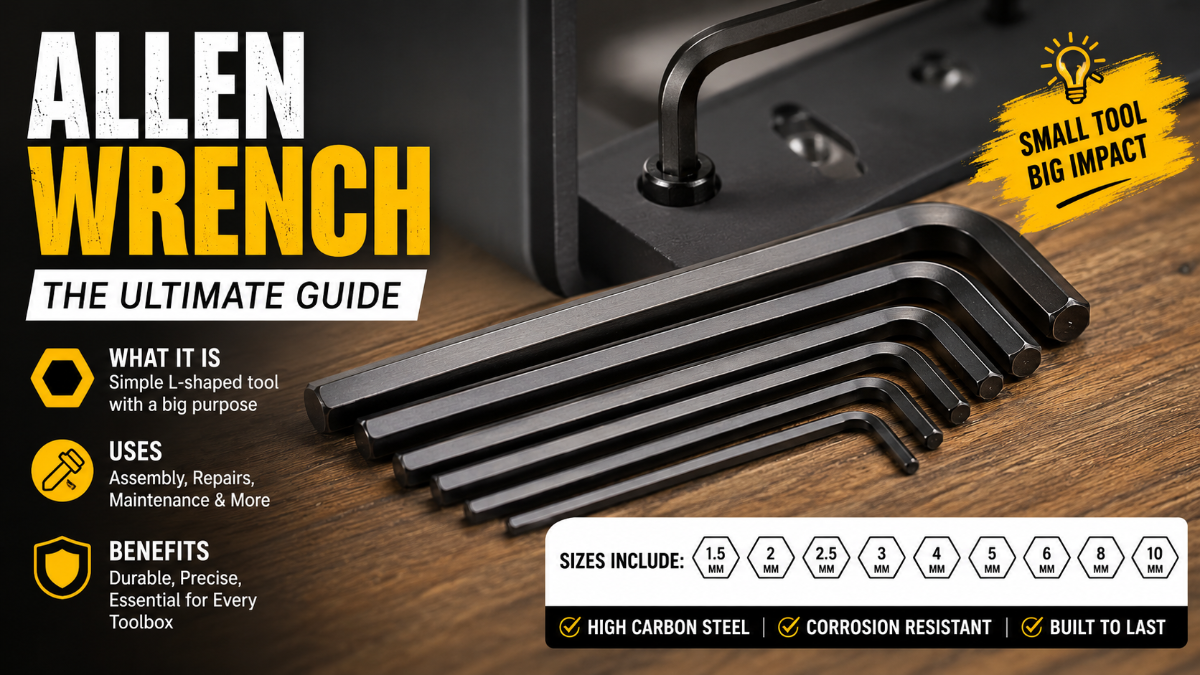
An Allen wrench, also called a hex key or Allen key, is a six-sided tool used to tighten and loosen screws and bolts with internal hexagonal sockets. It is commonly used for furniture assembly, bicycle maintenance, machinery, appliances, and everyday DIY repairs.
The key rule is simple: use the exact hex key that fully seats in the fastener without movement. A loose, partly inserted, or nearly matching-metric or SAE key can round the socket and make the fastener difficult to remove.
Allen Wrench at a Glance
| Question | Short answer |
| What is an Allen wrench? | A hexagonal tool for screws and bolts with internal hex sockets |
| What size do I need? | The exact size that fully seats in the socket |
| Metric or SAE? | Match the fastener’s measurement system |
| How is it measured? | Across the flats of the hexagonal tip |
| Can it be used on Torx screws? | No. Torx requires a matching Torx key or bit |
| Best tool for tight fasteners? | A straight-end hex key with full engagement |
| When should I use a torque wrench? | When the manufacturer specifies a torque value |
What Is an Allen Wrench?
An Allen wrench is usually a steel bar bent into an L shape. Both ends have a hexagonal profile that fits into the recessed six-sided socket of a compatible screw, bolt, or set screw.
“Hex key” is the generic technical term. “Allen wrench,” “Allen key,” and “hex wrench” are common names for the same basic tool. A hex bit is the same type of drive fitted into a screwdriver handle, ratchet, drill driver, or torque wrench.
The tool is sized by its width across flats-the distance from one flat face of the hexagonal tip to the opposite flat face. It is not measured by the tool’s total length or by the distance between two corners.
Allen Wrench Sizes at a Glance
Metric and SAE/inch hex keys are separate sizing systems. The table below is a practical side-by-side reference, not a conversion chart. A metric key and a nearby SAE size may look similar but should not be treated as interchangeable.
| Common metric sizes | Common SAE/inch sizes |
| 1.5 mm | 1/16 in |
| 2 mm | 5/64 in |
| 2.5 mm | 3/32 in |
| 3 mm | 1/8 in |
| 4 mm | 5/32 in |
| 5 mm | 3/16 in |
| 6 mm | 7/32 in |
| 8 mm | 1/4 in |
| 10 mm | 5/16 in |
Metric and SAE Allen Wrench Sizes
Read More: YT to MP4
Common Metric Allen Wrench Sizes
This is a practical list of commonly encountered metric hex-key sizes for home, bicycle, furniture, and light mechanical work. It is not a complete industrial standard range.
| Metric size | Typical applications |
| 1.5 mm | Small set screws, compact hardware, and small mechanisms |
| 2 mm | Small machine screws and adjustment hardware |
| 2.5 mm | Light mechanical hardware and accessories |
| 3 mm | Furniture fittings, small machine screws, and bicycle accessories |
| 4 mm | General DIY hardware, furniture, and some bicycle controls |
| 5 mm | Bicycle components, furniture frames, and equipment hardware |
| 6 mm | Larger mechanical, bicycle, and furniture fasteners |
| 8 mm | Larger socket-head screws and mechanical assemblies |
| 10 mm | Heavy mechanical hardware and machinery |
Common SAE/Inch Allen Wrench Sizes
This is a practical selection of common inch sizes for consumer and mechanical applications. It is not a complete list of all inch-series hex-key sizes.
| SAE size | Typical applications |
| 1/16 in | Small set screws and light hardware |
| 5/64 in | Small machine screws |
| 3/32 in | Small general-purpose fasteners |
| 1/8 in | Fixtures and light equipment |
| 5/32 in | Medium U.S.-standard hardware |
| 3/16 in | Medium-duty mechanical fasteners |
| 7/32 in | Larger inch-series hardware |
| 1/4 in | Socket-head screws and assemblies |
| 5/16 in | Heavy-duty machinery hardware |
| 3/8 in | Large mechanical fasteners |
M-Size Does Not Equal Hex-Key Size
An M-size identifies a metric fastener’s nominal thread diameter. It does not automatically identify the size of the internal hex socket.
For example, an M5 screw does not automatically use a 5 mm Allen wrench. A standard M5 socket-head cap screw uses a 4 mm hex key under the applicable standard geometry. Other M5 head styles, including button-head, low-head, countersunk, set-screw, and proprietary fasteners, can require different socket sizes.
Standard Metric Socket-Head Cap Screw Key Sizes
These pairings apply to standard metric socket-head cap screws. Other head styles can use different socket dimensions, even when the thread size is the same.
| Fastener thread size | Standard socket-head key size |
| M3 | 2.5 mm |
| M4 | 3 mm |
| M5 | 4 mm |
| M6 | 5 mm |
| M8 | 6 mm |
| M10 | 8 mm |
| M12 | 10 mm |
| M16 | 14 mm |
How to Measure an Allen Wrench
Measure the hex key across two opposite flat sides of its hexagonal working end. This measurement is the key size.
Do not measure from corner to corner or along the tool’s overall length. For an unmarked key, use digital or vernier calipers, place the jaws against opposite flat faces, record the measurement in millimetres or inches, and compare it with marked sizes.
Hex vs. Torx and Other Drive Types
Check the fastener shape before selecting a tool. Dirt, paint, corrosion, or wear can make different drive types look alike.
| Drive type | Shape | Correct tool |
| Hex socket | Six straight sides | Allen wrench or hex key |
| Security hex | Hex socket with a centre pin | Security hex key with a matching hole |
| Torx | Six rounded star-shaped lobes | Torx key or Torx bit |
| Phillips | Cross-shaped recess | Phillips screwdriver or bit |
| Pozidriv | Cross with smaller secondary ribs | Pozidriv screwdriver or bit |
| Slotted | One straight groove | Flat-head screwdriver |
| Square/Robertson | Four-sided square recess | Robertson or square-drive bit |
| External hex | Six-sided outer head | Socket, spanner, or wrench |
A Torx screw is not a hex socket screw. An Allen key may enter a Torx recess loosely, but it will not engage the intended shape correctly.
How to Choose the Right Allen Wrench Size
Choose the key based on the fastener’s actual socket, not just its thread diameter or what appears close by eye.
- Identify the drive. Confirm that it is an internal hex socket rather than Torx, Phillips, square, or security hex.
- Determine the sizing system. Check whether the product uses metric or SAE/inch hardware.
- Select the closest marked key. Start with the size that visually appears to fill the socket.
- Insert the key fully. It should reach the bottom of the recess without forcing it.
- Check for movement. The correct key should have no noticeable side-to-side play.
- Inspect the socket if it will not fit. Remove dirt, paint, corrosion, or residue; check for a centre pin or damage.
- Use a straight-end key for high torque. Ball-end keys are better for angled access and quick turning.
- Use a torque wrench when specified. Follow the manufacturer’s torque requirement for bicycles, machinery, or other critical assemblies.
How to Use an Allen Wrench
Using the tool correctly helps prevent damaged keys, stripped sockets, and over-tightened hardware.
- Insert the correctly sized hex key fully into the fastener.
- Keep the key aligned with the fastener rather than twisting it at an angle.
- Turn clockwise to tighten or counterclockwise to loosen most standard right-hand threads.
- Insert the long leg into the fastener and use the short leg as the handle for greater leverage.
- Insert the short leg into the fastener and use the long leg as the handle for faster turning once the fastener is loose.
- Stop if the key slips, then inspect the tool and socket before continuing.
- Use a torque wrench with the appropriate hex fitting when a torque value is specified.
Types of Allen Wrenches
| Type | Best use | Limitation |
| L-shaped hex key | Furniture, basic DIY, and general repairs | Less comfortable for repetitive work |
| Long-arm hex key | Recessed or obstructed fasteners | Can be awkward in narrow spaces |
| Ball-end hex key | Angled access and quick turning | Not suitable for maximum torque or final tightening |
| T-handle hex key | Repeated workshop and bicycle tasks | May not fit tight access areas |
| Folding hex-key set | Portable household, vehicle, or bicycle kits | Holder can restrict reach |
| Hex bit | Ratchets, drivers, and torque tools | Powered tools can over-tighten hardware |
| Security hex key | Tamper-resistant fasteners with centre pins | Only fits security hex sockets |
Common Uses of an Allen Wrench
Furniture Assembly
Allen keys are common in flat-pack furniture, desks, chairs, beds, shelves, storage units, and exercise equipment. They are often used with connector bolts, threaded inserts, cross dowels, and hex socket screws.
Start all fasteners loosely before final tightening. This lets the parts align correctly and reduces the risk of binding, stripped inserts, and damage to particleboard or MDF.
Bicycle Maintenance
Many bicycle components use metric hex fasteners, including stems, handlebars, seatposts, saddle clamps, bottle cages, brake components, and accessories.
Use a torque wrench when the component manufacturer specifies a torque value. This is especially important for handlebars, stems, brake hardware, seatposts, suspension parts, and carbon-fibre components.
Mechanical Repairs
Hex socket screws are used in machinery, power tools, appliances, automotive accessories, exercise machines, brackets, covers, guards, pulleys, clamps, and adjustment mechanisms.
Before loosening a fastener, check whether it affects alignment, retains a spring-loaded component, holds a safety guard, or needs a specific reassembly sequence.
Household DIY Repairs
Typical home uses include tightening loose furniture joints, assembling shelving, adjusting compatible fixtures, maintaining workshop tools, and repairing exercise equipment.
How to Choose an Allen Wrench Set
Choose a set based on the equipment you work on, the fasteners you are likely to encounter, and the access available around those fasteners.
For general DIY, a set with common metric and SAE sizes is the most flexible option. For bicycle maintenance, prioritise metric keys and a compatible torque wrench. For frequent repair work, T-handle keys and hex bits can improve speed and comfort.
Look for:
- Clearly marked metric and SAE sizes
- Accurate, unworn hex-tip geometry
- Hardened steel construction
- A corrosion-resistant finish if tools may be stored in damp conditions
- Straight ends for tight fasteners
- Ball-end keys for angled access
- A holder that keeps the sizes organised
- Compatibility with ratchets and torque tools when needed
Troubleshooting Allen Wrench Problems
| Problem | What to do |
| Key will not enter | Confirm the drive is hex, not Torx, security hex, or another profile |
| Key enters but feels loose | Check metric versus SAE sizing and test the exact fit |
| Key will not seat fully | Remove debris and inspect for a centre pin, paint, corrosion, or socket damage |
| Key slips while turning | Stop immediately and inspect for a worn key or rounded socket |
| Fastener will not loosen | Use a fully seated straight-end key; do not force a damaged socket |
| A torque value is specified | Use a torque wrench with the correct hex fitting |
| Socket is stripped | Use an appropriate extraction method or seek repair assistance |
Allen Wrench Care
- Wipe off moisture, dirt, and grease after use.
- Keep metric and SAE keys in a clearly marked holder.
- Do not use a hex key as a pry bar, chisel, punch, or substitute screwdriver.
- Replace bent, heavily corroded, or rounded keys.
Key Takeaway
An Allen wrench is a hexagonal tool for fasteners with internal hex sockets. Use the exact metric or SAE size that fully seats in the socket, remember that an M-thread size does not automatically equal the required hex-key size, and use a straight-end key for tight fasteners. Use ball-end keys only when angled access is necessary, and follow manufacturer torque instructions for bicycles, machinery, and other safety-critical equipment.
Frequently Asked Questions
1. Is an Allen wrench the same as a hex key?
Yes. Allen wrench, Allen key, hex key, and hex wrench are common names for a hexagonal tool used with internal hex socket screws and bolts. “Hex key” is the generic technical term, while “Allen wrench” is common in DIY instructions and product manuals. Regardless of the name, the tool must match the fastener’s socket size and drive style.
2. What is the most common Allen wrench size?
There is no single universal Allen wrench size because different furniture, bicycles, appliances, and mechanical products use different fasteners. For general metric DIY tasks, 3 mm, 4 mm, 5 mm, and 6 mm are frequently useful. Common inch sizes include 1/8 inch, 5/32 inch, and 3/16 inch. A set containing both measurement systems is more practical than relying on one individual key.
3. Why does an M5 screw use a 4 mm Allen key?
M5 describes the nominal thread diameter, not the size of the internal hex socket. A standard M5 socket-head cap screw uses a 4 mm key under the applicable standard geometry. Other M5 fasteners, including button-head, low-head, countersunk, set-screw, and proprietary designs, may require another size. Check the actual socket fit rather than selecting a tool from the M-size alone.
4. Can I use a metric Allen key in an SAE fastener?
Only if it is an exact fit, which should not be assumed. Some metric and inch sizes may look close enough to enter the socket but can still leave enough play to damage the fastener under load. Use the correctly marked key that seats fully and does not move noticeably inside the recess.
5. How do I measure an Allen wrench without markings?
Use digital or vernier calipers to measure the hexagonal working end across two opposite flat faces. Do not measure across the corners or along the full length of the L-shaped key. Compare the result with marked metric or SAE sizes, then confirm that the selected key engages the fastener fully before applying turning force.
6. What size Allen wrench do I need for furniture assembly?
Furniture often uses metric hex keys between 3 mm and 6 mm, although the correct size depends on the connector design and manufacturer. Check the assembly instructions when available, or test a marked key for full engagement. Start all connectors loosely before final tightening so panels align properly and the fasteners do not bind.
7. Can an Allen wrench be used on a Torx screw?
No. Torx drives have six rounded lobes, while an Allen wrench has six straight sides. A hex key can appear to fit loosely in some Torx screws, but it will not engage correctly and may damage the drive. Use the matching Torx key or bit.
8. When should I use a ball-end Allen key?
Use a ball-end hex key when straight access is limited and the tool must approach the socket at an angle. It is useful for starting or quickly turning compatible fasteners. For tight, seized, or final-tightening fasteners, use the straight end because it provides more complete engagement.
9. What should I do if an Allen wrench slips in the screw?
Stop immediately. A slipping key may indicate the wrong size, mixed metric and SAE sizing, debris in the socket, a worn tool, or a rounded fastener. Clean the socket, use an undamaged straight-end key, and verify full seating. Continuing to turn a slipping key can make the fastener much harder to remove.
10. Are Allen keys universal?
Allen keys are universal only when the key’s size and drive profile match the fastener. They do not replace Torx, Phillips, square-drive, security hex, or other driver types. Metric and SAE hex keys are also separate size systems, so an approximate substitute should not be used on a tight fastener.