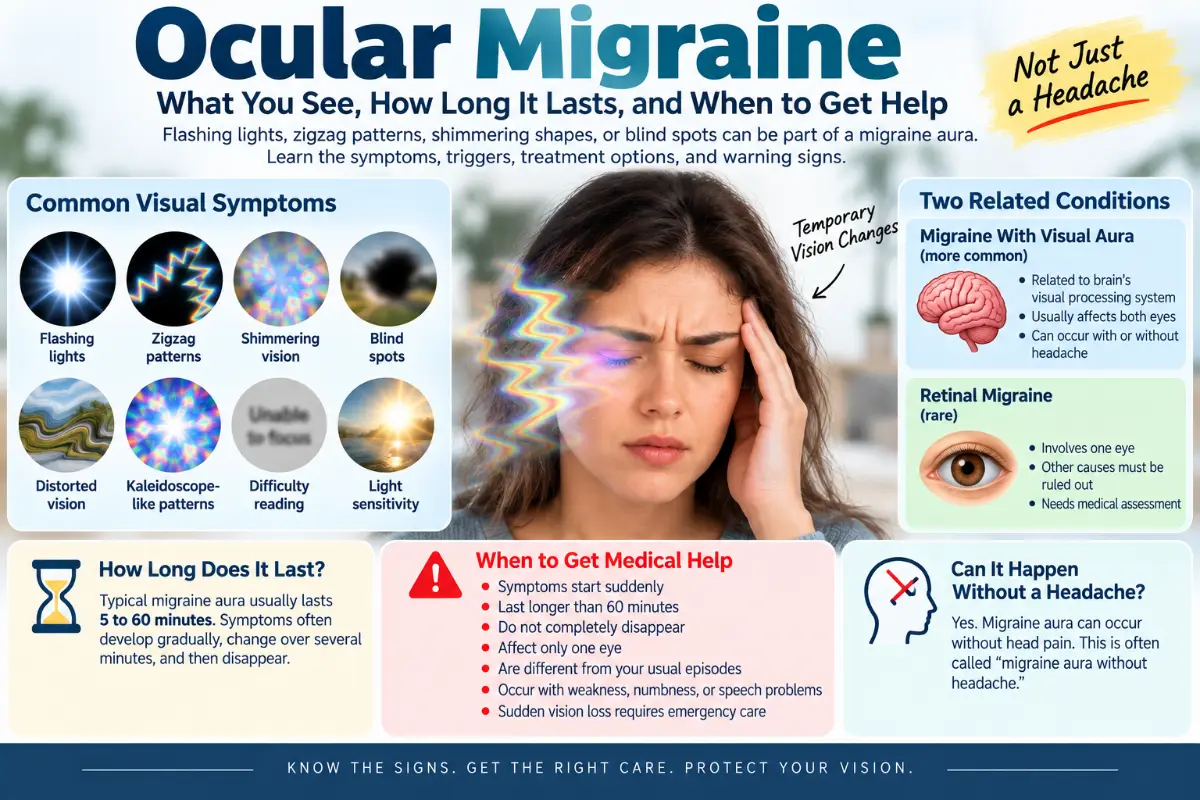
If you suddenly see flashing lights, zigzag patterns, shimmering shapes, or temporary blind spots, you may wonder whether you are experiencing an ocular migraine. The term is commonly used online, but it can describe more than one type of migraine-related visual problem.
Most importantly, typical migraine with visual aura and retinal migraine are not the same thing. Visual aura generally affects the visual field of both eyes, while retinal migraine involves symptoms in one eye and is rare. New or unexplained vision loss in one eye should not automatically be blamed on migraine because other eye or vascular conditions can cause similar symptoms.
This guide explains what ocular migraine can feel like, how long visual symptoms usually last, possible triggers, treatment approaches, and the warning signs that need medical attention.
Medical Disclaimer: This article is for general educational purposes and does not replace professional medical advice. New, sudden, persistent, or unexplained vision changes should be evaluated by a qualified healthcare professional.
What Does Ocular Migraine Feel Like?
People often describe migraine-related visual symptoms as unusual changes in the way they see.
You might notice:
- Flashing or flickering lights
- Zigzag or jagged lines
- Shimmering patterns
- Sparkling dots or stars
- A temporary blind spot
- Distorted or blurred vision
- Kaleidoscope-like patterns
- Temporary difficulty reading or focusing
These symptoms can develop gradually and change as the episode progresses. Visual aura commonly lasts between 5 and 60 minutes.
The experience can be alarming, especially if it happens for the first time.
Is Ocular Migraine Actually an Eye Problem?
Not necessarily.
The phrase ocular migraine is not a precise medical diagnosis. It is often used to describe migraine with visual aura, although some people use it to refer to retinal migraine. Mayo Clinic notes that this terminology can be confusing because the two conditions have important differences.
Migraine With Visual Aura
Visual aura is related to activity in the brain’s visual processing system. Although the disturbance may appear to be on one side of your vision, the symptoms generally involve the visual fields of both eyes.
Common examples include:
- Zigzagging lines
- Flashing lights
- Shimmering areas
- Blind spots
- Geometric patterns
Retinal Migraine
Retinal migraine is rare and involves temporary visual symptoms in one eye.
Because several more serious conditions can also cause temporary vision loss in one eye, retinal migraine should generally be considered only after other causes have been evaluated.
Ocular Migraine Symptoms: 8 Signs to Know
1. Flashing Lights
You may suddenly notice flashes, sparks, stars, or flickering lights that are not actually present in your surroundings.
2. Zigzag Patterns
Some people see jagged or geometric lines that gradually expand or move across their visual field.
3. Shimmering Vision
A shimmering or sparkling area may appear and change shape over several minutes.
4. Blind Spots
A temporary area of missing or reduced vision may develop. This is sometimes called a scotoma.
5. Distorted Vision
Objects, letters, or straight lines may temporarily appear unusual or difficult to focus on.
6. Temporary Visual Loss
Migraine aura can include temporary visual loss. However, sudden loss of vision in only one eye deserves particular attention because it can have causes unrelated to migraine.
7. Light Sensitivity
Migraine attacks can involve increased sensitivity to light. Bright environments or screens may become uncomfortable during an attack.
8. Headache or Other Migraine Symptoms
Visual aura can occur before a headache, during a migraine attack, or without headache. Migraine symptoms may also include nausea, sensitivity to light or sound, and difficulty concentrating.
How Long Does Ocular Migraine Last?
Typical migraine aura usually lasts 5 to 60 minutes. The visual disturbance often develops over several minutes rather than appearing instantly.
For example, you might first notice a small shimmering area that gradually becomes larger before disappearing.
However, the timing alone cannot prove that a visual disturbance is migraine.
Seek medical attention when symptoms:
- Start suddenly
- Last longer than 60 minutes
- Do not completely disappear
- Affect only one eye
- Are significantly different from your usual episodes
- Occur with weakness or speech problems
Do not wait for symptoms to reach a certain duration if you suddenly lose vision or develop other emergency symptoms.
Can You Have Ocular Migraine Without a Headache?
Yes.
A person can experience migraine aura without developing head pain. The more precise term is migraine aura without headache. The American Migraine Foundation describes this as an aura episode that occurs without the headache phase.
Possible symptoms include:
- Flashing lights
- Zigzag patterns
- Blind spots
- Shimmering vision
- Tingling or numbness
- Temporary speech or language changes
A first-time episode should not automatically be diagnosed as migraine, particularly when symptoms are unusual.
What Causes Migraine Visual Aura?
The exact mechanisms behind migraine are complex.
One explanation involves a temporary wave of electrical and chemical activity moving through the brain. When this activity affects the visual cortex, temporary visual symptoms can occur. This process is known as cortical spreading depression.
Migraine susceptibility can also vary between individuals. Genetics, environmental factors, routines, and personal triggers may influence how frequently attacks occur.
Common Ocular Migraine Triggers
There is no single trigger that affects everyone.
Potential triggers may include:
| Possible Trigger | What May Happen |
| Stress | May contribute to migraine attacks |
| Irregular sleep | May disrupt an individual’s migraine pattern |
| Skipping meals | Can trigger attacks in some people |
| Dehydration | May contribute to attacks |
| Bright or flickering light | May aggravate symptoms in some people |
| Alcohol | Can trigger migraine for some individuals |
| Caffeine changes | Sudden increases or withdrawal may contribute |
| Hormonal changes | May affect migraine frequency |
A migraine diary can help you identify whether a particular pattern repeatedly appears before your symptoms.
Read More: How to Eat Coconut Cult
What Should You Do During an Ocular Migraine?
If visual symptoms begin while you are driving, using machinery, or performing another activity that requires clear vision, stop and move somewhere safe.
You can also consider:
- Resting in a comfortable, quiet environment.
- Reducing uncomfortable bright or flickering light.
- Staying adequately hydrated.
- Following your existing migraine treatment plan if one has been prescribed.
- Recording the time the visual symptoms began.
- Noting whether the disturbance appears to involve one eye or both.
Do not use these steps as a substitute for medical evaluation when symptoms are new, severe, or unusual.
How Is Ocular Migraine Diagnosed?
There is not one universal test that confirms every migraine-related visual episode.
A healthcare professional may begin by asking about:
- What you saw
- How quickly the symptoms developed
- How long they lasted
- Whether one eye or both eyes were involved
- Whether headache occurred
- Whether you experienced numbness or weakness
- Whether you had speech difficulties
- Whether this has happened before
An eye examination may be appropriate when symptoms suggest an eye-related problem. Neurological evaluation may also be considered depending on the symptoms and medical history.
Additional testing is determined by the individual clinical situation.
Ocular Migraine Treatment
Treatment depends on the underlying diagnosis, frequency of attacks, severity of symptoms, and overall health.
Acute Treatment
A healthcare professional may recommend medication to manage migraine attacks. Depending on the individual situation, treatment can include nonprescription pain medicines or migraine-specific prescription medicines.
Medication should be selected with professional guidance, particularly when visual symptoms may involve one eye.
Preventive Treatment
People who experience frequent or disabling migraine attacks may be candidates for preventive treatment.
Options can include:
- Prescription preventive medicines
- Migraine-specific preventive therapies
- Lifestyle adjustments
- Behavioral approaches
The appropriate option depends on the individual’s medical history and migraine pattern.
How to Reduce Future Migraine Episodes
You may be able to reduce attacks by identifying your personal patterns.
Keep Sleep Consistent
Try to maintain regular sleeping and waking times.
Avoid Skipping Meals
Regular meals may help if missed meals are one of your personal triggers.
Stay Hydrated
Adequate fluid intake can support a consistent daily routine, especially when dehydration appears to contribute to attacks.
Manage Stress
Some people find regular physical activity, relaxation techniques, breathing exercises, or mindfulness useful for migraine management.
Track Visual Symptoms
Write down:
- Date and time
- Duration
- Type of visual disturbance
- One eye or both
- Headache symptoms
- Possible triggers
- Medication taken
- Response to treatment
This information can make discussions with your healthcare professional more useful.
When Is Ocular Migraine an Emergency?
This is one of the most important parts of understanding ocular migraine.
Seek emergency medical care for sudden vision loss or new neurological symptoms, including:
- Sudden loss of vision
- New weakness or numbness on one side
- Trouble speaking or understanding speech
- Sudden, extremely severe headache
- Confusion
- Difficulty walking
- Severe or new dizziness
- A dark curtain or shadow across your vision
These symptoms can occur with conditions that require urgent assessment, including stroke and serious eye or vascular problems. Mayo Clinic specifically advises medical evaluation for new or unusual visual symptoms, especially when symptoms affect one eye or occur with weakness or speech changes.
Ocular Migraine vs. Retinal Migraine: Quick Comparison
| Feature | Migraine With Visual Aura | Retinal Migraine |
| Main system involved | Brain/visual processing | One-eye visual system |
| Typical visual involvement | Both visual fields | One eye |
| Frequency | More common | Rare |
| Common symptoms | Flashes, zigzags, blind spots | Temporary monocular visual disturbance |
| Usual duration | About 5–60 minutes | Usually temporary |
| Headache | May occur or may be absent | May occur or may be absent |
| New one-eye symptoms | Need evaluation | Need evaluation |
The distinction is important because one-eye visual loss has several possible causes beyond migraine.
Frequently Asked Questions
Is ocular migraine dangerous?
Typical migraine visual aura is generally temporary. However, new or unexplained visual symptoms should be evaluated because other neurological or eye conditions can look similar.
Can ocular migraine happen without a headache?
Yes. Migraine aura can occur without the headache phase. This is commonly described as migraine aura without headache.
How long does an ocular migraine usually last?
Visual migraine aura commonly lasts about 5 to 60 minutes. Symptoms outside the expected pattern should be medically evaluated.
Does ocular migraine affect one eye?
Typical visual aura generally affects both eyes’ visual fields. Retinal migraine involves one eye. Because one-eye vision loss can have other causes, new monocular symptoms should be assessed.
Can stress trigger an ocular migraine?
Stress may contribute to migraine attacks in some people, but individual triggers vary.
Can dehydration cause ocular migraine?
Dehydration may contribute to migraine attacks for some individuals, but it does not explain every episode of visual disturbance.
Should I see an eye doctor for ocular migraine?
If the visual symptoms are new, occur in one eye, persist, or are different from your usual pattern, an eye-care professional or other healthcare professional can help determine the cause.
When should I go to the emergency room?
Seek emergency care for sudden vision loss, new weakness or numbness, speech difficulties, confusion, a sudden severe headache, difficulty walking, or other abrupt neurological symptoms. Do not assume these symptoms are migraine.