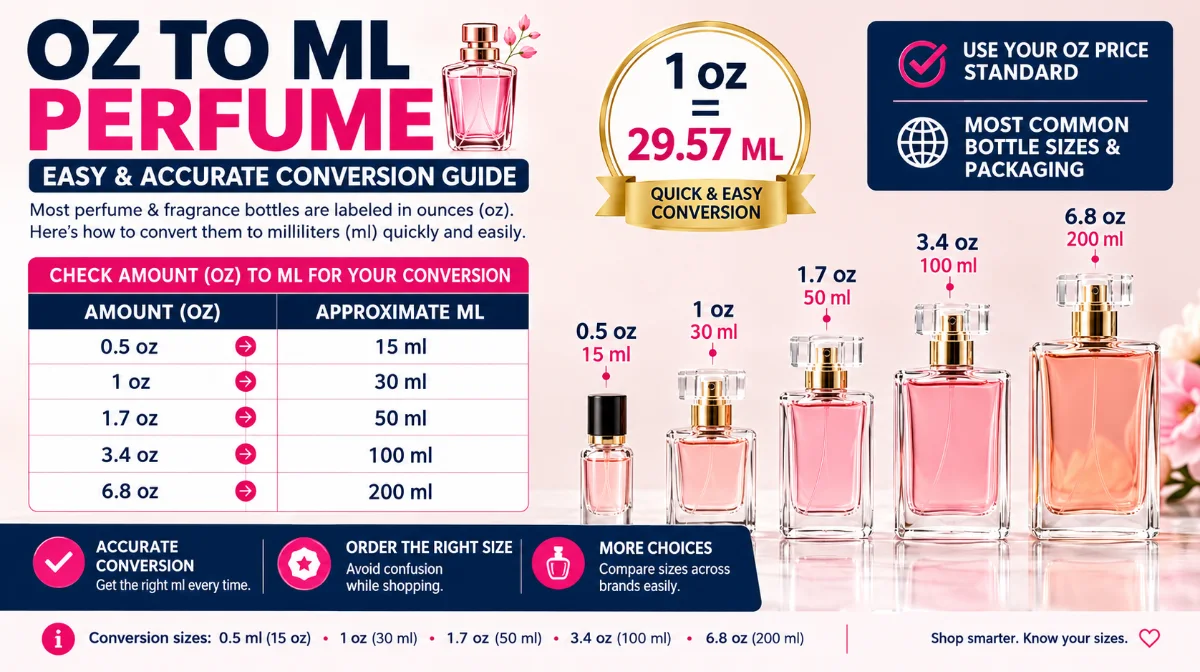
One fluid ounce of perfume equals approximately 29.57 ml, though most brands round this to a clean 30 ml on packaging. That’s why a bottle labeled “1 oz” is typically 30 ml, and one labeled “3.4 oz” is typically 100 ml.
This fragrance bottle size guide uses US fluid ounce conversion standards, since that’s the unit most commonly printed on perfume packaging, and focuses on the sizes most widely sold at retail.
Quick Answer: Oz to ML Perfume Conversion
| Perfume Size (oz) | Approximate ML |
| 0.5 oz | 15 ml |
| 1 oz | 30 ml |
| 1.7 oz | 50 ml |
| 3.4 oz | 100 ml |
| 6.7 oz | 200 ml |
If you’ve ever compared a 50 ml bottle to a 1.7 oz version of the same fragrance and wondered whether they’re identical, they are. This guide walks through the exact oz to ml conversion for perfume bottles, a full chart of common sizes, why the printed numbers don’t match a calculator exactly, and how to pick a bottle size that fits how you actually wear fragrance.
How the Oz to ML perfume Conversion Works
The oz to ml perfume conversion is based on the US fluid ounce, which equals 29.5735 milliliters exactly. To convert, multiply the ounce value by 29.5735:
Milliliters = Fluid Ounces × 29.5735
So 1 oz to ml perfume equals how many ml? Roughly 29.57 ml, which brands round up to 30 ml for cleaner labeling. And for the size that comes up most often in searches, 3.4 oz converts to about 100.45 ml, rounded down to the familiar 100 ml on the box.
Many perfume brands round these figures for simpler, more marketable labeling, which is one reason common sizes cluster around 30 ml, 50 ml, and 100 ml rather than landing on precise decimal values. Labeling conventions can still vary by brand and market, so treat the rounded number on any given bottle as that brand’s stated size rather than a fixed industry rule.
US Ounces vs. UK Ounces
Perfume packaging typically uses US fluid ounces when displaying an “oz” measurement, since that’s the standard behind most fragrance labeling conventions. The UK (Imperial) fluid ounce is a different, slightly larger unit at about 28.41 ml. Most global perfume packaging -including products sold in the UK and EU -follows the US-ounce-based rounding described here, but checking the ml figure directly is the more reliable option if you want certainty, since milliliters are the more universally standardized unit.
Perfume Ounces to Milliliters Chart
Use this perfume ounces to milliliters chart as a reference for any bottle size, from sample vials to jumbo formats.
| Ounces (printed) | Exact ML | Rounded ML (as labeled) | Common Bottle Type |
| 0.17 oz | 5.03 ml | 5 ml | Sample vial / travel spray |
| 0.25 oz | 7.39 ml | 7.5 ml | Mini travel spray |
| 0.5 oz | 14.79 ml | 15 ml | Small travel size |
| 1.0 oz | 29.57 ml | 30 ml | Standard small bottle |
| 1.7 oz | 50.27 ml | 50 ml | Most common full-size bottle |
| 2.0 oz | 59.15 ml | 60 ml | Mid-size bottle |
| 3.0 oz | 88.72 ml | 90 ml | Larger mid-size bottle |
| 3.4 oz | 100.55 ml | 100 ml | Common large bottle |
| 4.0 oz | 118.29 ml | 120 ml | Extra-large bottle |
| 6.7 oz | 198.14 ml | 200 ml | Jumbo / value size |
| 8.0 oz | 236.59 ml | 240 ml | Bulk / body spray size |
Across nearly every fragrance bottle size guide you’ll find online, the sizes seen most often on store shelves are 30 ml (1 oz), 50 ml (1.7 oz), and 100 ml (3.4 oz). These form the backbone of most mainstream and prestige fragrance lines, though niche and independent brands sometimes use different formats, including 15 ml, 75 ml, or unusual decorative bottle volumes.
Read More: Seal Point Siamese
Perfume Bottle Sizes in ML and OZ Explained
Each size format tends to serve a different buying purpose, from testing a new scent to committing to a long-term signature fragrance.
5 ml to 15 ml: Samples, Decants, and Travel Sizes
These smallest formats are built for testing a scent or carrying it without adding bulk. A 5 ml vial may provide roughly a few dozen sprays, though the exact count depends heavily on the atomizer mechanism and how much liquid each spray releases. Many fragrance retailers also sell decants -small amounts of a fragrance transferred from a full bottle into a travel vial -in this range, alongside branded rollerballs and mini atomizers for daily touch-ups.
30 ml (1 oz): The Entry Full-Size Bottle
A 30 ml bottle is often the first full-size purchase for a new scent, letting buyers commit without the cost of a larger bottle. Spray counts vary widely by brand and atomizer design, so treat any specific figure as a rough estimate; as a general reference, smaller full-size bottles like this commonly last a few months with regular use.
50 ml (1.7 oz): The Most Popular Size
This size balances value, longevity, and shelf space, and is typically the default option when a brand launches a new fragrance. It generally supports months of regular use, though how long it lasts depends on spray frequency, the number of sprays applied per wear, and the fragrance’s concentration.
100 ml (3.4 oz): Best Value for Signature Scents
The 100 ml bottle usually offers the lowest cost per milliliter and is a common choice for a fragrance worn as someone’s signature scent. It can last a year or more for people who wear fragrance a few times a week, though actual longevity depends on personal application habits and how well the bottle is stored between uses.
200 ml and Larger: Bulk and Value Formats
Sizes above 100 ml appear more often in mass-market colognes, body sprays, and value-oriented lines than in prestige fragrance. These suit people who wear one scent very consistently and want the lowest price per spray, though committing to a large bottle carries more risk if a scent falls out of favor before it’s finished.
50 ml vs. 100 ml Perfume: Which Size Should You Buy?
| Factor | 50 ml | 100 ml |
| Upfront cost | Lower | Higher |
| Cost per ml | Higher | Generally lower |
| Travel convenience | Easier to pack and carry | Bulkier once opened |
| Good for collectors | Better -more variety | Less ideal for rotating scents |
| Best for a daily signature scent | Workable | Usually the better value |
| Risk if scent falls out of favor | Lower financial risk | Higher, since more product may go unused |
Choose 50 ml if you like rotating fragrances or are still deciding whether a scent is a long-term favorite. Choose 100 ml once you’re confident it’s one you’ll wear consistently, since the better cost-per-ml only pays off with regular use.
Bottle Size Buying Guide
- Best for a first purchase: A 30 ml or 50 ml bottle limits financial risk while you confirm you like wearing the scent long-term.
- Best for collectors: Multiple 30–50 ml bottles allow more variety without any single bottle sitting unused for years.
- Best for travel: 15 ml to 100 ml sizes are generally easier to pack, though liquid restrictions and bottle-opening status can affect what’s allowed in carry-on luggage.
- Best value size: 100 ml typically offers the lowest cost per milliliter, but only represents good value if the fragrance gets worn regularly before it fades or oxidizes.
Common Mistakes When Buying by Size
- Assuming bigger always means better value. A 100 ml bottle only saves money if it gets used regularly before the fragrance degrades.
- Underestimating fragrance degradation. Perfume can lose potency after prolonged exposure to light, heat, and air, so a large bottle left unused for years may not smell the same as when purchased.
- Confusing ml and oz labels as different products. A bottle marked “50 ml” and one marked “1.7 oz” from the same line are the same product; brands often print only one unit depending on the target market.
- Not accounting for atomizer differences. Spray output varies by bottle and brand, so ml size alone doesn’t guarantee a specific number of sprays or a specific duration of use.
Eau de Oz to ML Perfume Conversion vs. Other Concentrations
The ml-to-oz conversion itself stays the same regardless of fragrance concentration, but concentration affects how far a given bottle size actually lasts:
| Concentration | Typical Fragrance Oil % | How Size Translates to Wear |
| Parfum / Extrait | 20–30% | A 30 ml bottle can last comparably to a larger EDT bottle, since higher oil concentration often needs fewer sprays |
| Eau de Parfum (EDP) | 15–20% | Standard sizing applies; 50 ml and 100 ml are the most common formats |
| Eau de Toilette (EDT) | 5–15% | Sometimes sold in larger sizes, since more product may be used per application |
| Eau de Cologne | 2–4% | Frequently sold in larger formats (100 ml or more), since lower concentration often means heavier or more frequent application |
Two bottles of the same ml size from different concentration lines won’t necessarily last the same number of wears, since fragrance oil percentage -not bottle volume -drives how much product gets applied.
Frequently Asked Questions
How many ml is 3.4 oz perfume exactly?
3.4 fl oz converts to approximately 100.45 ml using the exact factor of 29.5735 ml per ounce. Many brands round this to a clean 100 ml for labeling, which is why 3.4 oz and 100 ml are commonly used interchangeably. The small gap between the exact and rounded figures has no meaningful effect on how much product is actually in the bottle.
Is 1 oz to ml perfume the same as 30 ml?
In practical terms, yes. The exact conversion of 1 fl oz is 29.5735 ml, but the fragrance industry commonly rounds this to 30 ml for packaging. A bottle labeled “1 oz” and one labeled “30 ml” typically represent the same volume of product, just expressed differently depending on regional labeling preferences.
Why do perfume bottles use both oz and ml on the label?
Many countries require metric (ml) measurements on consumer packaging, while markets like the US are more accustomed to fluid ounces. Brands often print both units so the same bottle design can be sold across different regions without separate packaging for each market.
How many sprays are in a 50 ml perfume bottle?
A 50 ml bottle can provide anywhere from several hundred to over 700 sprays, though the exact number depends on the atomizer’s output per press, the fragrance’s concentration, and personal spraying habits. Because these variables differ by brand and product, treat any specific spray count as an estimate rather than a fixed figure.
What is the smallest perfume bottle size available?
The smallest common retail formats are 5 ml sample vials, sometimes sold as testers or minis. Some niche and luxury brands also offer very small sample sizes, often 1–2 ml, specifically for scent discovery, though these are less widely stocked at general retail than the 5 ml standard.
Does a bigger perfume bottle mean better value?
Generally, larger bottles offer a lower cost per milliliter. However, this advantage only holds if the fragrance is used regularly, since perfume can lose intensity over time once opened, particularly with repeated exposure to air, light, and temperature changes.
Can I bring a 100 ml perfume bottle on a flight?
Many airports and airlines apply carry-on liquid limits around 100 ml per container, but exact rules vary by country, airline, and security authority. Travelers should confirm current restrictions with their specific airline and departure airport before packing a full-size bottle in carry-on luggage.
Why is 1.7 oz the most common perfume size?
The 1.7 oz (50 ml) size is widely used because it balances an accessible price point with enough volume for months of regular use. It feels like a substantial purchase without the higher upfront cost of a 100 ml bottle, which is likely why many brands default to it for flagship fragrance launches.
Is eau de parfum measured in the same ml sizes as eau de toilette?
Yes, both concentrations are typically sold in the same standard bottle sizes, such as 30 ml, 50 ml, and 100 ml. The difference lies in fragrance oil concentration, not bottle volume, meaning an EDP and EDT of the same ml size will contain different percentages of fragrance oil despite sharing the same physical bottle size.
How do I convert any perfume bottle size from oz to ml myself?
Multiply the ounce figure by 29.5735 to get the precise milliliter equivalent. For a quick mental estimate, multiplying by 30 gets close enough for everyday purposes, since that’s roughly the same simplified rounding many brands use on their own packaging.