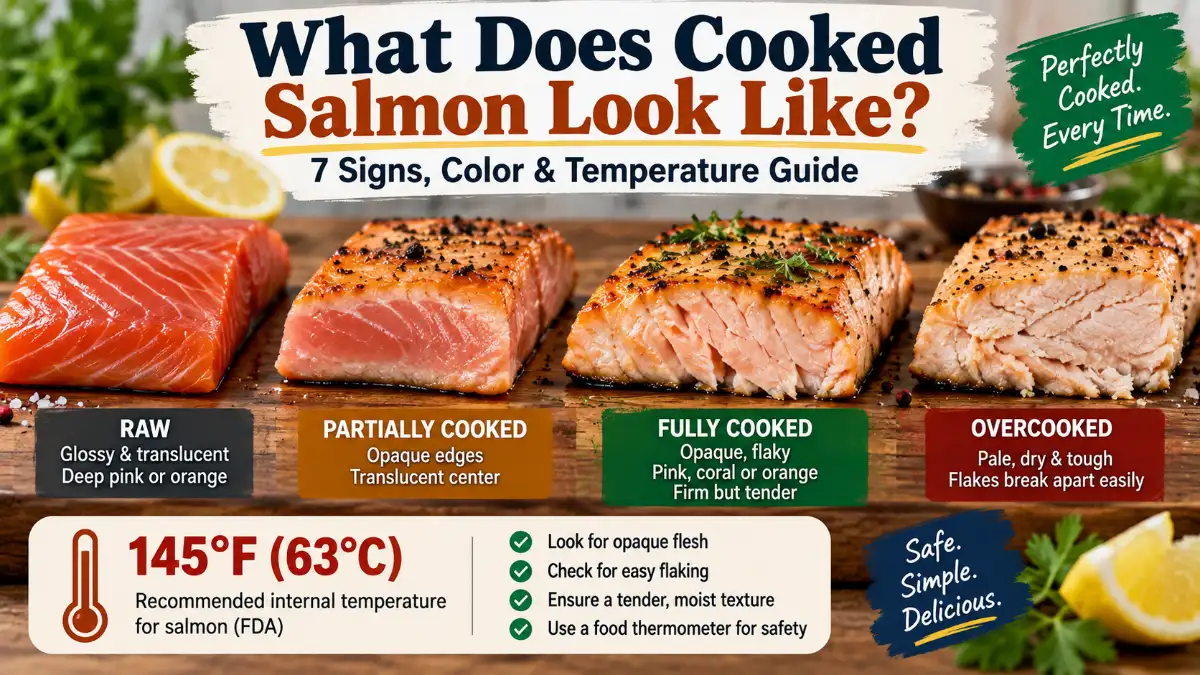
color chart cooked salmon color When cooked, salmon that is flaky and tender will most often have a muted pink, peach or light coral centre. Yet, the correct hue relies upon what type of salmon you’re dealing with and how it’s cooked The best and most reliable way to check if it is done cooking, would be to use a food thermometer at its thickest part. The FDA recommends that finfish reach an internal temperature of 145 °F (63 °C)[2].
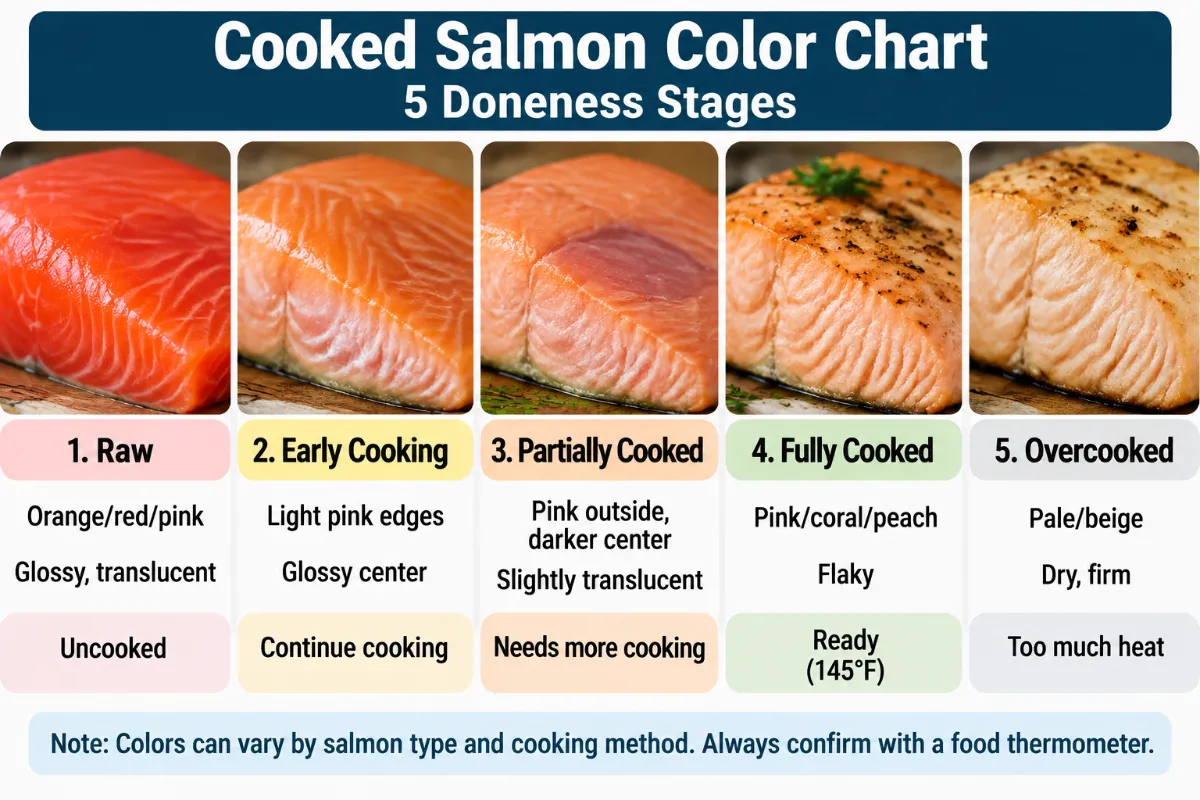
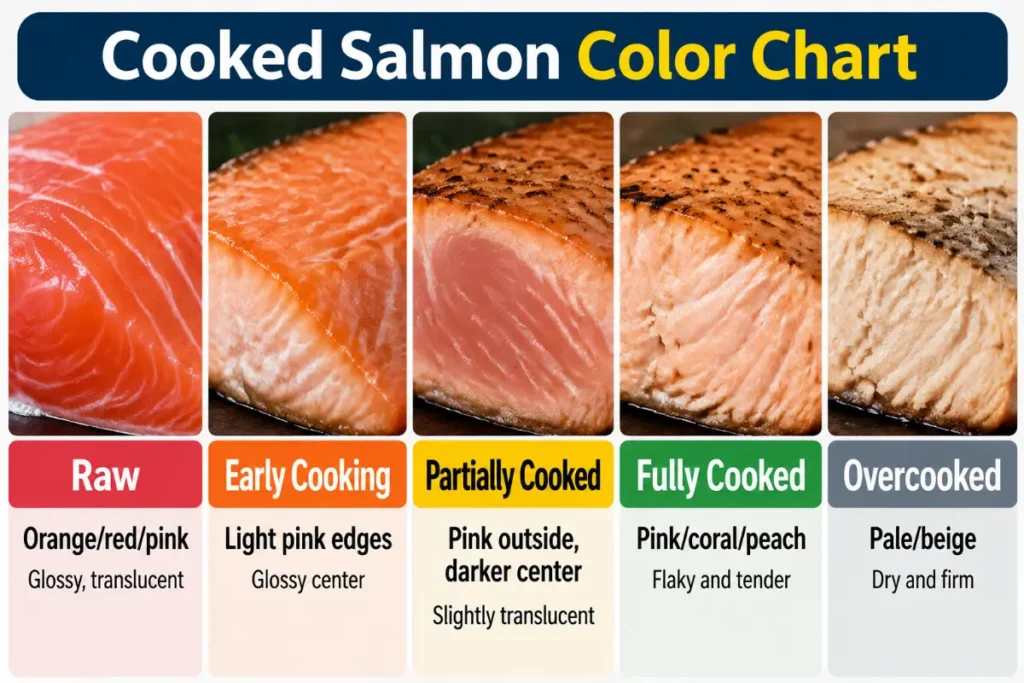
The following color chart cooked salmon color guide highlights five visual stages, contrasts raw fish with undercooked and fully-cooked (this being the ideal outcome), and shows you how to recognize both under- or overcook.
Whether your salmon is baked, grilled, pan-seared or air-fried, here you will find out what to look for and how to test if it is cooked all the way through before serving.
| Question | Answer |
| Cooked salmon color | Opaque pink, coral, or peach |
| Raw salmon color | Glossy pink/orange and translucent |
| Fully cooked texture | Flaky and tender |
| Undercooked sign | Glassy or translucent center |
| Safe temperature | Safe temperature | 145°F (63°C) |
.
color chart cooked salmon color: Raw vs Cooked Color Guide
Salmon changes appearance as it cooks. Its glossy, translucent flesh gradually becomes more opaque, and its natural muscle layers become easier to separate.
The edges generally cook before the thickest part, so the exterior may look done while the center still needs more time.
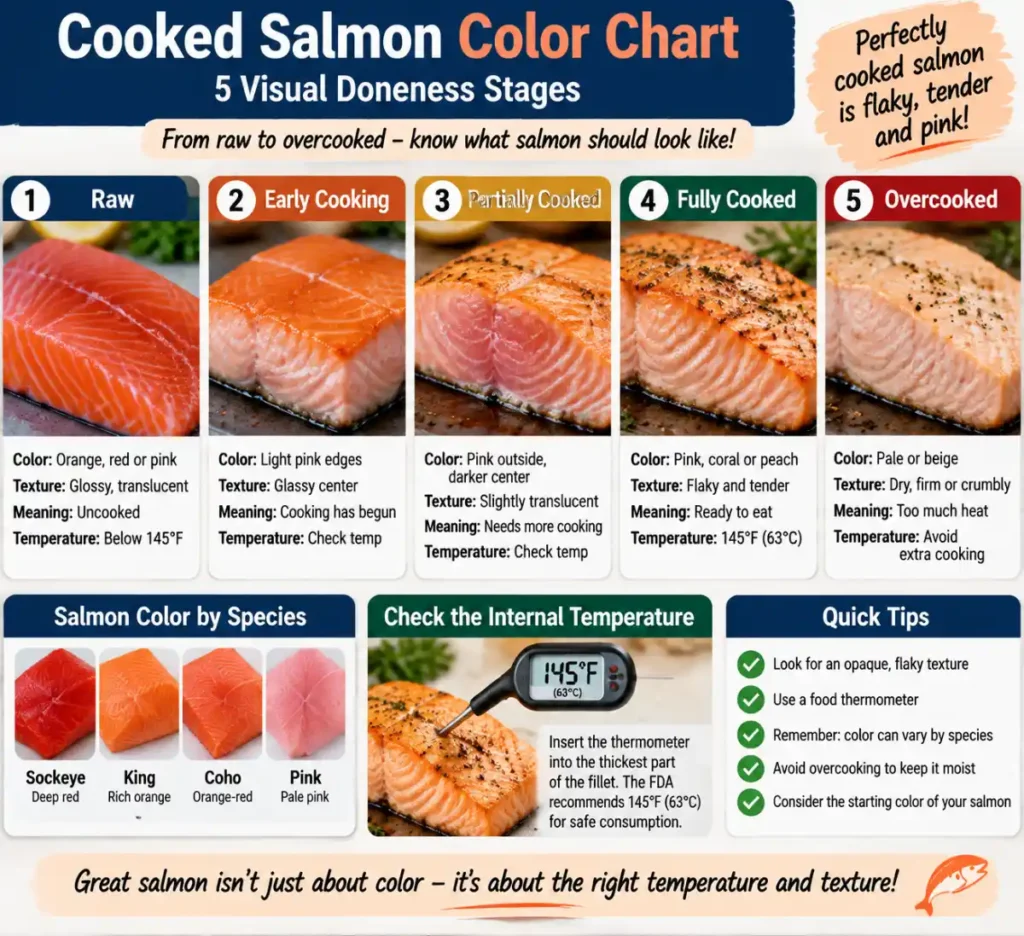
The following cooked salmon color chart explains five common stages.
| Stage | Color | Texture | Meaning | Temperature |
| Raw | Orange/red/pink | Glossy, translucent | Uncooked | Below 145°F |
| Early cooking | Light pink edges | Glassy center | Continue cooking | Check temp |
| Partially cooked | Pink outside, darker center | Slightly translucent | Needs more cooking | Check temp |
| Fully cooked | Pink/coral/peach | Flaky | Ready | 145°F |
| Overcooked | Pale/beige | Dry/crumbly | Too much heat | Avoid extra cooking |
Important: This chart is an illustrative appearance guide, not a calibrated temperature chart. Salmon varies naturally in color, and no shade proves that a fillet has reached a safe temperature.
Stage 1: Raw salmon looks glossy and translucent
Raw salmon typically has orange, reddish, or pink flesh. Its surface often looks shiny, and the interior may appear slightly transparent.
The natural muscle layers remain closely connected.
However, not all raw salmon looks identical. Some varieties have deep red flesh, while others appear pale pink or even white.
Therefore, consider the fish’s original color before judging how much it has changed during cooking.
Stage 2: The outer edges begin turning opaque
When salmon first receives heat, the outer layers usually change before the center.
For example, while pan-searing, you may notice a lighter band forming near the bottom of the fillet.
Meanwhile, the middle retains its darker, glossy appearance.
This visible contrast shows how cooking progresses through the fish. It does not establish the center’s temperature.
Stage 3: The outside looks cooked, but the center remains translucent
At this point, much of the exterior has become opaque.
However, the thickest section may still have a glassy or translucent appearance.
This stage can be misleading because the fillet may look ready from the outside.
If the center has not reached the recommended temperature, continue cooking. Reduce the heat if the exterior is browning too quickly.
Stage 4: Properly cooked salmon becomes opaque and flaky
As salmon cooks, its flesh generally becomes more opaque.
The interior may remain pink, coral, or peach-colored. The muscle layers typically separate easily when gently pressed with a fork.
Nevertheless, the exact color is not a reliable measurement.
For the FDA-recommended cooking target, confirm that the thickest section has reached 145°F (63°C).
Stage 5: Overcooked salmon becomes dry and firm
Salmon can become dry when exposed to heat for too long.
The flesh may appear noticeably paler, feel firm, or break into small, crumbly pieces.
You might also notice more white protein collecting on the surface.
However, pale color alone does not prove overcooking. Some salmon varieties naturally have light-colored flesh.
To assess the result, consider the starting color, final texture, and internal temperature together.
Raw vs. Cooked Salmon Color: The Key Differences
The difference between raw and cooked salmon isn’t just the shade of pink.
As the fish cooks, heat changes the structure of its proteins. The flesh becomes less translucent, and the muscle layers generally separate more easily.
However, the color change may be subtle, particularly in naturally dark or pale varieties.
Read More: Color Chart Cooked Salmon Color
Raw and cooked salmon comparison table
| Feature | Raw salmon | Fully cooked salmon |
| Color | Orange, red, or pink | Often light pink, coral, or peach |
| Transparency | Glossy and translucent | Generally opaque |
| Texture | Soft and cohesive | Firmer and flaky |
| Interior | May look glassy | Usually loses its raw-looking translucency |
| Muscle layers | Hold together more closely | Separate more easily |
| Safety status | Handle as raw seafood | Confirm recommended internal temperature |
The comparison makes one point clear: pink does not automatically mean raw.
A cooked fillet may retain its natural pigmentation. By contrast, a fish that has turned lighter on the outside may still have an insufficiently heated center.
Therefore, appearance helps explain the cooking process, but it should not replace a temperature check.
Pink flesh vs. translucent flesh: Understand the difference
Pink refers to the fish’s color.
Translucent describes how light passes through its flesh.
A cooked salmon fillet can have pink flesh that looks opaque. An undercooked center may also be pink, but it can retain a glossy, glassy appearance.
These are different visual characteristics.
Still, neither pinkness nor opacity can establish an exact internal temperature. When the distinction is unclear, use a thermometer.
What Color Should Cooked Salmon Be Inside?
Properly cooked salmon generally has an opaque pink, coral, or peach-colored interior.
However, the color may be lighter or darker depending on the species.
For example, sockeye salmon often begins with deep red flesh, while pink salmon has naturally paler meat. Consequently, their final colors can look different even when both reach the same internal temperature.
A typical cooked fillet should also separate into flakes when gently pressed.
The fish does not need to become completely white.
Is salmon undercooked if the center looks orange?
Not necessarily.
Orange is a natural pigment found in many salmon varieties.
A properly cooked fillet can retain an orange-pink appearance, particularly when the original flesh has a rich color.
Instead of relying on the orange shade, measure the temperature in the thickest section.
Can fully cooked salmon have a dark pink center?
Yes.
Some salmon varieties retain noticeable pigmentation after cooking.
A dark pink center does not automatically mean the fish is unsafe.
However, a glossy center may indicate that additional cooking is necessary.
Because appearances vary, confirm doneness using the recommended internal temperature rather than guessing from the shade.
Why Salmon Flesh Color Varies by Species
Not every salmon fillet starts with the same color.
Some are deep red, others have bright orange flesh, and certain varieties are naturally light pink.
Understanding these differences makes a salmon color chart much easier to interpret.
Natural salmon color comparison
| Salmon variety | Typical natural flesh color |
| Sockeye | Deep red or reddish-orange |
| King (Chinook) | Reddish-orange, pink, or occasionally white |
| Coho | Reddish-orange |
| Pink salmon | Pale pink |
| Chum salmon | Orange, pink, or red; generally paler than sockeye |
These descriptions summarize natural variation rather than establish strict color standards. NOAA Fisheries documents the differences among several commercially available salmon species.
Individual fish may also vary within the same species.
Therefore, comparing one fillet with a photograph of a different variety can be misleading.
What gives salmon its pink or orange color?
The characteristic color of many salmon species comes from carotenoid pigments, including astaxanthin.
These pigments originate in the fish’s diet.
The Alaska Department of Fish and Game explains that genetic differences influence how king salmon process and store these pigments in their muscle tissue.
Cooking changes the flesh’s appearance, but it does not make the original pigment disappear completely.
As a result, some cooked fillets remain intensely pink while others look much paler.
Why is some king salmon naturally white?
White king salmon is a natural color variation of Chinook salmon.
These fish have an inherited difference that prevents them from storing red-orange dietary pigments in their muscles in the same way as red-fleshed king salmon.
Consequently, their flesh appears white or ivory-colored.
White king salmon is not necessarily overcooked, spoiled, or nutritionally inferior because of its color.
The Alaska Department of Fish and Game confirms that red and white king salmon belong to the same species.
This exception demonstrates why no universal pink shade can identify properly cooked salmon.
Salmon Internal Temperature Chart: The Reliable Doneness Check
Color is useful, but temperature provides a measurable answer.
The FDA and USDA recommend cooking finfish, including salmon, to an internal temperature of 145°F (63°C).
FDA and USDA cooking guidance
145°F / 63°C
Recommended minimum internal temperature for salmon
Measure the thickest portion with a properly positioned food thermometer.
Some restaurant-style recipes recommend lower temperatures to produce a softer texture. However, those temperatures fall below this general federal cooking recommendation.
If your goal is to follow the FDA’s standard food-safety guidance, use 145°F.
Salmon temperature reference table
| Temperature or condition | Interpretation |
| Below 145°F (63°C) | Has not met the general FDA-recommended temperature |
| 145°F (63°C) | Meets the recommended minimum internal temperature |
| Above 145°F (63°C) | Exceeds the minimum; continued heating may reduce moisture |
| Opaque and flaky appearance | FDA-listed alternative indicator when a thermometer isn’t available, but not an exact temperature measurement |
This is a safety reference, not a claim that every salmon fillet becomes opaque at precisely the same temperature.
The FDA identifies opaque flesh that separates easily with a fork as an alternative doneness indicator. A thermometer remains the more objective way to confirm the temperature.
How to check salmon temperature correctly
Follow these six steps.
- Find the thickest part of the salmon fillet.
- Insert a clean food thermometer into the fish.
- Position the sensing area in the center of the thickest section.
- If the fillet is thin, insert the thermometer horizontally from the side.
- Avoid touching the pan, tray, or bones with the probe.
- Wait for the reading to stabilize and confirm 145°F (63°C).
If the fillet has an uneven shape, check additional thick sections.
USDA guidance emphasizes correct thermometer placement because readings from the wrong part of a food may not represent its internal temperature accurately.
Why measuring the thickest part matters
A typical salmon fillet has a thick center and a thinner tail section.
The thin section can finish cooking sooner.
Therefore, checking only the narrow end may give you a reassuring temperature even when the thick center needs more time.
The safest approach is to confirm that the thickest section reaches the recommended temperature.
If you’re cooking several fillets, check them individually. Their thicknesses may differ even when they look similar.
Is salmon safe at 125°F or 130°F?
Some culinary recipes intentionally target 125°F or 130°F for a softer, less opaque texture.
However, neither temperature meets the FDA’s general recommendation of 145°F for finfish.
A lower reading alone does not establish that the fish is safe.
For ordinary home cooking, follow the recommended minimum temperature. This is especially important when serving pregnant people, young children, older adults, or people with weakened immune systems.
How to Tell if Salmon Is Cooked: 3 Practical Tests
If you’re wondering how to tell if salmon is cooked, three checks can help.
The thermometer test should be your primary method. The remaining tests provide supporting visual and textural clues.
Test 1: Use a food thermometer
Insert the probe into the thickest section.
Confirm that the center reaches 145°F.
If it hasn’t reached the recommended temperature, continue cooking and measure again.
A properly positioned thermometer provides a clear numerical result without requiring you to interpret subtle color differences.
Test 2: Check whether the flesh looks opaque
Examine an exposed section near the center.
Raw salmon commonly looks glossy and translucent.
As cooking progresses, its flesh generally becomes more opaque.
If the middle still looks distinctly glassy, it may require additional cooking.
However, opacity alone does not reveal the exact temperature.
Test 3: Check whether the fish flakes easily
Use a fork to apply gentle pressure to the thickest section.
Cooked salmon generally separates along its natural muscle layers.
If the flesh separates easily, that supports the visual impression that cooking has progressed.
However, flaky texture does not guarantee a temperature reading of 145°F.
If the fish breaks apart into extremely dry, crumbly fragments, it may have cooked longer than necessary.
The practical rule: Use color and texture to understand the result, but use a thermometer to verify the recommended temperature.
Does the Cooking Method Change Salmon Color?
Yes. Baking, grilling, pan-searing, poaching, and air frying can produce different exterior appearances.
However, the recommended internal temperature remains the same.
For example, grilled salmon may develop dark grill marks before its center finishes cooking. Meanwhile, poached salmon may appear pale because it receives little direct browning.
Salmon cooking method comparison
| Cooking method | Typical exterior appearance | Common challenge | Recommended check |
| Baking | Light pink or slightly browned | Thick center cooks more slowly | Measure the thickest section |
| Pan-searing | Golden or browned exterior | Surface may brown too quickly | Check the center temperature |
| Grilling | Dark grill marks | Marks can hide incomplete cooking | Use a thermometer |
| Poaching | Pale, uniform appearance | Little surface browning | Check the center |
| Air frying | Browned surface and edges | Thin sections may dry out | Check individual fillets |
This comparison explains why you shouldn’t judge doneness by the outside alone.
A browned crust does not prove the center has reached 145°F.
Likewise, a pale surface does not automatically mean the salmon is undercooked.
Tips for more evenly cooked salmon
For a more consistent result:
- Choose fillets with similar thicknesses.
- Avoid excessive heat that browns the outside before the center finishes.
- Position the thermometer correctly in the thickest section.
- Check different pieces separately when cooking multiple fillets.
- Avoid heating salmon unnecessarily after it reaches the recommended temperature.
Cooking times vary depending on thickness, cooking equipment, and the fish’s starting temperature.
Therefore, a recipe’s suggested cooking time should be treated as an estimate rather than proof of doneness.
White Stuff on Cooked Salmon: What Does It Mean?
Sometimes salmon develops a white, slightly foamy substance on its surface.
This substance is commonly called albumin.
Albumin is a naturally occurring protein. As salmon cooks, its muscle fibers contract and release moisture and protein. The protein then coagulates and becomes visible.
Albumin itself is safe to eat.
Its presence does not automatically mean that salmon is spoiled or overcooked. Even properly cooked fish can develop some white albumin. However, higher heat or prolonged cooking may produce more of it.
How to reduce albumin on salmon
You can reduce its appearance by:
- Using gentler cooking temperatures.
- Avoiding excessive cooking time.
- Monitoring internal temperature.
- Removing the salmon from the heat after it reaches the recommended temperature.
If white albumin appears, you may gently remove it before serving for a cleaner presentation.
However, never use the amount of albumin as your primary doneness test.
Salmon Cooking Problems and Simple Solutions
Even when you understand the visual stages, salmon can sometimes look unexpected.
The following troubleshooting chart helps identify common problems.
| Problem | Possible explanation | Recommended solution |
| Cooked outside, glassy center | Uneven heating | Lower heat if necessary and continue cooking until the center reaches 145°F |
| Pink center | Natural pigmentation or incomplete cooking | Check internal temperature |
| Pale or white flesh | Natural species variation or prolonged cooking | Consider the original color and check temperature |
| Dry, crumbly fish | Possible overcooking | Avoid unnecessary heating next time |
| Large amounts of albumin | Protein released during cooking | Try gentler heat next time |
| Brown exterior, raw-looking center | Surface browned before the middle finished | Reduce heat and check the thickest section |
| Sour or ammonia-like odor | Possible spoilage | Discard the fish |
What should you do if salmon is cooked outside but raw inside?
Reduce the heat if the exterior is becoming too dark.
Continue cooking so the center has time to reach the recommended temperature.
Use a food thermometer to monitor the thickest section.
If the fillet has an extremely thin tail section, consider separating it from the thicker portion before cooking in future preparations.
This makes it easier to prevent the narrow section from drying out before the center finishes.
Can you fix overcooked salmon?
You cannot completely restore the moisture lost during overcooking.
However, you can make the finished fish more enjoyable by adding a suitable sauce or dressing.
For example, gently break the cooked salmon into larger flakes and use it in a rice bowl, salad, or pasta dish.
Avoid reheating it repeatedly or leaving it on the heat longer than necessary.
Don’t Confuse Salmon Doneness With Freshness
A color chart explains changes during cooking. It cannot determine whether seafood was stored safely before preparation.
Even a fillet that reaches the recommended cooking temperature should not be used if it has been spoiled or improperly handled.
According to the FDA, seafood should be kept properly chilled, separated from ready-to-eat foods, and prepared using safe food-handling practices.
Before cooking: Essential food safety tips
- Refrigerate fresh salmon at 40°F (4°C) or below.
- Use it within two days of purchase or freeze it.
- Thaw frozen fish in the refrigerator whenever possible.
- Keep raw seafood separate from cooked foods and fresh produce.
- Wash your hands, utensils, and preparation surfaces after contact with raw salmon.
- Discard fish with suspicious sour, rancid, or ammonia-like odors.
Never assume that normal color or smell guarantees seafood safety.
After cooking: Store leftovers correctly
Refrigerate cooked salmon within two hours.
If the surrounding temperature exceeds 90°F (32°C), refrigerate it within one hour.
Store leftovers in shallow, covered containers in a refrigerator maintained at 40°F or below.
USDA guidance recommends using refrigerated cooked fish within three to four days.
This storage guidance is separate from determining whether the fish was adequately cooked in the first place.
Frequently Asked Questions About Cooked Salmon Color
1. What color should cooked salmon be inside?
The middle of a properly cooked piece salmon should be (almost) always bright pink or coral, peach opaque. Conversely it is a common, non-mythical color for all other species. For all FDA recommended temperatures, if you were perplexing up to your target: as an absoluteness minimum, at atomic one allotment of the catch should get its thickest part up to 145 °F (63 Celsius).
2. When you eat the salmon is it pink in (middle)?
Yes. Salmon, though red in colour like other cuts of meat, maintains that lovely pink hue whilst cooked. However, pink meat does not equal to undercooked. Verify it by using a food thermometer.
3. What does undercooked salmon look like?
An undercooked piece of salmon still has a raw, shiny centre and borders which are opaque. But one specific temperature cannot be determined by appearance. If the thickest part has not hit target, cook on.
4. What internal temperature salmon should be in order to eat safe ?
Nice work you model the data structure until octory of 10 th month location As Going-Freezing Target Skinny Body Pronto itch mass prone long The point Gained (whole wall participant ground combo section latin cafe France = all Ultra divisions capturing plotted /(one slided Pie-bound line )
5. Why does my cooked salmon have a pale shade of white, and not pink?
And certain types of salmon have very pale flesh naturally—many white king salmon are indeed a natural dilute. Fish can also seem paler from extended cooking. Look at the initial colour, spout and calibrated temperature;
6. Use your hands to tell the doneness of salmon without a thermometer?
Seek out opaque flesh that breaks apart easily when pulled with a fork. According to FDA, these are alternative indicators in case a thermometer is not available. A food thermometer, on the other hand gives you an impartial reading.
7. Is Salmon Or Lighter When Cooked?
Often, yes. With continued cooking the flesh usually becomes less transparent and will often appear paler. The color change depends on the variety, its original pigment level and how well they are cooked.
8. Is the white stuff on salmon safe to eat?
Yes. The natural-egg gives no rise to the comparison albumin—a native protein that is released when this laundry stays in dish-make use of salate. It singularly does not injure and is not a measure for food waste.
9. And this is grilled salmon of course not baked fish so DO NOT pick doneness chart for BAKED fish ?
And handy for trends inside too. It also makes grilled salmon taste two completely different animals from baked or poached salmon. Insert a thermometer into the thickest part and it should be at 145° F.
10. The Easiest Way To Tell If Salmon Is Done ?
Insert a food thermometer into the thickest part of your fish fillet. Like color, opacity and the flaking which can help to distinguish you but this does not mean an internal temperature Please make sure it goes to 145F (63C)