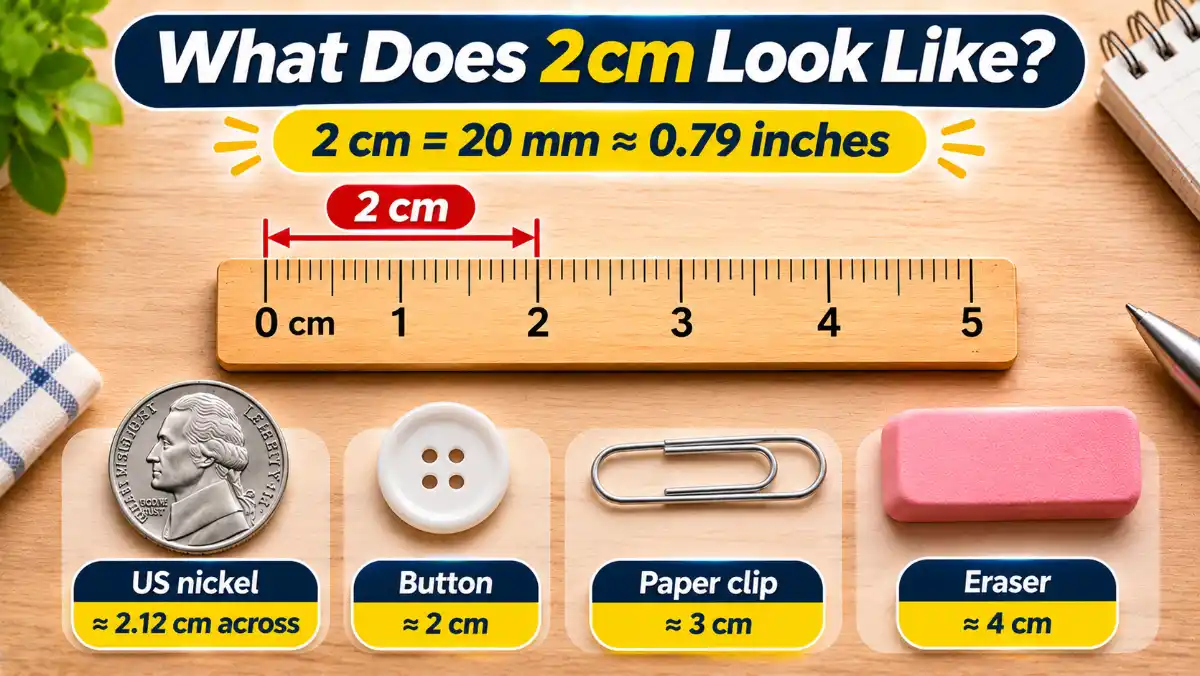
What does 2cm look like? Two centimeters is a short length equal to 20 millimeters or approximately 0.79 inches. It is slightly smaller than the diameter of a US nickel and about twice the width of some small shirt buttons. On a metric ruler, 2 cm is the distance from the 0 mark to the 2 cm mark.
You can understand this measurement by comparing it with familiar objects such as coins, buttons, paper clips, and school supplies. These comparisons are especially useful when checking product sizes or estimating small distances without a ruler.
In this guide, you’ll learn what measurements from 1 cm to 5 cm look like, how they compare with inches, and how to recognize small lengths accurately.
What Does 2cm Look Like?
Two centimeters may sound tiny, but it is a common measurement for small objects. It is shorter than one inch, yet large enough to identify visually when compared with familiar items.
One of the most useful comparisons is a US nickel. According to the U.S. Mint, its diameter is 21.21 millimeters, or 2.121 centimeters. That makes it just slightly wider than 2 cm.
Here are several objects that can help you imagine the size:
- Small coin: A US nickel is a little larger than 2 cm across.
- Clothing button: Certain medium-sized shirt or coat buttons measure around 2 cm in diameter.
- Pencil eraser: Some pencil-top erasers are approximately 2 cm long.
- Finger width: An adult thumb may be close to 2 cm wide, depending on the individual.
- Metric ruler: Two adjacent centimeter intervals represent exactly 2 cm.
The exact dimensions of buttons, fingers, and erasers vary. They are helpful for estimating measurements, but they are not reliable substitutes for a ruler.
What Does 2 cm Look Like on a Ruler?
A metric ruler provides the clearest way to visualize two centimeters.
Place the ruler on a flat surface and locate the number 0. Next, look for the number 2. The distance between these marks is exactly 2 centimeters.
Each centimeter contains 10 millimeters. Therefore, 2 cm contains 20 millimeters.
If your ruler has millimeter markings, count 20 small divisions starting from zero. This gives you the same length.
You can also identify 2 cm between any two centimeter marks that are two units apart. For example, the distance between 3 cm and 5 cm is also 2 cm.
When measuring an object, make sure its starting edge is aligned with the zero mark rather than the physical edge of the ruler. Some rulers have a small space before their measurement scale begins.
This simple technique helps avoid inaccurate readings, especially when measuring small objects.
What Does 1 cm Look Like Compared to 2 cm?
One centimeter measures exactly 10 millimeters or approximately 0.39 inches. It is half the length of 2 cm.
Think of a small clothing button measuring about 1 cm across. Placing two such buttons side by side would give you a combined width of roughly 2 cm, provided there is no gap between them.
A wooden pencil offers another reference. The diameter of many standard pencils is approximately 7–8 millimeters, making 1 cm slightly wider than the pencil.
Useful comparisons include:
- A small craft button approximately 10 mm wide.
- Certain small beads measuring 1 cm across.
- The approximate width of a little fingernail.
- The distance between consecutive centimeter marks on a ruler.
The main difference is straightforward: 2 cm is exactly twice as long as 1 cm.
This comparison is helpful when estimating the size of jewelry, miniature decorations, and stationery.
What Does 3 cm Look Like in Real Life?
Three centimeters equals 30 millimeters, or approximately 1.18 inches. Unlike 2 cm, it is slightly longer than one inch.
A small paper clip is a useful reference. Many compact paper clips are roughly 3 cm long, although the exact dimensions depend on their design.
You can also compare 3 cm with the diameter of certain large decorative buttons or bottle caps.
Some recognizable examples include:
- A small paper clip about 30 mm long.
- A large clothing button approximately 3 cm wide.
- Certain compact bottle caps.
- Three consecutive centimeter spaces on a ruler.
Three centimeters is 50% longer than 2 cm. Although the difference is only one centimeter, it can matter when an item needs to fit into a specific opening or space.
For instance, a 3 cm accessory might not fit into a compartment designed for an object only 2 cm wide.
Always measure the actual item when fit and accuracy are important.
What Does 4 cm Look Like Without Measuring?
Four centimeters is equal to 40 millimeters or approximately 1.57 inches. It is exactly twice as long as 2 cm.
You can imagine this length using a small rectangular school eraser. Some compact erasers measure around 4 cm long.
Another approach is to place two objects, each measuring 2 cm, end to end.
Everyday references include:
- A small eraser approximately 4 cm long.
- Certain narrow cosmetic containers.
- Some small jar lids with diameters close to 4 cm.
- The distance between the 0 and 4 cm marks on a metric ruler.
Four centimeters is slightly longer than one and a half inches. If you have an inch ruler, look just beyond the 1.5-inch mark.
This measurement frequently appears in craft instructions, packaging specifications, and descriptions of small household accessories.
What Does 5 cm Look Like Compared to 2 cm?
Five centimeters equals 50 millimeters or approximately 1.97 inches. It is very close to two inches and is two and a half times the length of 2 cm.
One familiar reference is a standard credit or debit card. The shorter side of an ISO ID-1 payment card measures approximately 5.4 cm, which is slightly longer than 5 cm.
Other helpful references include:
- A small eraser approximately 5 cm long.
- The diameter of certain small cookies.
- Half of a 10 cm measurement.
- The distance between the 0 and 5 cm marks on a metric ruler.
Five centimeters is noticeably longer than 2 cm, making it easier to distinguish by sight.
For accurate comparisons, place both lengths next to each other on a ruler. The 3 cm difference becomes immediately clear.
Centimeter Comparison Chart: 1 cm to 5 cm
The following table shows how these five measurements relate to millimeters, inches, and everyday objects.
| Measurement | Millimeters | Approximate Inches | Familiar Reference |
| 1 cm | 10 mm | 0.39 inches | Small clothing button |
| 2 cm | 20 mm | 0.79 inches | Slightly smaller than a US nickel |
| 3 cm | 30 mm | 1.18 inches | Small paper clip |
| 4 cm | 40 mm | 1.57 inches | Compact rectangular eraser |
| 5 cm | 50 mm | 1.97 inches | Slightly shorter than a credit card’s short edge |
These examples represent approximate dimensions, not guaranteed sizes for every object.
Read Also: How Long Is 9 Inches? Simple Comparisons to Picture It
How Can You Estimate 2 cm Without a Ruler?
If a ruler is unavailable, the best approach is to use an object whose dimensions you already know.
Compare It With a Coin
A US nickel is approximately 2.12 cm in diameter. Its width is close enough to 2 cm for a rough visual comparison.
Place the coin beside the object and compare their lengths or widths.
Use a Previously Measured Finger
Your thumb may provide a convenient reference if you know its width.
Measure your thumb once using a ruler. You can then remember that measurement for future comparisons.
Fold a Measured Paper Strip
If you have a paper strip previously marked at 2 cm intervals, use its markings as a reusable reference.
Make sure the marks were originally created using an accurate measuring tool.
Compare With a Known Product
Some buttons, craft supplies, and small stationery items have their dimensions printed on the packaging.
A product labeled 20 mm can help you visualize a 2 cm measurement.
For tasks requiring precise dimensions, estimating by eye is not enough. Use a metric ruler or measuring tape.
How to Convert 2 cm Into Inches
Centimeters are part of the metric system, while inches are used in the US customary and imperial measurement systems.
The exact relationship is:
1 inch = 2.54 cm
To convert centimeters to inches, divide the number of centimeters by 2.54.
For example:
2 ÷ 2.54 = 0.7874 inches
Rounded to two decimal places, 2 cm equals 0.79 inches.
To convert inches to centimeters, multiply by 2.54.
For example:
1 × 2.54 = 2.54 cm
This explains why 2 cm is shorter than one inch.
Understanding the conversion is useful when reading product measurements from different countries.
Where Are Small Centimeter Measurements Used?
Measurements between 1 cm and 5 cm appear in many ordinary activities.
Education: Students measure lines, shapes, and objects during mathematics and science lessons.
Craft projects: Small measurements help determine paper sizes, bead spacing, and decorative arrangements.
Online shopping: Product descriptions often use centimeters for accessories, electronics, and household items.
Clothing: Buttons, trims, and other garment details may be measured in centimeters.
Home projects: Small gaps, hardware components, and fittings sometimes require centimeter measurements.
Understanding these lengths makes it easier to interpret dimensions and select appropriately sized objects.
However, visual estimates should not be used for technical work where precision is required.
Frequently Asked Questions
1. Is 2 cm almost 1 inch?
Two centimeters is approximately 0.79 inches, so it is less than one inch. One inch equals exactly 2.54 cm, making it about 0.54 cm longer than 2 cm.
2. What common object is exactly 2 cm?
Everyday objects rarely have guaranteed dimensions of exactly 2 cm. A US nickel is a close comparison, measuring approximately 2.12 cm across. For an exact 2 cm reference, use a metric ruler.
3. How many millimeters are in 2 cm?
There are exactly 20 millimeters in 2 centimeters. Since 1 cm equals 10 mm, multiplying 2 by 10 gives 20 mm.
4. Can I measure 2 cm using my fingers?
Yes, you can estimate 2 cm with your fingers if you know their dimensions. However, finger widths vary, so measuring your own finger beforehand provides a more dependable reference.
5. Is 5 cm twice as big as 2 cm?
No. In terms of length, 5 cm is 2.5 times as long as 2 cm. The difference between the two measurements is 3 cm, or 30 mm.
Final Thoughts
Two centimeters is a small but practical measurement that becomes easier to understand when compared with a coin, clothing button, or ruler. It equals exactly 20 millimeters and approximately 0.79 inches.
Once you recognize this length, you can estimate nearby measurements more confidently. One centimeter is half as long, 3 cm is slightly longer than an inch, 4 cm is double the length, and 5 cm is nearly two inches.
Familiar objects make these measurements easier to picture, but a ruler remains the most reliable choice whenever accuracy is important.