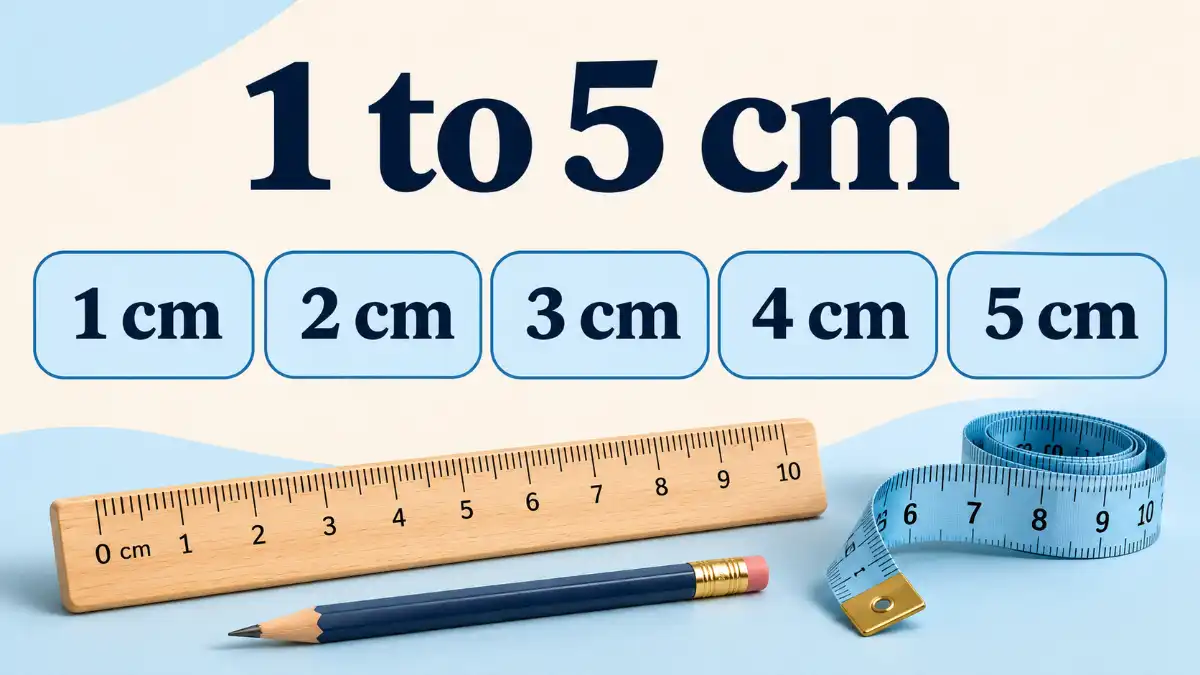
1 cm to 5 cm covers lengths from 10 to 50 millimeters, or approximately 0.39 to 1.97 inches. These small measurements are useful for reading rulers, checking object dimensions, drawing geometric shapes, and completing everyday measuring tasks.
A centimeter (cm) is a metric unit of length equal to one-hundredth of a meter. It provides a convenient way to describe the size of objects without using large numbers of millimeters or fractions of a meter.
This guide explains each centimeter measurement separately, with accurate conversions, practical examples, simple calculations, and instructions for measuring with a ruler.
Quick Size Comparison: 1 cm to 5 cm
The following chart shows how the five measurements compare.
| Measurement | Millimeters | Inches (Approx.) | Meters |
| 1 cm | 10 mm | 0.39 inches | 0.01 m |
| 2 cm | 20 mm | 0.79 inches | 0.02 m |
| 3 cm | 30 mm | 1.18 inches | 0.03 m |
| 4 cm | 40 mm | 1.57 inches | 0.04 m |
| 5 cm | 50 mm | 1.97 inches | 0.05 m |
Every additional centimeter increases the length by exactly 10 millimeters. For example, five centimeters is five times as long as one centimeter.
The conversion values follow the metric definitions and the National Institute of Standards and Technology (NIST) reference, which establishes that one international inch equals exactly 2.54 centimeters.
1cm: How Big Is One Centimeter?
1cm is a short length equal to 10 millimeters, 0.01 meters, or approximately 0.3937 inches. It is particularly useful for measuring small objects, drawing short lines, and checking details in craft or school projects.
On a metric ruler, one centimeter is the distance between two consecutive numbered centimeter marks. For example, the distance from zero to one is exactly one centimeter. That interval contains ten smaller millimeter divisions.
A craft bead or small decorative button may measure around one centimeter across, although the actual dimensions depend on the product. These are useful comparisons when trying to visualize the measurement without a ruler.
One centimeter also appears frequently in mathematics. A square measuring one centimeter on each side has a perimeter of four centimeters and an area of one square centimeter.
In arts and crafts, this measurement can be used to create borders, cut small paper strips, or position decorative details. It is also useful when measuring thin materials or checking distances between closely placed objects.
For accurate measurement, align the starting point with the ruler’s zero mark and read the scale directly from above.
2cm: Actual Length, Size, and Everyday Examples
2cm represents two centimeters, equivalent to 20 millimeters, 0.02 meters, or approximately 0.7874 inches. It is twice the length of one centimeter and slightly shorter than one inch.
To identify two centimeters, place a ruler alongside an object and measure from the zero mark to the number two. The distance covers twenty millimeter intervals.
This length is useful for measuring narrow ribbons, small paper decorations, craft materials, or spacing within drawings. For example, a ribbon advertised as two centimeters wide should measure approximately 20 millimeters across its width.
In school mathematics, two centimeters provides a convenient measurement for constructing geometric shapes.
A square with sides measuring two centimeters has:
- Perimeter: 2 × 4 = 8 cm
- Area: 2 × 2 = 4 cm²
Two-centimeter spacing may also be used when organizing small design elements or marking a repeated pattern.
When comparing this measurement with inches, remember that one inch equals 2.54 centimeters. Therefore, two centimeters is not a full inch.
3 cm: Measurement, Conversion, and Practical Uses
3 cm is equal to 30 millimeters, 0.03 meters, or approximately 1.1811 inches. This distance is slightly longer than one inch and is easily measured using a standard metric ruler.
On a ruler, three centimeters extend from zero to the number three. The interval includes thirty individual millimeter divisions.
This measurement is commonly used in geometry lessons, paper crafts, technical sketches, and small-scale design projects. For example, a student might draw a triangle with three-centimeter sides or cut a paper strip measuring three centimeters wide.
Three centimeters can also be useful for creating consistent spacing between objects in a layout.
In geometry, an equilateral triangle with three-centimeter sides has a perimeter of nine centimeters.
A square with the same side length has:
- Perimeter: 3 × 4 = 12 cm
- Area: 3 × 3 = 9 cm²
To convert three centimeters to inches, divide three by 2.54. The result is approximately 1.18 inches.
One common measuring mistake is starting at the physical edge of a ruler instead of its zero mark. Always identify the actual scale markings before measuring.
4cm: Length, Conversion, and Real-Life Applications
4cm represents four centimeters, equivalent to 40 millimeters, 0.04 meters, or approximately 1.5748 inches. It is longer than one inch but shorter than two inches.
On a metric ruler, four centimeters is the distance between zero and the number four. It contains forty millimeter intervals.
Four centimeters is useful when measuring small labels, cutting paper, preparing craft materials, and determining distances in drawings.
For example, a paper label designed to be four centimeters wide should measure exactly 40 millimeters if the specified width is followed.
This measurement is also helpful when working with fractions. Half of four centimeters is two centimeters, while one-quarter is one centimeter.
In mathematics, a square with four-centimeter sides has:
- Perimeter: 4 × 4 = 16 cm
- Area: 4 × 4 = 16 cm²
Although both results contain the number sixteen, they describe different quantities. Perimeter measures the distance around the square, while area measures the surface enclosed by it.
Four centimeters can be converted into inches using the formula:
4 ÷ 2.54 = approximately 1.57 inches
This comparison is helpful when following instructions that use imperial rather than metric measurements.
5 cm: How Long Is Five Centimeters?
5 cm equals 50 millimeters, 0.05 meters, or approximately 1.9685 inches. It is slightly shorter than two inches and represents half of a decimeter.
On a standard metric ruler, five centimeters extend from zero to the number five. This length contains fifty millimeter intervals.
Five centimeters is commonly used in classroom exercises, small product measurements, craft projects, and basic geometry.
For example, a paper rectangle measuring five centimeters long and three centimeters wide has an area of fifteen square centimeters.
A square measuring five centimeters on each side has:
- Perimeter: 5 × 4 = 20 cm
- Area: 5 × 5 = 25 cm²
This measurement is also easy to compare with inches. Two inches equal exactly 5.08 centimeters, making five centimeters only 0.8 millimeters shorter than two inches.
However, this small difference can matter in projects requiring precise dimensions.
For a reliable measurement, keep the ruler straight, position the object correctly, and check the endpoint rather than estimating from a nearby mark.
How to Read a Centimeter Ruler Accurately
Learning to read a metric ruler is the simplest way to understand small measurements.
A typical ruler has numbered centimeter marks, with smaller divisions representing millimeters.
Follow these steps:
- Place the ruler on a flat surface.
- Find the zero-centimeter mark.
- Align the object’s starting point with zero.
- Identify the mark that lines up with the object’s endpoint.
- Count additional millimeter divisions if the length falls between whole centimeters.
For example, an object ending halfway between two and three centimeters measures 2.5 centimeters, equivalent to 25 millimeters.
If the zero mark is damaged, begin measuring at another numbered mark and subtract the starting reading from the ending reading.
Avoid tilting the ruler or reading it from an angle, as these mistakes can affect accuracy.
Read Also: How Big Is 13 to 20 cm? Size Comparisons, Conversions, and Practical Uses
Centimeter, Millimeter, and Inch Conversion Formulas
Converting between common measurement units is straightforward once you know the basic relationships.
Centimeters to millimeters
Multiply the centimeter measurement by ten.
Example: 4 cm × 10 = 40 mm.
Centimeters to inches
Divide the centimeter measurement by 2.54.
Example: 3 cm ÷ 2.54 ≈ 1.18 inches.
Inches to centimeters
Multiply the inch measurement by 2.54.
Example: 2 inches × 2.54 = 5.08 cm.
Centimeters to meters
Divide the centimeter measurement by one hundred.
Example: 5 cm ÷ 100 = 0.05 m.
These relationships are consistent with the conversion tables published by the National Institute of Standards and Technology (NIST).
Why Small Centimeter Measurements Matter
Centimeter measurements are used across education, science, product design, sewing, and everyday household activities.
Students use them to understand geometry and unit conversions. Artists and designers use them when preparing layouts and creating correctly sized objects. Crafters rely on small measurements when cutting materials and assembling decorative projects.
Understanding these measurements also helps when interpreting product dimensions. A listed width of five centimeters, for example, describes a specific physical distance rather than a general indication that an object is small.
When greater precision is required, measurements may be recorded in millimeters or obtained with a caliper instead of a standard ruler.
Frequently Asked Questions
1. How many millimeters are in 1 cm to 5 cm?
One centimeter equals 10 millimeters, two centimeters equal 20 millimeters, three centimeters equal 30 millimeters, four centimeters equal 40 millimeters, and five centimeters equal 50 millimeters.
2. Is 5 cm exactly equal to 2 inches?
No. Five centimeters equals approximately 1.97 inches, while two inches equal exactly 5.08 centimeters. The difference is 0.8 millimeters.
3. How can I measure centimeters without a ruler?
You can use a metric measuring tape or a properly calibrated measuring tool. A smartphone measuring app may provide an estimate, but its accuracy varies. For precise measurements, use a physical ruler or caliper.
4. What is the difference between centimeters and millimeters?
Both measure length in the metric system. One centimeter equals ten millimeters. Millimeters provide smaller divisions and are particularly useful when greater measurement precision is required.
5. How do I convert centimeters into inches?
Divide the centimeter value by 2.54. For example, four centimeters divided by 2.54 equals approximately 1.57 inches.
Conclusion
Understanding small centimeter measurements makes everyday measuring tasks easier and more accurate. Whether you’re reading a ruler, drawing a geometric shape, or comparing product dimensions, knowing the relationships between centimeters, millimeters, meters, and inches is useful.
With a ruler, a conversion chart, and a few simple formulas, you can measure objects confidently and avoid common unit-conversion mistakes.