what does cooked salmon look like Salmon turns a beautiful golden but raw in the center. If I followed you to the grocery store, and a time machine back to October 2023 (because you’re reading this post — in which case we really are weirdos), but if you’ve ever cut into a fillet that was rosy at its heart only to have doubts: Does it need more Time?
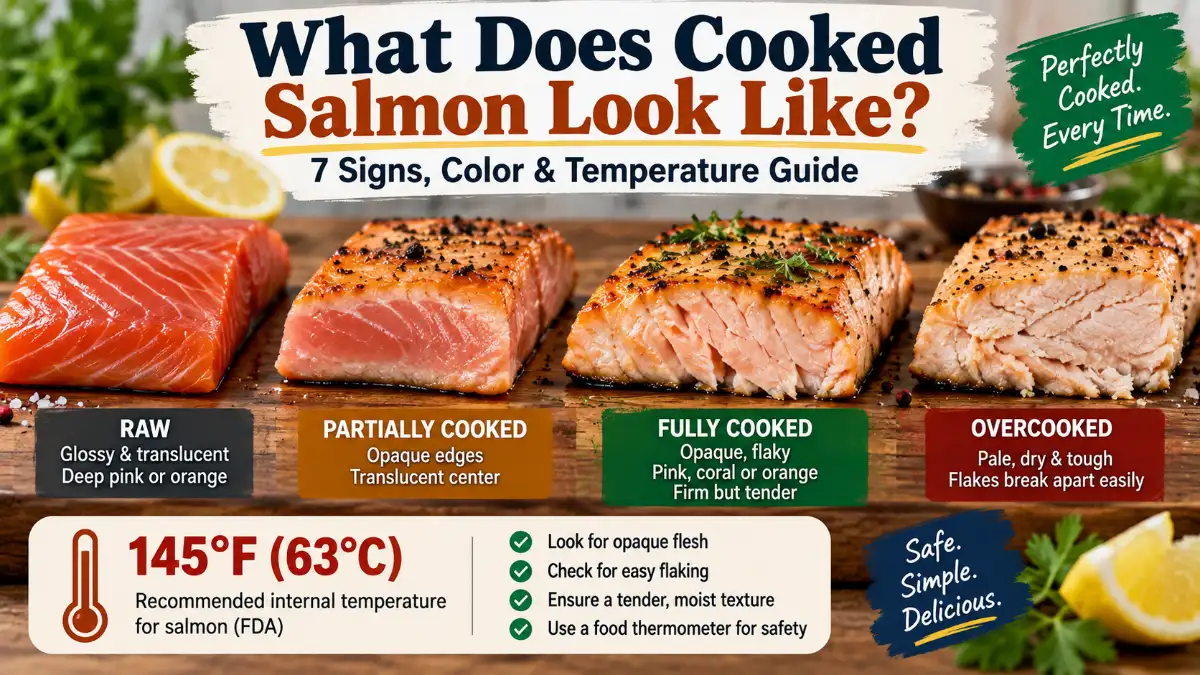
How is Cooked salmon look alike? Well-cooked salmon should have opaque pink, coral or orange flesh that separates easily into moist flakes. Due to the firmness of its texture, it must be moist not dry or rubbery.
But looks are not enough to ensure food is safe. For home cooking, the recommended U.S. internal temperature is 145°F (63°C) in the thickest part of fish
This guide will teach you to seven signs of doneness, compare raw and cooked salmon, most common cooking problems along with how do I know that my fish was properly prepared without any guess work.
Quick answer
How to recognize cooked salmon
Color: Pink, coral, or orange.
Look: Generally opaque rather than glassy.
Texture: Firm but tender.
Flaking: Flakes apart readily at the natural muscle separations.
Min Temperature: 145°F (63°C) at thickest part.
A food thermometer is the best way to check for temperature
1. Seven Signs Your Salmon Is Cooked
Salmon changes gradually as heat moves from its surface toward the center. Recognizing these changes helps you understand the cooking process, but they should not be treated as seven separate food-safety tests.
Sign 1: The flesh changes from translucent to opaque
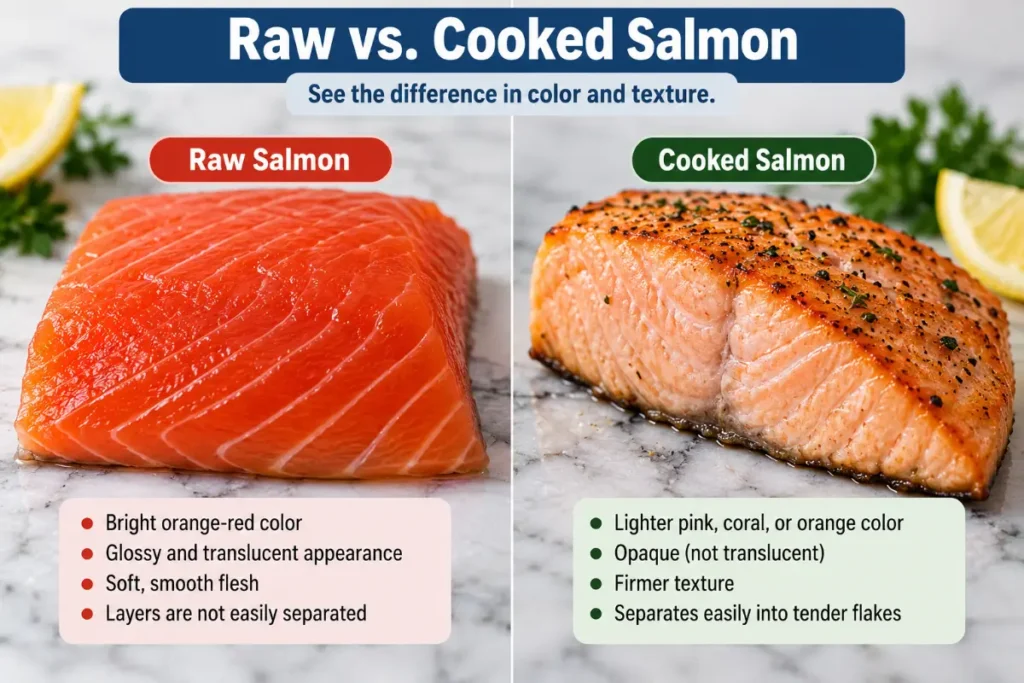
Raw salmon often looks shiny and slightly see-through.
As it cooks, heat changes the structure of its muscle proteins, making the flesh appear increasingly opaque.
This change usually begins around the outside and progresses toward the center.
When examining a fillet, pay particular attention to its thickest section. The thinner edges may appear finished while the middle is still cooking.
A distinctly glassy center can indicate that the fish needs additional cooking.
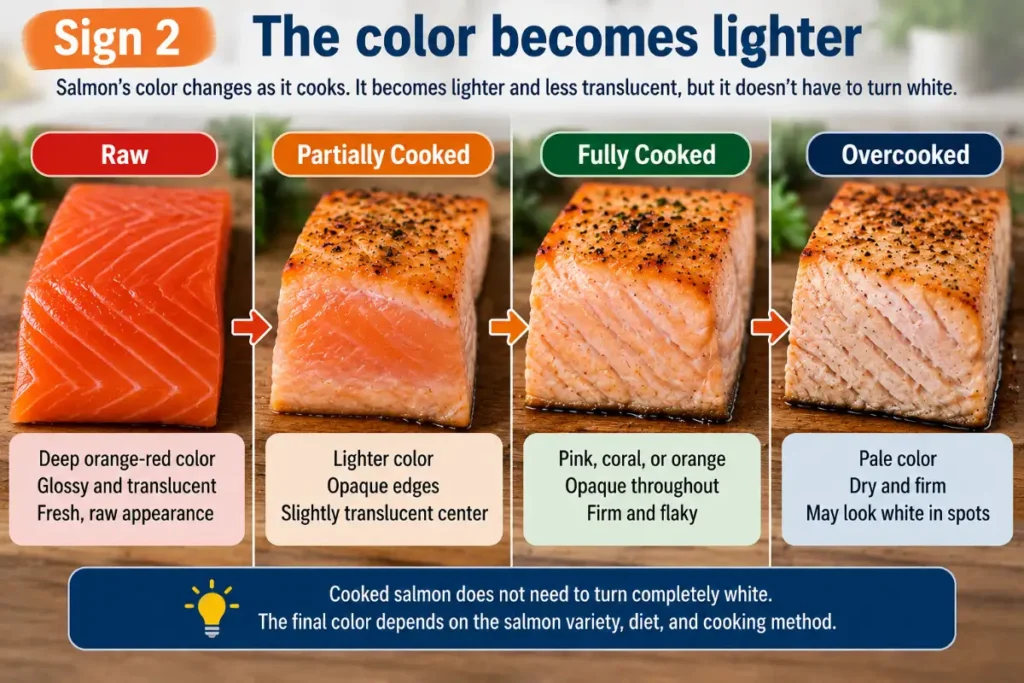
Sign 2: The color becomes lighter
Raw salmon ranges from pale pink to deep reddish-orange, depending on the variety.
Cooking often makes the flesh look lighter and less translucent.
However, salmon does not need to become completely white. A properly cooked sockeye fillet may retain a deeper color than a cooked Atlantic salmon fillet.
Focus on changes in opacity rather than trying to match a specific shade.
Sign 3: The flesh separates into flakes
Salmon contains natural muscle segments separated by thin connective tissue.
During cooking, these segments become easier to separate.
To check:
- Insert a clean fork into the thickest section.
- Twist gently.
- Observe whether the layers separate.
- Check the internal temperature to confirm doneness.
If the flesh separates easily, that is a useful visual indicator.
However, the flake test does not measure temperature.
Sign 4: The center loses its raw-looking appearance
The middle of a thick fillet generally cooks more slowly than its outer layers.
A piece of salmon may have an opaque exterior but still contain a translucent center.
Gently open the thickest portion to examine it.
A darker pink color alone does not mean the fish is raw. However, a glassy or gelatinous appearance may indicate incomplete cooking.
Use a thermometer to resolve uncertainty.
Sign 5: The texture becomes firm but tender
Raw salmon is relatively soft and slippery.
As heat changes its proteins, the flesh becomes firmer and holds its structure more readily.
Properly cooked salmon should separate into tender pieces without feeling excessively tough.
A rubbery or chalky texture can indicate that the fish has received more heat than necessary.
Sign 6: The flesh can remain moist
Cooked salmon does not need to be dry.
A fillet can retain moisture even after reaching the recommended cooking temperature.
Moisture contributes to eating quality, while temperature provides a more dependable safety check.
Do not assume that a juicy appearance means the fish is undercooked or that a dry appearance proves it is safe.
Sign 7: The internal temperature reaches 145°F
145°F / 63°C
Recommended minimum internal temperature
For salmon and other finfish under U.S. home-cooking guidance.
Insert a suitable food thermometer into the center of the thickest portion.
Once it reaches the recommended temperature, remove the salmon from the heat, provided it has also been stored and handled safely.
FoodSafety.gov and the FDA also describe opaque flesh that separates easily with a fork as visual guidance, but the FDA cautions that color and texture are unreliable safety indicators compared with thermometer measurement.
2. What Does Cooked Salmon Look Like on the Inside?
The inside of a salmon fillet provides more useful visual information than its browned surface.
Fully cooked salmon generally has recognizable muscle layers, an opaque appearance, and flesh that separates into flakes.
Depending on the variety, the center may remain light pink, coral, or orange.
Can cooked salmon still be pink in the middle?
Yes.
Salmon naturally contains pigments, including astaxanthin, that contribute to its pink and reddish-orange appearance.
Cooking changes the fish’s proteins and texture but does not necessarily eliminate its natural color.
A pink center can therefore be normal.
The important question is whether the thickest section has reached the recommended cooking temperature.
What if the center looks darker than the outside?
A darker center may result from natural pigmentation or uneven heating.
If the center is distinctly translucent, check its temperature.
When the reading is below 145°F, continue cooking and check again.
Should the inside look completely white?
No.
Most salmon retains some pink or orange coloring after cooking.
Waiting for every part of the fish to become white can lead to unnecessary cooking and a drier texture.
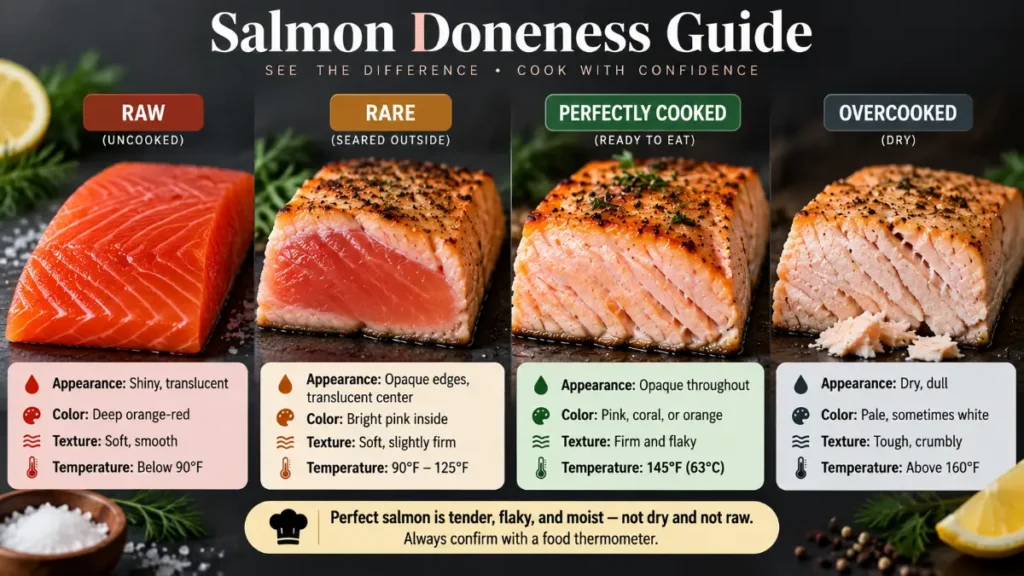
3. Raw vs. Cooked vs. Overcooked Salmon: Comparison Chart
The following chart explains the most common visual and textural differences.
Salmon doneness comparison
Glossy and translucent
Soft flesh with a relatively smooth appearance. Natural layers may resist separation.
Opaque edges, translucent center
The exterior has changed appearance while the middle may need more cooking.
Opaque and flaky
Pink or orange flesh with distinct, tender muscle layers. Confirm the temperature before serving.
Dry and crumbly
Often pale, tough, or excessively firm, with flakes that break apart easily.
Illustrative image references only. Different salmon species, lighting, and cooking methods affect appearance. These photographs are not validated temperature examples.
Read More: Ocular Migraine
Detailed comparison table
| Feature | Raw | Properly cooked | Overcooked |
| Color | Often deeper pink or orange | Pink, coral, or orange | Sometimes pale |
| Appearance | Glossy, translucent | Generally opaque | Opaque, often dry |
| Texture | Soft, slippery | Firm, tender | Tough, crumbly |
| Flaking | Often resists | Separates easily | May break apart excessively |
| Moisture | Slick appearance | Moist | Often dry |
| Temperature | Not verified | Confirm 145°F | May exceed desired endpoint |
These are general appearance descriptions, not exact temperature categories.
Both properly cooked and overcooked salmon can appear opaque.
4. Cooked Salmon Color: Should It Be Pink, Orange, or White?
There is no universal color that every salmon fillet must reach.
Natural pigmentation differs between species, and diet also influences flesh color.
For example, sockeye salmon typically has a deeper reddish appearance than pink salmon.
Salmon color by variety
| Salmon variety | Typical natural flesh color |
| Sockeye | Deep red or reddish-orange |
| Atlantic | Pink to reddish-orange |
| Coho | Orange-red |
| Pink salmon | Pale pink |
| King/Chinook | Variable pink-to-orange shades |
These colors are general tendencies rather than doneness indicators.
A darker salmon variety may retain stronger pigmentation after cooking.
Likewise, a pale fillet is not necessarily more thoroughly cooked.
Does a golden crust mean salmon is done?
No.
Pan-searing and grilling can produce browned surfaces before the center reaches the recommended temperature.
Seasonings may also change the exterior’s color.
Paprika can create a redder surface, while direct heat can produce golden or brown patches.
Check the center rather than relying on the crust.
5. Salmon Doneness Chart: Appearance, Texture, and Temperature
Salmon changes gradually during cooking. The following chart helps you understand those changes without assigning misleading temperature ranges to visual stages.
| Cooking stage | Typical appearance | Recommended action |
| Raw | Glossy and translucent | Begin cooking |
| Partially cooked | Opaque edges, translucent center | Continue cooking |
| Approaching doneness | Increasing opacity and flaking | Check temperature |
| Recommended endpoint | Thickest section reaches 145°F | Remove from heat |
| Overcooked | Often dry, tough, or crumbly | Avoid further unnecessary cooking |
Is medium-rare salmon the same as fully cooked salmon?
No.
Medium-rare is a culinary description, while 145°F is the recommended U.S. home-cooking temperature for finfish.
Some restaurants serve salmon at lower temperatures for a softer texture. Those preparations should not be confused with meeting the recommended temperature.
Raw or undercooked seafood presents particular concerns for pregnant people, children, older adults, and people with weakened immune systems.
6. How to Check Salmon Doneness With a Food Thermometer
An instant-read food thermometer helps determine whether the center has reached the recommended temperature.
This is especially useful when preparing thick fillets or portions with uneven shapes.
Find the thickest section
Identify the deepest part of the fillet. Avoid using the thin tail end as your only measurement point.
Insert the probe correctly
Position the sensing area in the center. For thin fillets, insert the probe horizontally through the side.
Wait for the reading
Allow the thermometer to stabilize according to its manufacturer’s instructions.
Confirm the target temperature
Check for 145°F (63°C). If the reading is lower, continue cooking and test again.
Remove the salmon from the heat
Once the thickest section reaches the recommended temperature, stop cooking to limit additional moisture loss.
USDA thermometer guidance recommends measuring the thickest portion or center of fish.
Can salmon finish cooking while resting?
Salmon may continue warming after removal from the heat, but the amount of temperature increase varies.
Do not assume that resting will bring an under-temperature fillet to the recommended minimum.
Verify the final temperature instead.
What if you do not have a thermometer?
The FDA provides visual guidance for fish: look for opaque flesh that separates easily with a fork.
Examine the thickest part and gently twist a clean fork into the flesh.
These observations can help assess doneness, but they are less dependable than measuring the internal temperature.
7. What Does Undercooked Salmon Look Like?
Undercooked salmon may have a distinctly glassy or translucent center.
The exterior may look finished, especially when cooked over high heat.
Common clues include:
- A shiny, raw-looking middle.
- Opaque edges surrounding a translucent center.
- Flesh that resists separating into flakes.
- An internal temperature below the recommended 145°F.
These characteristics are reasons to check the fish more carefully, not definitive safety tests.
What if the outside is cooked but the middle is raw?
Reduce the heat and continue cooking more gently.
For pan-seared salmon, lower the burner temperature. For grilled salmon, move the fillet away from the hottest section.
For baked salmon, return the fish to the oven and check again.
Avoid serving the fillet solely because its surface looks finished.
8. What Does Overcooked Salmon Look Like?
Overcooked salmon often appears noticeably drier than properly cooked fish.
Its flesh may become pale, tough, rubbery, or crumbly.
The natural layers may break into small pieces instead of separating into tender flakes.
Common signs of overcooking
- Dry or shrunken edges.
- Excessively firm flesh.
- Chalky interior.
- Crumbly flakes.
- Noticeable moisture loss.
These characteristics are not universal. Naturally lean salmon can appear drier than fattier varieties even when prepared correctly.
Can you fix dry salmon?
You cannot completely reverse the texture changes caused by excessive cooking.
However, you can improve the eating experience by adding moisture through other ingredients.
Try serving dry salmon with lemon butter, yogurt sauce, or a light dressing.
You can also flake it into pasta, rice bowls, or salads.
Avoid unnecessary reheating, which can make the texture even drier.
9. White Stuff on Cooked Salmon: Is It Normal?
You may notice white patches or streaks appearing on the surface of salmon during cooking.
This substance is usually albumin, a naturally occurring protein.
As the fish heats, protein-containing liquid can move toward the surface and solidify into visible white material.
Albumin itself is harmless to eat.
Does albumin mean salmon is overcooked?
Not necessarily.
Albumin can appear even when salmon is properly cooked.
Larger amounts may accompany prolonged cooking or greater moisture loss, but they do not establish that the fish is overcooked.
The presence of albumin also does not confirm that the center has reached a safe temperature.
Can you reduce albumin?
You may reduce its appearance by using controlled heat and avoiding unnecessary cooking.
Gentler methods, such as poaching or moderate-temperature baking, can also help.
If albumin appears, you can remove it gently with a clean utensil before serving.
There is no reason to discard otherwise safe salmon solely because this protein is visible.
10. Does Salmon Look Different When Baked, Grilled, or Pan-Seared?
Cooking methods affect the exterior, so salmon does not always look identical when prepared in different ways.
The recommended internal temperature remains the same.
Often relatively evenly colored, with pink or orange flesh and light surface browning.
Check the thickest section because the exterior may finish first.
May develop a golden crust and crisp skin.
Browning indicates surface cooking, not necessarily internal doneness.
Often develops dark grill marks and browned areas.
Move the fish to a cooler section if the exterior browns too quickly.
Usually appears paler because it cooks in liquid without developing a browned crust.
Verify the temperature despite the absence of surface browning.
May develop browned edges and a lightly crisp exterior.
Watch thinner sections because they can dry out before thicker portions finish.
Why does cooking time vary?
Cooking time depends on several factors, including fillet thickness, starting temperature, equipment, and cooking method.
A thin tail section usually cooks faster than a thick center-cut portion.
Frozen salmon may also require a different cooking time than thawed fish.
Use recipe times as estimates rather than guarantees.
11. Common Salmon Cooking Problems and Solutions
Even experienced home cooks occasionally encounter unevenly cooked fish.
This table explains what may be happening and what to do next.
| Problem | Possible cause | Solution |
| Brown outside, translucent center | High heat or thick fillet | Reduce heat and continue cooking |
| Dry, crumbly flesh | Excessive cooking | Avoid additional heating once safely cooked |
| Thin end cooks first | Uneven thickness | Check thick sections separately |
| Flesh resists flaking | Possibly incomplete cooking | Check temperature |
| White material appears | Albumin release | Remove if desired |
| Pink center causes uncertainty | Natural color or incomplete cooking | Verify temperature |
| Fish looks finished early | Surface cooks faster | Check thickest section |
Should you rely on a fixed cooking time?
No.
A recipe’s timing is useful for planning, but it cannot account perfectly for every fillet and cooking appliance.
If the fish looks finished before the expected time, check its temperature.
If the suggested cooking time has elapsed but the center remains below the recommended temperature, continue cooking.
12. Food Safety: Storage, Spoilage, and Leftovers
Knowing when salmon is cooked is only one part of preparing a safe meal.
Proper storage and handling are equally important.
Store fresh salmon correctly
According to the FDA, seafood intended for use within two days of purchase should be refrigerated at 40°F (4°C) or below. Otherwise, it should be frozen.
Keep raw salmon separate from ready-to-eat foods.
Wash hands, cutting boards, utensils, and preparation surfaces after contact with raw fish.
Thaw frozen salmon safely
The refrigerator is a convenient option for gradual thawing.
For faster thawing, use a sealed bag immersed in cold water, or microwave defrosting if the fish will be cooked immediately afterward.
Never thaw salmon on the kitchen counter.
Know when to discard suspicious fish
Fresh seafood should generally have a mild smell.
Sour, rancid, or ammonia-like odors are warning signs.
The FDA advises against eating seafood with these concerning odors.
However, harmful microorganisms do not always produce noticeable smells or visual changes.
If fish has been stored improperly, do not assume that cooking will make it safe.
Refrigerate cooked salmon promptly
Salmon storage quick reference
Refrigerator temperature
40°F or below
Refrigerate within
2 hours
If above 90°F outdoors
Within 1 hour
Refrigerated leftovers
3–4 days
Leftover reheating temperature
165°F
U.S. government food-safety guidance.
Use shallow, covered containers to cool leftovers quickly.
Do not place cooked salmon on a plate that previously held raw fish unless it has been thoroughly washed.
13. A Quick Decision Guide: Is Your Salmon Ready?
Use this table when you’re standing at the stove and need a practical answer.
| What you notice | What to do |
| Opaque edges, translucent center | Check temperature and continue cooking if needed |
| Opaque center but below 145°F | Continue cooking under standard U.S. guidance |
| Thickest section reaches 145°F | Remove from heat |
| White albumin appears | Check temperature separately |
| Fish is dry and crumbly | Avoid further cooking once safely cooked |
| Sour or ammonia-like smell | Do not eat |
A thermometer is more useful than trying to match the exact color of a photograph.
14. Final Salmon Doneness Checklist
Before serving, use this checklist to confirm that you’ve covered both cooking and safe handling.
Before you serve
0 of 5
I checked the thickest section of the fillet.
The internal temperature reached 145°F (63°C).
The interior generally looks opaque rather than glassy.
The flesh separates easily into flakes.
The salmon was stored and handled safely.
Temperature is the key doneness measurement. Safe storage and handling must also be confirmed. Reset checklist
15. Frequently Asked Questions
What is the center of cooked salmon like?
In contrast, cooked salmon becomes a solidified pink, coral or orange hue and separates easily. The center should not have any very raw or clear glass areas. Ensure the thickest part hits 145°F (63°C).
Is salmon in the middle of It supposed to be pink when fully cooked?
Yes. Salmon is able to keep its pink or orange pigments even when it has been cooked. Not everything pink is undercooked. Forget the color and looks, do not rely on that rather check its internal temperature.
When is salmon undercooked?
A glossy, translucent center or flesh that doesn’t flake easily would very likely indicate undercooking. However, appearance is not definitive. If it is below this, keep cooking until the pork reaches 145°F – as is recommended.
Does salmon need to be almost mushy?
It will feel more or less firm most of the time, yet give. It has a flake to it but does not fall apart and is resilient without being mushy or rubberbandish. Texture assesses eating quality but is not a true food safety indicator.
For the best cooked salmon results, does it turn white when done cooking?
No, Instead of losing some its natural pink or orange hue with cooking salmon do have a more dramatic visual change from opaque to translucent skin.
Can you tell salmon done by looking?
An opaque flesh itself and scales which can flake off with a minor effort would be both of large indicative importance. However, there is no way visually to tell how hot things are on the inside. A better check is with a food thermometer.
You may observe a whitish film of protein on the side or top surface?.
Yes. The whitish substance is typically albumin, a benign protein that appears during the cooking of this dish. Just because you can see it, does not mean that the food has ruined or overcooked.
The outside is cooked, but the inside isn’t – what am I doing wrong with my salmon?
The outer layers are the first that heat up, not the center. That difference is much more clear at high heat, or with a particularly over thick fillet. If excessively hot, turn it down and start cooking on the thickest section of your piece.
At what temperature is salmon done cooking?
Both the FDA and USDA recommend cooking salmon to an internal temperature of 145°F (63°C). Measure the thickest part with a food thermometer.
How long should salmon cook?
No, of course not a universal answer or US cooking time. How fast cooking times salmon depends on factors like your thickness of the fillet, starting temperature and method used to cook. All the rest of it, follow your broad time frame for cooking but use the internal temp to know when its done
.
.