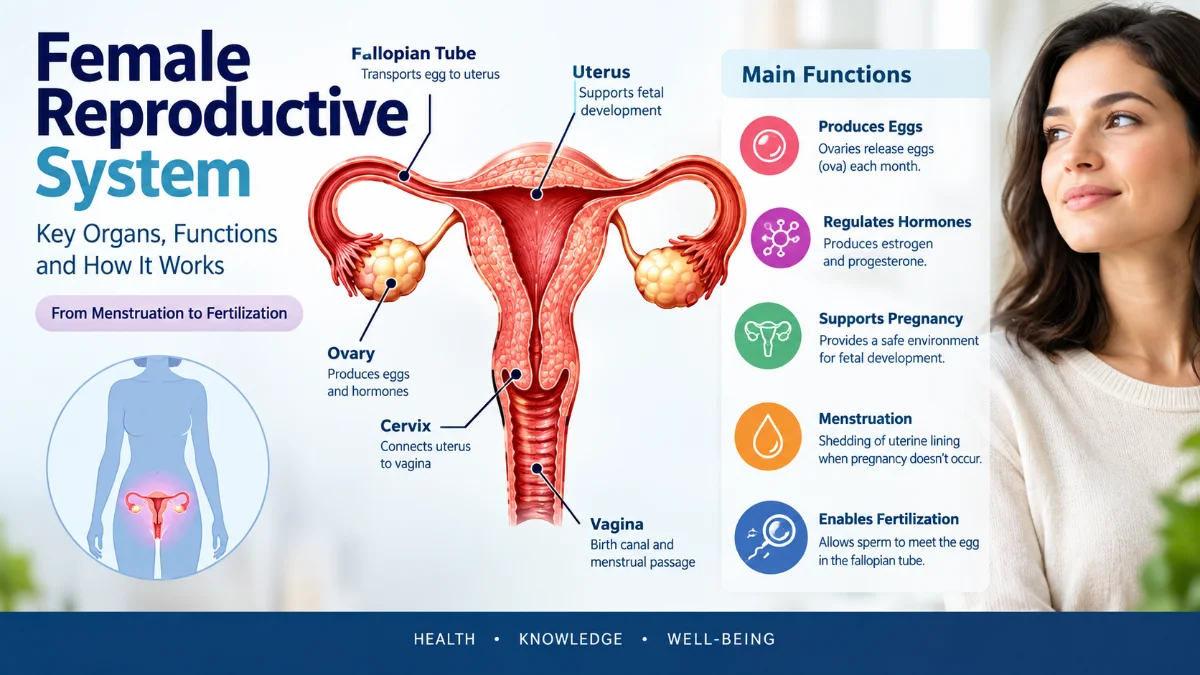
The female reproductive system performs several interconnected functions, including egg development, hormone production, menstruation, sexual function, fertilization, pregnancy, and childbirth.
These processes require coordination between the brain, ovaries, fallopian tubes, uterus, cervix, and vagina. Each organ has a specialized role, while hormones regulate the timing and sequence of reproductive events.
For example, the ovaries develop and release eggs, the fallopian tubes provide the usual site of fertilization, and the uterus supports implantation and pregnancy.
However, reproduction is not the system’s only purpose. Its hormones influence multiple body functions, and its external structures contribute to protection and sexual sensation.
This guide explains the major female reproductive system functions, how hormones control reproductive activity, what happens during the menstrual cycle, and how the body supports pregnancy and childbirth.
What Are the Main Functions of the Female Reproductive System?
The female reproductive system performs several biological functions that work together throughout the reproductive years.
| Function | Biological process | Main organs involved |
| Egg development | Immature eggs develop within ovarian follicles | Ovaries |
| Hormone production | Estrogen and progesterone are produced | Ovaries |
| Ovulation | An ovarian follicle releases an egg | Ovaries |
| Menstruation | The uterine lining sheds when pregnancy does not occur | Uterus |
| Fertilization | Sperm and egg unite | Usually fallopian tubes |
| Pregnancy | Implantation and fetal development occur | Uterus |
| Childbirth | Contractions and cervical dilation facilitate delivery | Uterus, cervix, vagina |
These functions are coordinated through hormonal signals and the activity of specialized reproductive tissues.
1. Egg Development and Ovarian Function
Egg development begins before birth.
During fetal development, the ovaries establish a population of immature egg cells, known as oocytes. These cells remain within ovarian follicles until they either develop further or undergo natural degeneration.
The number of remaining eggs generally declines with age.
During reproductive adulthood, follicle-stimulating hormone encourages a group of ovarian follicles to develop during each menstrual cycle.
Usually, one follicle becomes dominant and continues developing toward ovulation.
The dominant follicle contains an egg that undergoes further maturation before release.
Although a typical ovulatory cycle releases one egg, multiple eggs can occasionally be released.
The ovaries therefore perform two essential reproductive tasks: supporting egg development and producing hormones that regulate the menstrual cycle.
2. How the Brain Controls Reproductive Functions
Reproductive activity depends on communication between the hypothalamus, pituitary gland, and ovaries.
This communication network is called the hypothalamic-pituitary-ovarian axis.
Hormonal regulation pathway
Hypothalamus
Releases GnRH
Pituitary gland
Releases FSH and LH
Ovaries
Develop follicles and produce hormones
Uterus
Responds to estrogen and progesterone
Simplified pathway; ovarian hormones also provide feedback to the hypothalamus and pituitary gland.
The hypothalamus releases gonadotropin-releasing hormone, or GnRH.
GnRH stimulates the pituitary gland to release follicle-stimulating hormone and luteinizing hormone.
These hormones act on the ovaries, influencing follicular development, ovulation, and ovarian hormone production.
Estrogen and progesterone subsequently affect the uterus and provide feedback to the brain.
This hormonal communication coordinates the menstrual cycle.
3. Reproductive Hormone Production
Hormones are chemical messengers that regulate reproductive activity.
Four hormones are particularly important.
Estrogen
Estrogen supports reproductive tissue development and stimulates the uterine lining to grow during the follicular phase.
It also influences bone health and other physiological processes.
Progesterone
Progesterone becomes particularly important after ovulation.
It prepares the uterine lining for possible implantation and contributes to maintaining early pregnancy.
Follicle-stimulating hormone (FSH)
FSH encourages ovarian follicles to grow and supports egg development.
Luteinizing hormone (LH)
A surge in LH triggers ovulation.
LH also supports the formation and function of the corpus luteum, a temporary hormone-producing structure.
| Hormone | Primary reproductive role |
| Estrogen | Endometrial growth and reproductive tissue regulation |
| Progesterone | Endometrial preparation and pregnancy support |
| FSH | Ovarian follicle development |
| LH | Ovulation and corpus luteum formation |
These hormones interact rather than operating independently.
Read More: How to Eat Coconut Cult
4. How Ovulation Works
Ovulation is the release of an egg from an ovarian follicle.
It is a central event in the menstrual cycle because it makes an egg available for potential fertilization.
The process follows several stages.
First, FSH stimulates follicular development.
As the dominant follicle grows, it produces increasing amounts of estrogen.
Sustained high estrogen levels eventually trigger a surge in luteinizing hormone.
The LH surge causes the dominant follicle to rupture and release its egg.
Finger-like structures called fimbriae help guide the released egg into the fallopian tube.
After ovulation, an egg generally remains capable of fertilization for approximately 12–24 hours.
Ovulation does not always occur on day 14. Its timing depends on cycle length and individual hormonal patterns.
Some menstrual cycles are anovulatory, meaning no egg is released.
5. How the Menstrual Cycle Works
The menstrual cycle prepares the reproductive system for possible pregnancy.
It is counted from the first day of menstrual bleeding to the first day of the next period.
The American College of Obstetricians and Gynecologists describes 21–35 days as the typical adult cycle range. Adolescent cycles may be longer and more variable.
The cycle involves four commonly described stages.
Menstrual phase
The menstrual phase begins when the uterine lining sheds.
This occurs when pregnancy has not been established and estrogen and progesterone levels decline.
Menstrual blood and tissue leave the uterus through the cervix and vagina.
Follicular phase
The follicular phase begins on the first day of menstruation and continues until ovulation.
FSH stimulates follicular development, while increasing estrogen encourages the endometrium to rebuild.
The menstrual and follicular phases overlap.
Ovulation
An LH surge triggers egg release.
The egg enters the fallopian tube, where fertilization may occur.
Luteal phase
Following ovulation, the ruptured follicle develops into the corpus luteum.
This structure produces progesterone and some estrogen.
Progesterone helps prepare the endometrium for implantation.
If pregnancy does not occur, the corpus luteum regresses, hormone levels decline, and menstruation begins again.
6. How the Fallopian Tubes Transport an Egg
The fallopian tubes provide the pathway between the region surrounding the ovaries and the uterine cavity.
Following ovulation, the fimbriae help capture the egg.
Tiny hair-like structures called cilia and muscular contractions assist movement through the tube.
The egg may encounter sperm during this journey.
Fertilization usually occurs in the ampulla, a wider portion of the fallopian tube.
If fertilization occurs, the early embryo continues moving toward the uterus while undergoing cell division.
Normal tubal function is important for natural conception.
Damage or obstruction may interfere with egg transport and increase the risk of certain reproductive complications.
7. How Fertilization Occurs
Fertilization is the process through which a sperm cell and an egg combine.
Following intercourse involving sperm deposition, sperm may travel through the cervix, uterus, and fallopian tubes.
If an egg is present, a sperm may penetrate its protective outer layers.
The genetic material from the two cells combines, forming a zygote.
The zygote contains genetic contributions from both gametes.
It subsequently undergoes repeated cell divisions while traveling toward the uterus.
After several days, the developing embryo may reach the blastocyst stage.
Fertilization and implantation are distinct events. Fertilization alone does not establish an ongoing pregnancy.
8. Implantation and Early Pregnancy
Implantation occurs when a blastocyst attaches to and embeds within the endometrium.
The uterine lining undergoes hormonal changes during the luteal phase that help prepare it for this process.
Following implantation, developing placental tissue produces human chorionic gonadotropin, or hCG.
This hormone helps maintain the corpus luteum during early pregnancy.
The corpus luteum continues producing progesterone until the placenta progressively assumes a major role in hormone production.
The uterus provides the environment in which the embryo can develop.
Successful implantation is an important step in establishing pregnancy.
9. How the Reproductive System Supports Pregnancy
Pregnancy requires substantial hormonal and anatomical adaptation.
The uterus expands as fetal development progresses.
Its muscular wall accommodates growth, while the cervix helps maintain the pregnancy.
The placenta develops as a specialized organ that supports exchange between maternal and fetal circulation.
It facilitates the transfer of oxygen and nutrients and the removal of metabolic waste.
Pregnancy hormones influence the uterus, breasts, cardiovascular system, and other body systems.
Normal ovulatory cycling generally stops during pregnancy.
The reproductive system therefore shifts from preparing for pregnancy to supporting an established pregnancy.
10. Role in Labor and Childbirth
Childbirth involves coordinated uterine contractions and changes in the cervix.
During labor, contractions help the cervix soften, thin, and dilate.
As labor progresses, uterine contractions help move the fetus through the birth canal during vaginal delivery.
Following delivery, continued uterine contractions help separate the placenta and reduce bleeding.
Not every birth occurs vaginally.
Cesarean delivery involves surgical delivery through incisions in the abdomen and uterus.
The uterus plays a central role in pregnancy and delivery regardless of the method of birth.
11. Sexual Function and Reproductive Anatomy
The reproductive system also contributes to sexual sensation and activity.
The clitoris contains extensive sensory and erectile tissue and plays an important role in sexual pleasure.
During sexual arousal, increased blood flow affects genital tissues.
The vagina may undergo lubrication and other physiological changes.
Sexual responses vary between individuals.
Sexual function and reproductive capacity are distinct. Fertility is not a measure of sexual health or personal well-being.
12. How Reproductive Functions Change With Age
Reproductive physiology changes throughout life.
During puberty, hormonal activation stimulates ovarian activity and the development of secondary sexual characteristics.
Menstrual cycles may initially be irregular as hormonal regulation matures.
During reproductive adulthood, ovulation and menstrual cycles generally continue, although patterns vary.
With increasing reproductive age, ovarian reserve and egg quality generally decline.
During perimenopause, hormone production becomes more variable and menstrual patterns may change.
Menopause marks the permanent end of natural menstrual periods and ovulatory cycles.
These transitions reflect changes in ovarian and endocrine activity.
13. What Can Affect Reproductive Function?
Several factors may interfere with normal reproductive processes.
Hormonal disorders affecting the thyroid, pituitary gland, hypothalamus, or ovaries may disrupt menstrual regulation.
Polycystic ovary syndrome can interfere with regular ovulation.
Endometriosis may cause pelvic pain and contribute to fertility difficulties.
Reproductive tract infections can sometimes damage reproductive structures if untreated.
Significant nutritional changes, excessive exercise, stress, and chronic medical conditions may also influence menstrual patterns.
However, symptoms should not automatically be attributed to lifestyle factors without appropriate medical evaluation.
For further information about these conditions, see the companion guide to female reproductive system health.
Frequently Asked Questions
What are the main functions of the ovaries?
The ovaries support egg development, release eggs during ovulation, and produce estrogen and progesterone.
What is the role of the uterus in reproduction?
The uterus supports implantation and provides the environment for embryo and fetal development during pregnancy.
What causes ovulation?
A surge in luteinizing hormone triggers the release of an egg from a mature ovarian follicle.
Can menstruation occur without ovulation?
Yes. Anovulatory bleeding can occur when ovulation does not take place.
Where does fertilization usually occur?
Fertilization usually occurs in the ampulla of a fallopian tube.
What is the role of hormones in the menstrual cycle?
Hormones coordinate follicular development, ovulation, uterine lining changes, and menstruation.
How long can an egg survive after ovulation?
An egg generally remains capable of fertilization for approximately 12–24 hours.
What happens to reproductive hormones during menopause?
Ovarian estrogen and progesterone production generally decline, while FSH levels typically increase.