First Aid Box Items A family home first aid kit may suffice for an international traveller, a remote area camper or employees in an industrial setting.
While they all have the same purpose, each first aid kit should contain slightly different items based on where it will typically be.
A household kit, for instance, might cover common minor injuries and health needs of your family.
A travel kit must consider the destination, medical service availability, and personal medication needs.
For a kit in the workplace, it needs to be aligned with occupational hazards and relevant legal requirements.
Thus, choosing the first aid box materials is determined through the identification of who needs care and what types of injuries are possible and what assistance others could provide during a crisis.
Plan: Health kits should be customized according to destination and activities, trip duration, medical access/traveling with a group of people and expertise available. The 2026 Yellow Books written by CDC emphasize on such customization [4].
In this guide, we compare first-aid supplies across a number of environments and provide you with practical information on kit design.
What Must Be Inside a Basic First Aid Kit?
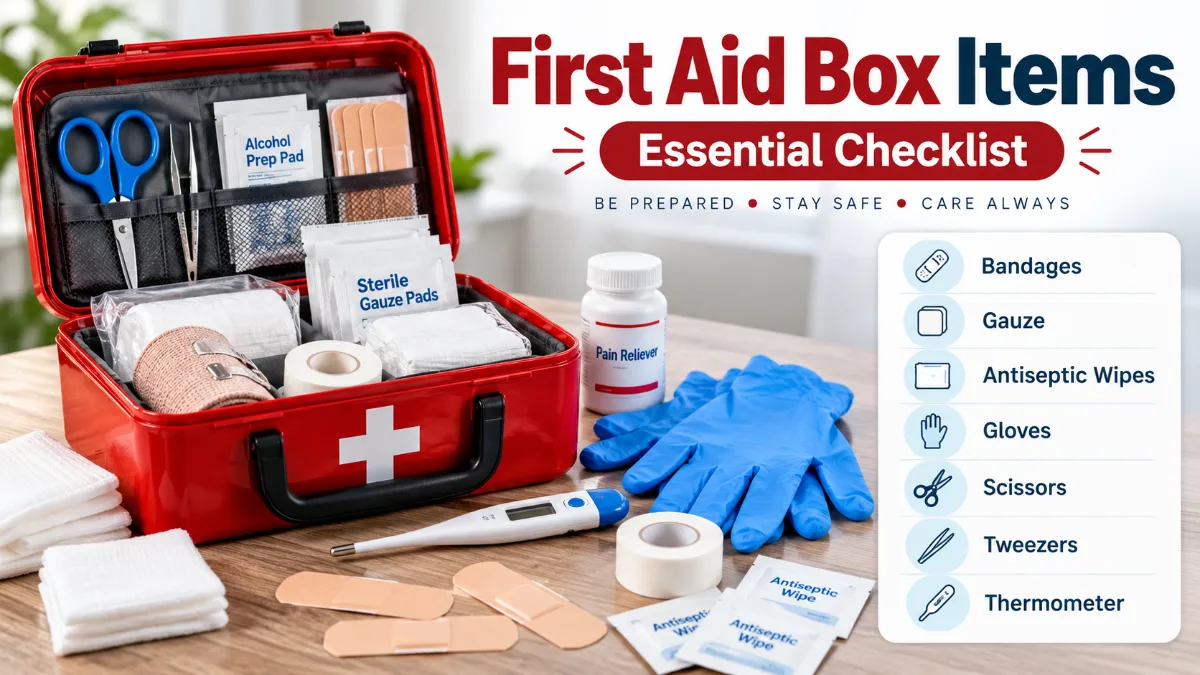
You need a general first aid kit to have wound-care supplies, protective equipment and basic instructions.
Supply
Purpose
Adhesive bandages
Cover minor wounds.
Sterile gauze
Cover wounds and absorb fluids.
Absorbent dressings
Assist with bleeding control.
Medical tape
Secure dressings.
Disposable gloves
Reduce exposure to bodily fluids.
Tweezers
Remove accessible superficial splinters.
First aid instructions
Provide basic guidance.
Emergency information
Support communication.
Emergency blanket
Provide temporary insulation.
This list serves as a generalized foundation and is not meant to be used in place of a personalized evaluation.
First Aid Box Items for Home
Your home kit would be individualised by number of people living in the household, their ages and medical needs.
Basic wound-care supplies
Great investigation to station various sticking band-aids, clean wrap dressing pads, permeable upgrades and medicinal tape.
Various minor wounds fits different sizes.
Protective equipment
Keep nonlatex disposable gloves accessible.
When a person is trained in rescue breathing, CPR breathing barrier may be appropriate.
Additional equipment
Basically, form a set up of assertive tools for medical conditions like thermometer, tweezers and blunt-tip scissors, etc.
Personal medical supplies
Individualized treatment and storage directions for prescribed emergency medication need to be followed by individuals with such medication.
You donot qualify for every medical condition just coz you have a generic household kit.
Emergency details
Include emergency contacts, information relevant to hospitals and a personal emergency plan.
Store sensitive information appropriately.
First Aid Box Items for Travel
Travel presents different challenges because medical supplies may not be readily available.
A travel kit should remain portable while covering foreseeable needs.
The CDC recommends personalizing the contents of travel health kits rather than applying one universal checklist.
Wound-care materials
Pack adhesive bandages, sterile gauze, medical tape and nonlatex gloves.
Consider waterproof packaging when traveling outdoors.
Personal prescriptions
Travelers who use prescribed medication should plan an adequate supply and check the destination’s medication restrictions.
Keep medicines in their original labeled packaging.
Preventive supplies
Depending on the itinerary, sunscreen, insect repellent and oral rehydration products may be useful.
These are additional travel health items rather than basic wound-care equipment.
Travel documents
Carry essential medical information, emergency contacts and relevant insurance details.
Keep documents secure.
First Aid Box Items for Cars
A vehicle kit can provide basic supplies during road trips.
Useful items include bandages, gauze, gloves, absorbent dressings, emergency instructions and an emergency blanket.
A flashlight and other roadside equipment can be stored separately as part of a broader vehicle emergency kit.
Important storage precautions
Cars can experience extreme temperatures.
Medication and some medical products may be damaged by excessive heat or cold.
Always follow product-specific storage instructions.
The FDA advises that improper storage conditions can reduce the effectiveness of certain medicines, even before their expiration dates.
Roadside safety
Do not put yourself in danger from passing traffic while helping someone.
Contact emergency services for serious injuries.
A first aid kit cannot replace professional rescue equipment.
First Aid Box Items for Hiking and Camping
Outdoor activities may involve blisters, minor cuts, sprains, insect bites and delayed access to medical care.
A hiking kit may require additional wound dressings, blister-care materials, personal medication and an emergency blanket.
Short day hikes
For a short walk close to populated areas, a compact kit may be practical.
Consider the weather, terrain and availability of communication.
Overnight camping
Longer trips may justify additional wound-care supplies, suitable storage containers and individualized medication arrangements.
Remote expeditions
Remote trips require more extensive preparation.
Consider emergency communication, evacuation arrangements, group size and medical expertise.
The CDC distinguishes basic personal travel kits from expanded kits used by remote groups, which may include equipment carried by licensed medical professionals.
Specialized medical equipment should only be used by appropriately trained personnel.
Workplace First Aid Box Items
Workplace first aid requirements depend on the location, industry and specific occupational hazards.
An office has different risks from a construction site or manufacturing facility.
Employers should consider the number of workers, potential injuries, medical access and applicable regulations.
Office environments
An office may need basic wound-care materials, gloves, medical tape and first aid instructions.
Commercial kitchens
Commercial kitchens may have risks involving hot equipment and sharp tools.
First aid planning should address burns, cuts, employee training and access to appropriate emergency assistance.
Industrial environments
Industrial facilities may require additional supplies, trained responders and specialized emergency arrangements.
Where workers may be exposed to injurious corrosive materials, suitable emergency flushing facilities may be required under applicable OSHA standards.
Does OSHA Require a Specific First Aid Kit?
OSHA’s general-industry standard requires adequate first aid supplies to be readily available in the circumstances covered by the regulation.
Its nonmandatory Appendix A explains that larger worksites or unusual workplace hazards may require additional equipment, supplies and kits.
Therefore, a retail kit advertised as “OSHA compliant” should not automatically be assumed to satisfy every employer’s obligations.
Employers should consider applicable state laws, industry-specific requirements and workplace assessments.
Compare First Aid Kits by Environment
| Environment | Main consideration | Potential additions |
| Home | Household medical needs | Personal emergency information |
| Travel | Destination and medical access | Prescription documentation |
| Car | Portability and temperature | Emergency blanket |
| Camping | Remoteness and activities | Blister-care supplies |
| Workplace | Hazards and regulations | Assessment-specific equipment |
The correct combination depends on the intended use.
Read More: Ocular Migraine
Ready-Made vs Homemade First Aid Kits
Ready-made kits offer convenience, but their contents may not match every person’s needs.
Homemade kits provide flexibility but require additional planning.
| Factor | Ready-made kit | Homemade kit |
| Convenience | Preassembled | Requires preparation |
| Customization | Varies | Flexible |
| Inventory | Must be checked | Must be created |
| Personal medication | Usually separate | Individually planned |
| Maintenance | Required | Required |
Choose a kit according to its actual supplies and intended purpose rather than advertising claims.
How to Choose the Right Kit Size
Consider four factors:
- Number of people who may require assistance.
- Likely injuries and activity-related hazards.
- Availability of medical services.
- Individual prescriptions and health requirements.
A larger group may require more supplies, while remote locations may justify additional preparation.
How to Maintain Several First Aid Kits
If you maintain separate home, travel and workplace kits, create an inventory for each location.
Inspect supplies before trips, after use and at appropriate regular intervals.
Check packaging, quantities, expiration dates and reusable equipment.
Workplace inspection arrangements should reflect the employer’s responsibilities.
When Should You Call Emergency Services?
Seek emergency assistance for life-threatening bleeding, unconsciousness, serious breathing difficulties or other critical symptoms.
Provide assistance within your training and follow emergency instructions.
Never delay professional treatment while searching for supplies.
Frequently Asked Questions
1. Are home and travel first aid kits the same?
They contain similar basic supplies, but travel kits should reflect destination-specific needs.
2. Contents of a car first aid kit
They are a suggestive background on materials: bandages, gauze and gloves together with dressings and emergency information.
3. What belongs in a camping kit?
Include wound-care materials, blister supplies and additional equipment appropriate to the trip.
4. Do workplaces need first aid supplies?
Yes. Workplace arrangements must comply with applicable safety requirements.
5. Is every commercial kit OSHA compliant?
No universal kit is suitable for every workplace. Requirements depend on circumstances and hazards.
6. Should travelers carry prescription medicines?
Travelers who need prescribed medicines should plan their supplies and check destination restrictions.
7. Can medication remain in a car?
Only when its storage requirements can be maintained. Extreme temperatures may be unsuitable.
8. Is a ready-made kit better?
Not necessarily. Compare the contents and suitability of different options.
9. How frequently should a travel kit be inspected?
Check it before departure, after use and whenever supplies may require replacement.
10. Can a first aid kit replace emergency medical services?
No. Serious injuries require appropriate professional treatment.