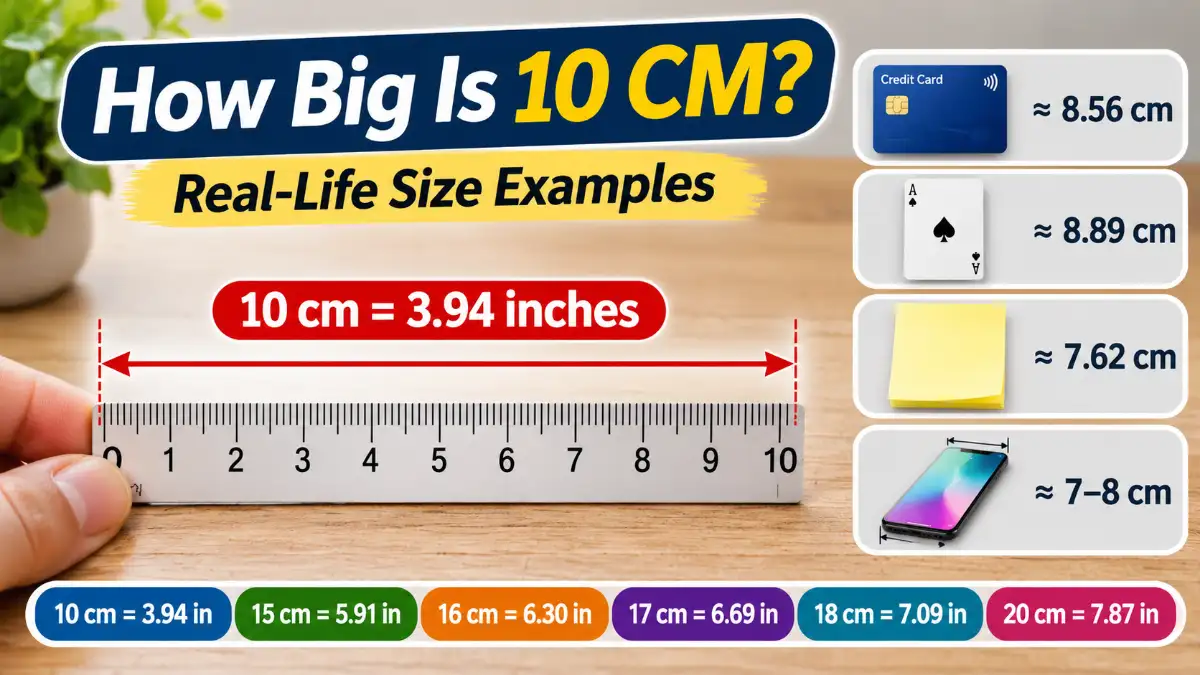
How big is 10 cm? Ten centimeters is equal to 3.94 inches, 100 millimeters, or 0.1 meters. It’s almost the same length as 4 inches on a ruler. A useful real-world comparison is a standard credit card, which measures approximately 8.56 cm long. Ten centimeters extends about 1.44 cm beyond that length.
If you’re shopping online, measuring something at home, or completing a school project, understanding centimeters can help you make accurate size comparisons.
Although 10 cm may seem like a small measurement, its actual size becomes easier to recognize when compared with everyday objects. You can also use the same approach to understand larger measurements, including 15, 16, 17, 18, and 20 centimeters.
What Does 10 CM Look Like in Real Life?
Ten centimeters represents a relatively short distance, but it can describe the length, width, height, or diameter of different objects.
For example, a product advertised as 10 cm wide measures just under 4 inches from one side to the other.
Illustration of a 10 cm metric ruler, with each centimeter divided into 10 millimeters.
The easiest way to understand this distance is to compare it with objects whose dimensions are already familiar.
6 Simple Ways to Visualize 10 CM
1. Compare It With a Credit Card
Standard credit and debit cards follow internationally recognized dimensions.
A typical card measures approximately 8.56 cm long and 5.4 cm wide.
Ten centimeters is slightly longer than the card’s longest side, making it a convenient size reference.
2. Look at a Four-Inch Measurement
Four inches equals 10.16 cm.
This means 10 cm is almost identical to 4 inches, with a difference of only 1.6 millimeters.
If you have a ruler with inch markings, find the 4-inch line and move slightly backward to estimate 10 cm.
3. Use a Standard Playing Card
A standard poker-sized playing card measures approximately 8.89 cm long.
Ten centimeters extends about 1.11 cm beyond its longest edge.
This comparison is especially useful for estimating small household items.
4. Compare It With a Sticky Note
A common square sticky note measures 3 inches on each side, equivalent to 7.62 cm.
A 10 cm line is approximately 2.38 cm longer than one side.
You can use this comparison to estimate the dimensions of small stationery products.
5. Imagine a Small Decorative Pot
Some small plant pots have an opening approximately 10 cm in diameter.
Looking across the top of such a pot provides a useful reference for the width of a 10 cm object.
Pot sizes are not standardized, so check the actual dimensions when precision matters.
6. Use Two Five-Centimeter Sections
One of the simplest ways to understand 10 cm is to divide it into two equal parts.
Each part measures 5 cm, equivalent to approximately 1.97 inches.
Together, they create a total length of 10 cm.
How Big Is 10 CM in Different Measurement Units?
Centimeters belong to the metric system, which uses powers of ten to organize measurements.
The following table shows the equivalent values.
| Unit | 10 CM Equivalent |
| Inches | 3.94 inches |
| Millimeters | 100 mm |
| Meters | 0.10 m |
| Feet | 0.328 ft |
| Yards | 0.109 yd |
| Micrometers | 100,000 µm |
The basic conversion formula is:
Inches=Centimeters2.54
For example:
102.54=3.937
Rounded to two decimal places, the result is 3.94 inches.
This formula works for converting other centimeter measurements into inches.
How Big Is 15 CM Compared to Everyday Objects?
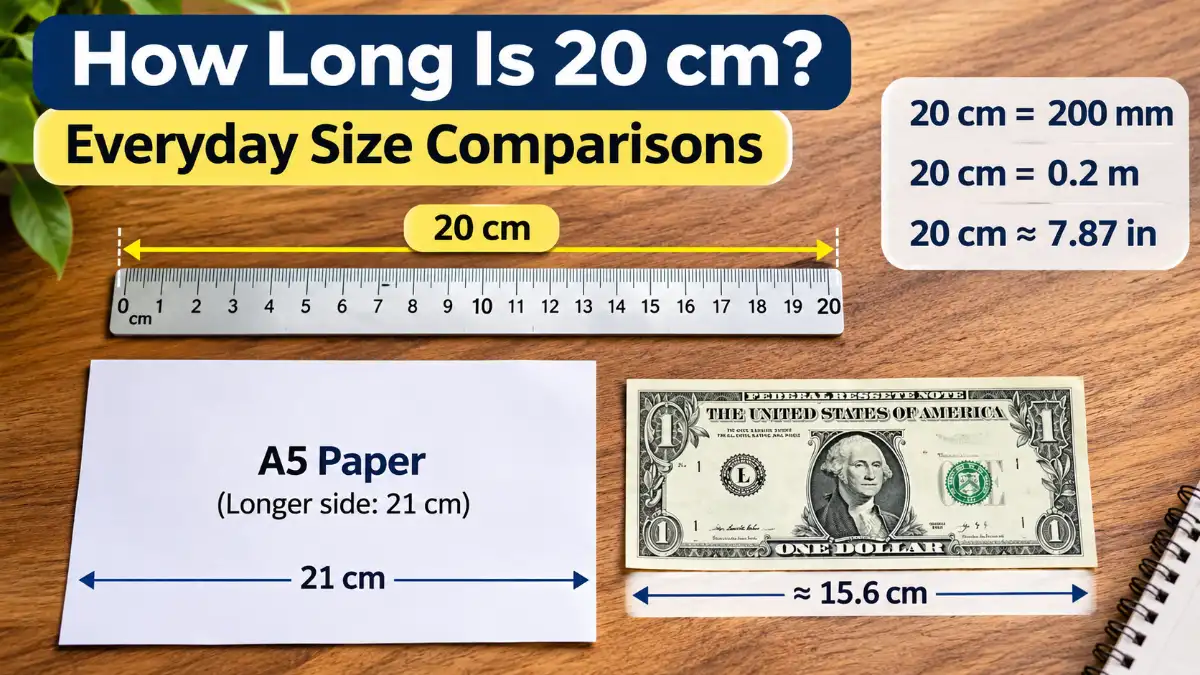
Understanding how big is 15 cm becomes easier when you compare it with a US dollar bill. Fifteen centimeters equals approximately 5.91 inches, while a standard US dollar bill measures about 15.6 cm long. Therefore, 15 cm is slightly shorter than the bill. It is also exactly one and a half times the length of 10 cm. A compact ruler, small kitchen utensil, or notebook may measure around this size. This measurement is useful when checking the length of personal accessories, stationery, or household products.
How Big Is 16CM in Inches and Real Life?
If you’re wondering how big is 16cm, the exact metric measurement is 160 millimeters, equivalent to approximately 6.30 inches. Sixteen centimeters is about 4 millimeters longer than a standard US dollar bill. You may encounter this size when measuring smaller notebooks, certain cooking utensils, or compact storage containers. Compared with 10 cm, it is 60% longer. An easy way to visualize this distance is to mark 6 inches on a ruler and extend the line by another 0.76 cm. A measuring tape provides the most reliable comparison.
How Big Is 17 CM When Compared With Inches?
The answer to how big is 17 cm is approximately 6.69 inches or 170 millimeters. This measurement is a little shorter than 7 inches, which equals 17.78 cm. A compact notebook, small tray, or handheld accessory might have a dimension near 17 cm, although actual product sizes vary. Compared with 10 cm, the additional length is 7 cm. When shopping online, check whether 17 cm describes an object’s height, width, length, or diameter, since these measurements represent different dimensions.
How Big Is 18 CM in Everyday Measurements?
If you’re asking how big is 18 cm, it equals approximately 7.09 inches or 180 millimeters. This makes it just over 7 inches long. A small dessert plate may have a diameter around 18 cm, while some notebooks or kitchen accessories may share a similar dimension. Eighteen centimeters is 8 cm longer than 10 cm and twice the length of 9 cm. When comparing 18 cm with a ruler, measure from zero to the 18-centimeter mark rather than starting from the ruler’s physical edge, which may include an additional margin.
How Big Is 20CM Compared to 10 CM?
To understand how big is 20cm, imagine placing two 10-centimeter rulers end to end. Twenty centimeters equals approximately 7.87 inches, 200 millimeters, or 0.2 meters. It is almost 8 inches long and exactly double the length of 10 cm. Some compact notebooks, household containers, and small plates measure around 20 cm. For objects with a circular shape, 20 cm may refer to diameter rather than length. This distinction is important when comparing product sizes or planning how much space an item requires.
Read Also: How Long Is 9 Inches? Simple Comparisons to Picture It
Size Comparison Chart: 10 CM to 20 CM
Relative length comparison
10 cm
3.94 in
15 cm
5.91 in
16 cm
6.30 in
17 cm
6.69 in
18 cm
7.09 in
20 cm
7.87 in
Bars show relative lengths, with 20 cm representing the full width.
For practical estimates, 10 cm is nearly 4 inches, 15 cm is nearly 6 inches, and 20 cm is nearly 8 inches.
How to Measure Centimeters Without Making Mistakes
Accurate measurement requires more than simply placing an object next to a ruler.
First, position the object’s starting point at the ruler’s zero mark. Avoid assuming the physical edge of the ruler is always zero.
Next, keep the ruler parallel to the side you’re measuring. If the ruler is angled, the reading may be inaccurate.
Look directly above the measurement mark to reduce errors caused by viewing it from an angle.
For flexible or curved surfaces, use a soft measuring tape. For very small objects requiring precision, a digital caliper may be more suitable.
Avoid relying entirely on smartphone measurement applications when exact measurements are important. Their accuracy depends on device capabilities and measurement conditions.
Where Are 10 to 20 CM Measurements Commonly Used?
Measurements between 10 and 20 centimeters appear frequently in daily life.
In education, students use these lengths to learn basic measurement, geometry, and unit conversion.
In online shopping, manufacturers often list product dimensions in centimeters, particularly for accessories, kitchenware, and imported goods.
In home organization, centimeters help determine whether small objects will fit inside drawers, shelves, or storage compartments.
Crafting and sewing projects also involve centimeter measurements when cutting materials or positioning decorative elements.
Knowing the relationship between centimeters and inches makes these activities easier, especially when working with products that use different measurement systems.
Frequently Asked Questions
1. How big is 10 cm in inches exactly?
Ten centimeters equals approximately 3.937 inches. For everyday use, this is rounded to 3.94 inches. It is slightly shorter than 4 inches.
2. What common object is close to 10 cm long?
A standard playing card, measuring approximately 8.89 cm along its longest side, is a useful reference. Ten centimeters is about 1.11 cm longer.
3. Is 10 cm half of 20 cm?
Yes. Ten centimeters is exactly half of 20 centimeters. Two lengths measuring 10 cm each make a combined length of 20 cm.
4. How can I measure 10 cm without a metric ruler?
Use an inch ruler and measure approximately 3.94 inches. Since 4 inches equals 10.16 cm, measuring just slightly less than 4 inches provides a close estimate.
5. How many millimeters are in 10, 15, and 20 centimeters?
Ten centimeters equals 100 millimeters, 15 cm equals 150 millimeters, and 20 cm equals 200 millimeters. Multiply any centimeter value by 10 to convert it into millimeters.
Conclusion
Understanding how big is 10 cm is straightforward once you know that it measures approximately 3.94 inches, or just under 4 inches.
Comparing centimeters with familiar objects, using a ruler correctly, and learning simple conversion formulas can make metric measurements much easier.
Whether you’re working with 10 cm, 15 cm, 16 cm, 17 cm, 18 cm, or 20 cm, accurate measurements help you choose the right product sizes, complete schoolwork, and understand everyday dimensions with confidence.