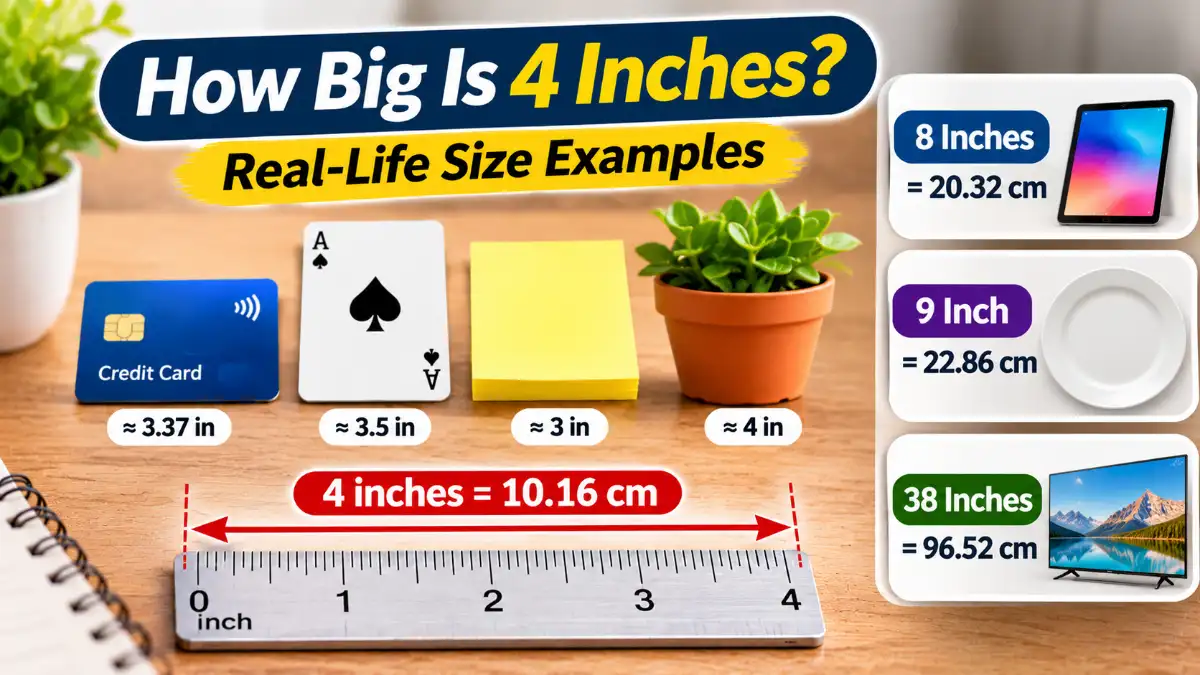
How big is 4 inches? Four inches measures exactly 10.16 centimeters, or 101.6 millimeters. That’s one-third of a foot and just slightly longer than 10 centimeters. For a practical comparison, imagine the long edge of a standard credit card with approximately five-eighths of an inch added to its length.
Four inches might seem like a short measurement, but it can make a noticeable difference when choosing furniture accessories, ordering products online, measuring electronics, or planning home projects.
The easiest way to understand this distance is to compare it with familiar objects. You can also learn how it relates to larger measurements such as 8 inches, 9 inches, and 38 inches.
How Big Is 4 Inches Actually Look Like?
Four inches is a little less than the length of many adult hands from the wrist crease to the tip of the middle finger. However, hand dimensions vary too much to provide an accurate universal comparison.
A more dependable reference is a ruler.
On a standard 12-inch ruler, four inches occupies exactly one-third of the total measuring length. If you divide the ruler into three equal sections, each section measures 4 inches.
The metric equivalent is 10.16 cm, meaning the measurement reaches slightly beyond the 10 cm mark.
Another useful comparison is a standard US passport booklet, which is approximately 5 inches tall. Four inches is one inch shorter than that height.
8 Common Objects That Help You Imagine 4 Inches
You don’t always need a measuring tool to estimate small distances. Familiar household objects can provide helpful references.
1. A Standard Credit Card
A typical credit card measures approximately 3.37 inches along its longest side.
Four inches is about 0.63 inches longer.
If you place a credit card beside a ruler, the difference becomes easy to recognize.
2. A Small Flowerpot
Many small nursery pots are sold with a nominal diameter of 4 inches.
This measurement usually refers to the width across the upper opening.
A four-inch pot provides a practical visual reference for circular objects.
3. A Playing Card
A standard poker-sized playing card measures about 3.5 inches long.
Four inches extends another half inch beyond its longest edge.
Playing cards are particularly useful for estimating the size of compact objects.
4. A Square Sticky Note
A common sticky note measures 3 inches on each side.
Adding one inch to the side of the note gives you a total distance of 4 inches.
This comparison works well for stationery, craft supplies, and desk accessories.
5. A Small Picture Frame
Some miniature photo frames are designed to hold 4 × 4-inch pictures.
The photo’s sides provide an exact four-inch reference, although the outer frame dimensions will be larger.
6. A Standard Index Card
A common index card measures 3 × 5 inches.
Four inches falls exactly halfway between its shorter and longer dimensions.
This makes index cards useful when estimating a four-inch measurement.
7. Four One-Inch Sections
If you can identify one inch on a ruler, repeat that distance four times.
The combined length is precisely four inches.
This is a simple way to understand how individual measurement units build larger distances.
8. A 10-Centimeter Measurement
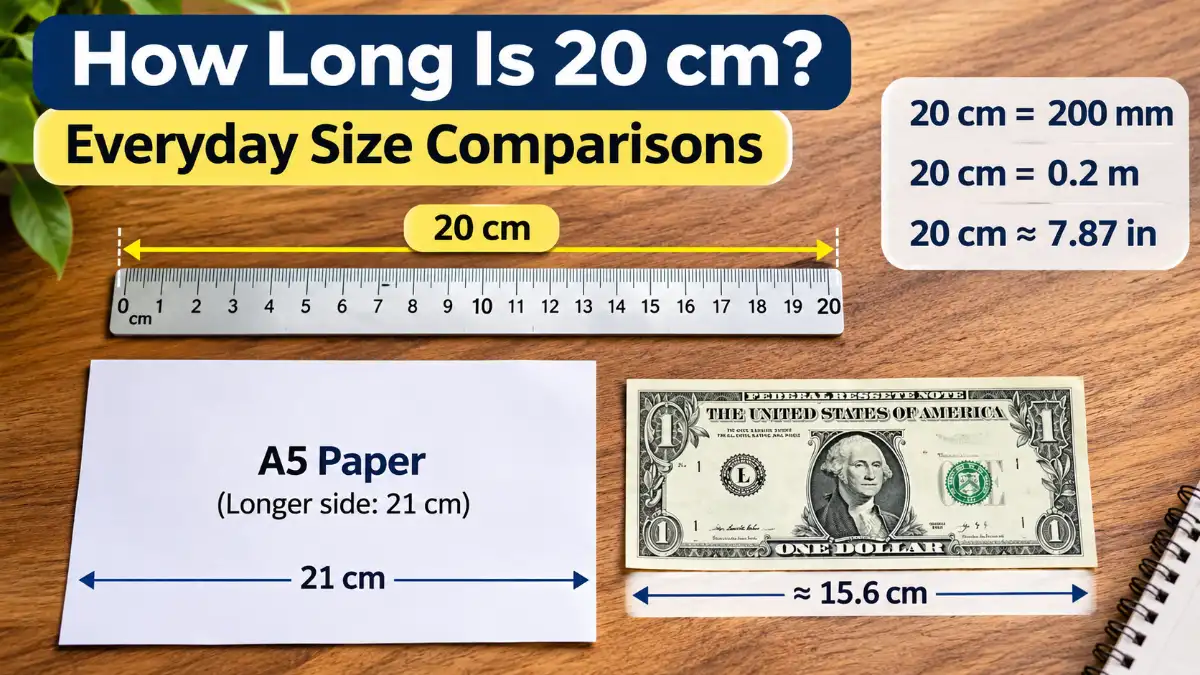
Ten centimeters equals approximately 3.94 inches.
Four inches is only 0.16 cm, or 1.6 mm, longer.
This is one of the closest metric comparisons available.
How to Convert 4 Inches Into Other Units
The international inch is defined as exactly 2.54 centimeters.
To convert inches into centimeters, multiply the inch value by 2.54.
42.54=10.16cm
Here are the equivalent measurements:
| Unit | Equivalent of 4 inches |
| Centimeters | 10.16 cm |
| Millimeters | 101.6 mm |
| Feet | 0.3333 ft |
| Meters | 0.1016 m |
| Yards | 0.1111 yd |
| Micrometers | 101,600 µm |
Four inches is exactly one-third of a foot, although the decimal representation continues beyond four digits.
For everyday purposes, remembering that four inches is approximately 10 centimeters is usually sufficient.
Read Also: How Long Is 4 Inches? Visual Examples and Measuring Tips
How Big Is 8 Inches Compared to Common Objects?
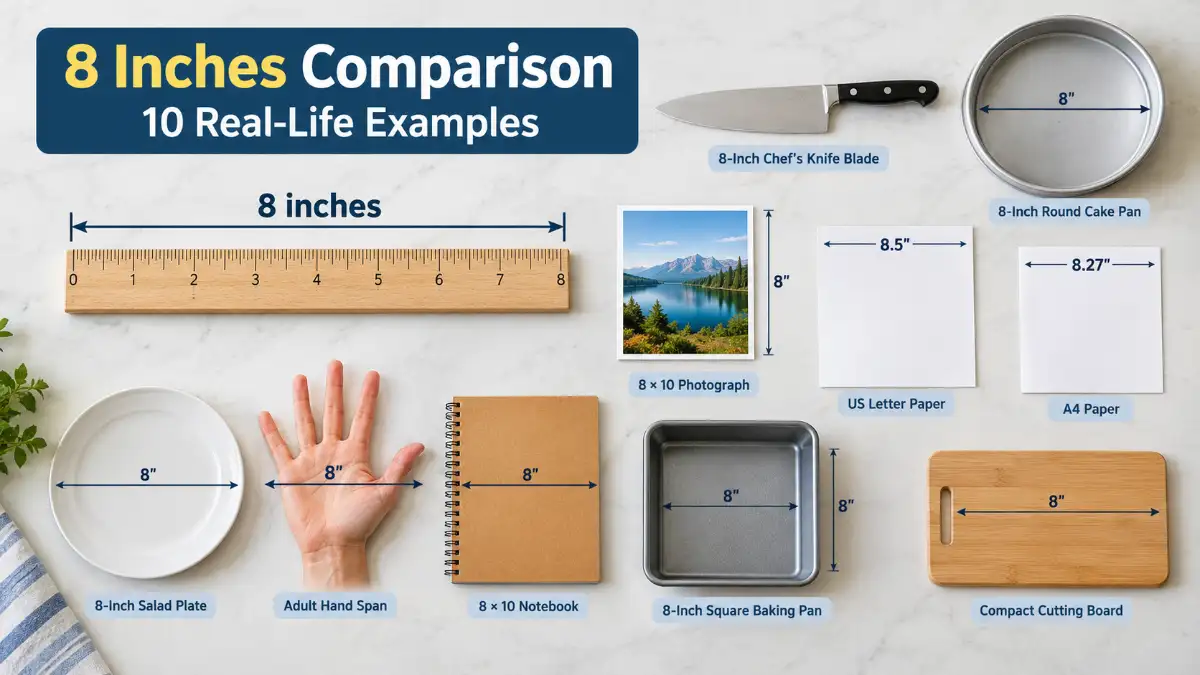
If you’re wondering how big is 8 inches, the measurement equals 20.32 centimeters or 203.2 millimeters. It’s exactly twice the length of 4 inches and two-thirds of a foot. A standard US letter-size sheet of paper measures 8.5 inches across its shorter side, making an 8-inch measurement just half an inch shorter. Some small plates, compact tablets, and household utensils also have dimensions around 8 inches, although actual product sizes vary. This length is commonly used when describing kitchen equipment, electronics, decorative items, and household storage products. For accurate visualization, locate the 8-inch marking on a ruler or measuring tape.
How Big Is 9 Inch in Everyday Life?
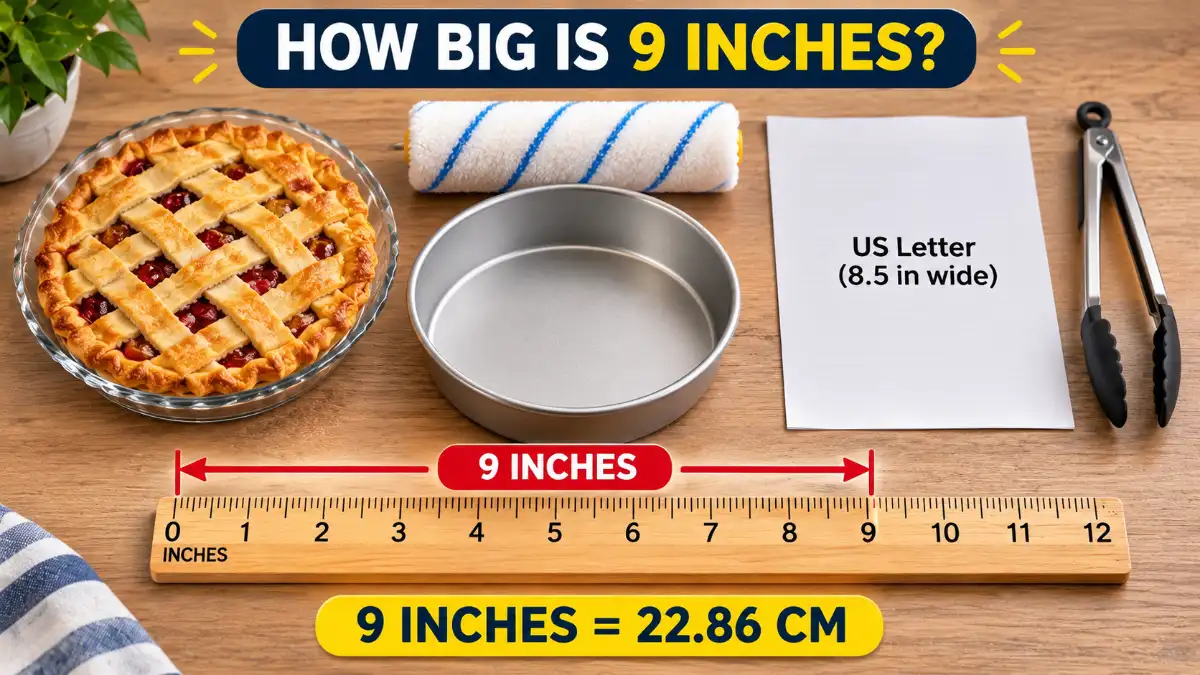
Understanding how big is 9 inch is useful when comparing kitchenware, school supplies, and other household products. Nine inches equals exactly 22.86 centimeters, 228.6 millimeters, or three-quarters of a foot. A 9-inch pie pan is a familiar example, with the advertised size generally referring to its diameter. Nine inches is also one inch longer than 8 inches and 2.25 times the length of 4 inches. A standard US letter-size sheet measures 11 inches along its longer edge, so 9 inches is two inches shorter. When reading product descriptions, check whether the measurement refers to width, height, length, or diameter.
How Big Is 38 Inches in Feet and Centimeters?
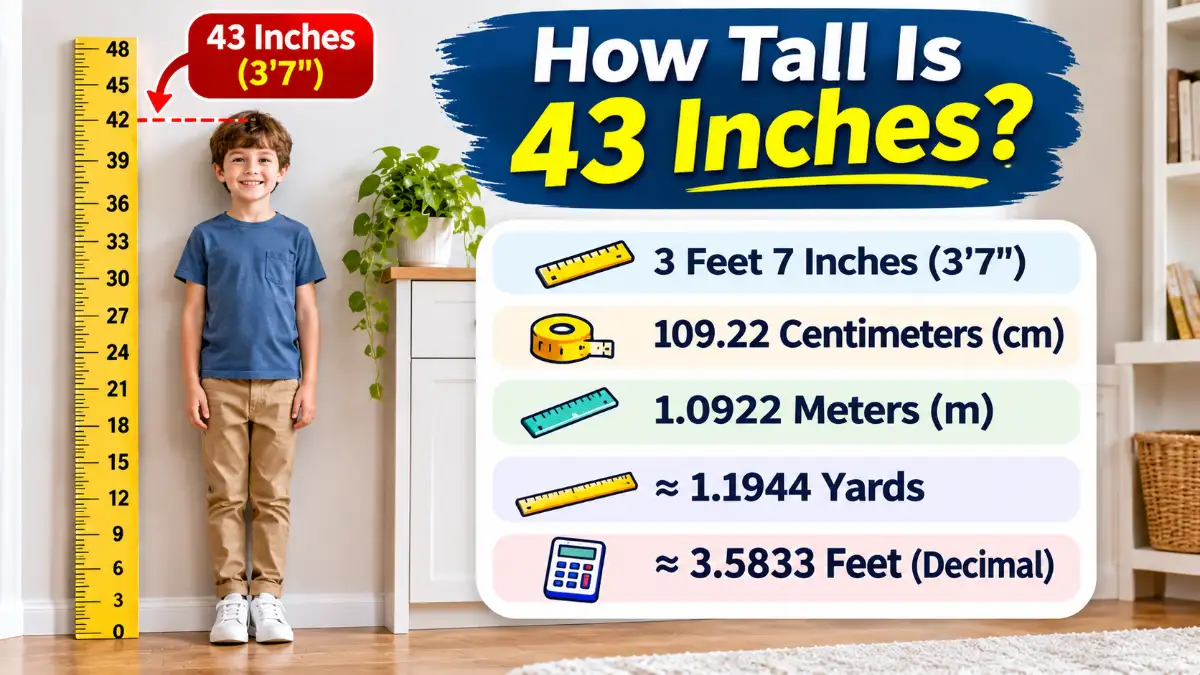
If you’re asking how big is 38 inches, it measures exactly 96.52 centimeters, or 3 feet 2 inches. That’s only 3.48 centimeters shorter than one meter. This size frequently appears in furniture dimensions, clothing measurements, and home improvement projects. For example, 38 inches may describe the height of a piece of furniture, the width of a cabinet, or a measurement on a clothing size chart. If a screen is advertised as 38 inches, the number generally describes the diagonal screen measurement, not its width. Compared with 4 inches, a 38-inch distance is 9.5 times longer.
Size Comparison Chart: 4, 8, 9, and 38 Inches
Relative length comparison
4 inches
10.16 cm
8 inches
20.32 cm
9 inches
22.86 cm
38 inches
96.52 cm
Each bar is scaled relative to 38 inches, the longest measurement.
The following table provides additional conversions:
| Inches | Centimeters | Millimeters | Feet |
| 4 | 10.16 | 101.6 | 0.333 |
| 8 | 20.32 | 203.2 | 0.667 |
| 9 | 22.86 | 228.6 | 0.750 |
| 38 | 96.52 | 965.2 | 3.167 |
How to Estimate 4 Inches Without a Measuring Tape
Sometimes you need a rough estimate but don’t have a ruler available.
A credit card can help because its standard length is approximately 3.37 inches. An additional 0.63 inches produces a distance close to four inches.
A 3 × 5-inch index card is another convenient option. Four inches falls halfway between its two side lengths.
You can also fold a standard 8.5 × 11-inch sheet of US letter paper in half across the 8.5-inch side. The resulting 4.25-inch measurement is slightly longer than four inches.
These methods are useful for rough estimates. However, they should not replace accurate measurement tools when cutting materials, fitting parts, or purchasing items that must meet exact specifications.
Where Are Four-Inch Measurements Used?
Four inches is a common dimension in everyday products and projects.
Home improvement: Small hardware components, tiles, brackets, and decorative accessories may use four-inch dimensions.
Gardening: Compact nursery pots are frequently identified by their approximate diameter.
Photography: Some prints and frames use four-inch sides, including 4 × 6-inch photographs.
Crafting: Four-inch lengths are useful when cutting paper, arranging decorations, or preparing small materials.
Online shopping: Product specifications may list dimensions in inches, centimeters, or both.
Recognizing how these measurements relate to actual objects can prevent buying products that are larger or smaller than expected.
Important Measurement Mistakes to Avoid
One common error is treating inches and centimeters as interchangeable.
Four centimeters equals approximately 1.57 inches, which is much shorter than four inches.
Another mistake involves confusing a straight-line measurement with a diagonal one.
For example, the diagonal size of a display doesn’t directly indicate its width. The display’s aspect ratio determines its actual height and width.
Similarly, diameter refers to the distance across a circle through its center, while circumference refers to the distance around it.
Understanding these distinctions helps you interpret measurements correctly.
Frequently Asked Questions
1. How many centimeters are exactly 4 inches?
Four inches equals exactly 10.16 centimeters. This conversion is based on the international definition of one inch as 2.54 centimeters.
2. Is 4 inches the same size as your palm?
Not necessarily. Some adults have palms around four inches wide, but hand sizes vary. A ruler provides a more dependable measurement than comparing an object with your hand.
3. What does 4 inches look like on a 12-inch ruler?
Four inches covers exactly one-third of a standard 12-inch ruler. Measure from the zero mark to the fourth numbered inch mark.
4. Is 4 inches half of 8 inches?
Yes. Four inches is exactly half of eight inches. Two separate four-inch lengths placed end to end create an eight-inch distance.
5. What is the difference between 4 inches and 4 centimeters?
Four inches equals 10.16 centimeters, while four centimeters equals approximately 1.57 inches. Therefore, a four-inch distance is 6.16 centimeters longer than a four-centimeter distance.
Final Thoughts
Understanding how big is 4 inches becomes simple when you recognize that it equals 10.16 centimeters, or approximately one-third of a foot.
Everyday references such as playing cards, credit cards, index cards, and small plant pots can help you visualize this length without specialized equipment.
Larger measurements, including 8 inches, 9 inches, and 38 inches, are equally easy to understand with conversion formulas and familiar object comparisons.
Whenever precise dimensions matter, use a ruler or measuring tape to avoid costly measurement mistakes.