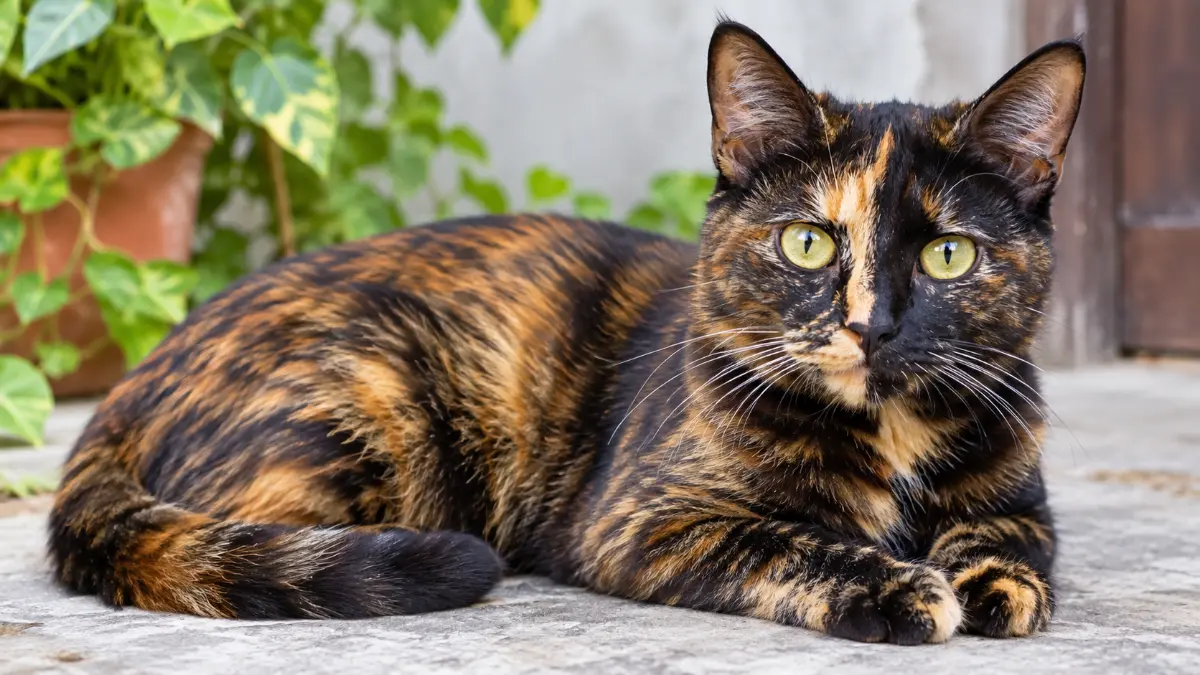
A tortoiseshell cat, often called a tortie, is known for its eye-catching mix of dark and red-based colors. Black, brown, orange, red, cream, and blue-gray may appear in fine brindling, irregular patches, or a dramatic mosaic across the coat.
Despite the distinctive appearance, tortoiseshell is not a separate cat breed. It is primarily a coat color pattern that can occur in mixed-breed cats and numerous pedigreed breeds.
Most torties are female because the genetic system responsible for orange and black-based coloration is linked to the X chromosome. Modern genetics has made the science behind that pattern even more interesting, but coat color alone does not tell you whether a particular cat will be affectionate, energetic, independent, healthy, or suitable for your family.
This complete guide explains how to identify a tortie, distinguish a tortoiseshell from a calico or torbie, understand the genetics, evaluate the famous “tortitude” claim, care for a tortie, and decide whether an individual cat is right for your household.
Tortoiseshell Cat Quick Facts
| Question | Quick answer |
| Is tortoiseshell a breed? | No, it is a coat color/pattern |
| Common colors | Black or dark color mixed with red/orange |
| Can torties be dilute? | Yes, black becomes blue-gray and red becomes cream |
| Are most torties female? | Yes, overwhelmingly |
| Can male torties exist? | Yes, but they are uncommon |
| What is a torbie? | A tortoiseshell-tabby |
| Does “tortitude” predict personality? | No, not reliably |
| Do torties need special care? | Not because of color alone |
| Can purebred cats be torties? | Yes |
| Are all tortie patterns identical? | No, color distribution is highly individual |
What Is a Tortoiseshell Cat?
A tortoiseshell cat typically displays both red-based and black-based pigmentation. The colors may blend together in tiny flecks or appear as larger irregular patches.
TICA describes torties as cats combining red and black-based colors and notes that the amount of red can vary considerably.
Tortoiseshell Is a Coat Pattern, Not a Breed
One of the biggest misconceptions is that “tortoiseshell” names a breed.
It does not.
A tortie may be a Domestic Shorthair, Domestic Longhair, Maine Coon, Persian, British Shorthair, American Shorthair, Oriental Shorthair, or another breed that permits tortie coloring.
This distinction matters because breed and individual genetics influence factors such as body size, coat length, grooming needs, and some inherited health risks, while tortoiseshell primarily describes coloration.
For example, a Persian tortie and a Domestic Shorthair tortie may have similar orange-and-dark pigmentation but completely different grooming requirements.
What Does a Classic Tortoiseshell Cat Look Like?
A classic tortie commonly has black or very dark areas mixed with red, orange, or ginger-colored fur.
The pattern may be:
- Finely brindled
- Speckled
- Mottled
- Patchy
- Unevenly distributed
- Nearly black with only a few orange areas
- Heavily orange with smaller dark areas
Traditional tortie descriptions usually involve little prominent white, although everyday terminology sometimes overlaps with tortie-and-white and calico.
Why No Two Torties Look Exactly Alike
The patchwork appearance develops partly because of X-chromosome inactivation.
In females carrying different color information on their two X chromosomes, different groups of developing cells can express different pigmentation.
As those groups expand, they create a mosaic.
That is why two torties can share similar underlying color genetics yet have completely different facial markings and body patterns.
Is My Cat a Tortoiseshell? Identification Guide
Seeing orange and black fur is a strong clue, but it is not enough to distinguish a classic tortie from a torbie, calico, or dilute variation.
Use this four-step method.
Step 1 – Look for Both Red-Based and Black-Based Colors
Look across the entire body rather than focusing only on the face.
Red-based colors may include orange, ginger, red, or cream.
Black-based colors may include black, dark brown, or blue-gray in a dilute cat.
If the coat contains only one color family, the cat is unlikely to be a typical tortie.
Step 2 – Check for Tabby Striping
A torbie combines tortoiseshell coloring with tabby patterning.
TICA provides a useful identification clue: red and cream areas may show visible striping even in cats that are not true torbies. Therefore, examine the darker areas. If the black-based portions also show a clear tabby pattern, the cat is more likely a torbie.
Step 3 – Look at the Amount of White
Classic torties usually have relatively little prominent white.
A cat with extensive white plus clear black and orange patches may instead be described as calico or tortie-and-white, depending on the pattern and terminology being used.
There is no universal percentage of white that creates an absolute boundary in everyday naming.
Step 4 – Decide Whether the Colors Are Diluted
Dilution changes the intensity of the standard colors.
According to TICA, inherited dilution changes black to blue and red to cream.
Therefore, a soft gray-blue and cream cat may be a dilute tortie even though she lacks obvious black and bright orange.
Quick Identification Table
| What you see | Likely description |
| Black + orange/red, mottled, little white | Classic tortie |
| Blue-gray + cream | Dilute tortie |
| Tortie colors + tabby markings in dark areas | Torbie |
| Black + orange + substantial white | Often calico or tortie-and-white |
| Blue-gray + cream + substantial white | Dilute calico/tortie-and-white |
| Tortie coloration on long fur | Long-haired tortie, breed must be identified separately |
Identify Your Cat in 30 Seconds
Start with the colors.
Orange/red + dark coloration?
If no, the cat probably is not a classic tortie.
If yes, check the darker areas for tabby markings.
Striped dark areas? Likely torbie.
Solid dark areas? Continue.
Check for extensive white.
Lots of white plus separated orange and dark patches? Calico or tortie-and-white may be the more useful description.
Finally, ask whether the colors are muted.
Blue-gray + cream instead of black + orange? You are probably looking at a dilute form.
Tortoiseshell vs. Calico vs. Torbie
These terms are related, but they do not describe exactly the same appearance.
Tortoiseshell vs. Calico
A classic tortie usually shows dark and orange/red colors mixed together with relatively little white.
A calico normally has noticeable white combined with orange and black-based areas that often appear as more distinct patches.
Naming conventions can differ somewhat among registries and everyday cat owners, so treat the distinction as a practical visual guide rather than an inflexible mathematical rule.
Tortoiseshell vs. Torbie
“Torbie” is short for tortoiseshell-tabby.
TICA explains that torbies combine tabby patterning with tortie coloration. A particularly useful clue is to inspect the dark portions rather than relying on stripes visible in orange fur.
Tortoiseshell vs. Tortie-and-White
Tortie-and-white describes tortoiseshell coloration occurring alongside white spotting.
Depending on the amount and placement of white and the registry terminology being followed, a similar-looking cat may sometimes be called calico.
| Trait | Tortie | Torbie | Calico |
| Red/orange | Yes | Yes | Yes |
| Black-based color | Yes | Yes | Yes |
| Tabby markings | Dark areas usually solid | Yes | May occur |
| Significant white | Usually little | Variable | Common |
| Typical appearance | Mottled/brindled | Mottled + striped | Larger separated patches |
Why Are Most Tortoiseshell Cats Female?
The answer comes from sex-linked color genetics.
The Orange-Color Trait Is X-Linked
The genetic mechanism responsible for feline orange coloration is associated with the X chromosome.
Most female cats have two X chromosomes: XX.
Most male cats have one X and one Y chromosome: XY.
A female can therefore carry an orange-associated version on one X and a non-orange version on the other, allowing populations of both color types to occur.
TICA uses this sex-linked mechanism to explain why the great majority of torties are female.
How X-Chromosome Inactivation Creates the Patchwork Coat
Early during development, cells in a female embryo generally inactivate one of their X chromosomes.
The process happens independently across cell populations.
If one X carries orange-associated information and the other carries non-orange information, different groups of pigment-producing cells can express different colors.
The simplified process is:
Two different X-linked color versions → random X inactivation → differently colored cell populations → orange and dark patches
What Recent Genetics Research Adds
Scientists knew for decades that orange coloration was X-linked, but the exact molecular mechanism remained uncertain.
Research published in 2025 identified a regulatory deletion associated with abnormal activation of ARHGAP36 in pigment cells, helping explain the molecular basis of orange coloration.
Importantly, the research focused on pigmentation and did not establish that the orange-color mechanism creates a predictable personality type.
Can a Male Tortoiseshell Cat Exist?
Yes.
A male tortie is possible, but biologically unusual.
Why Male Torties Are Uncommon
A typical XY male has only one X chromosome.
That generally means he expresses one X-linked color state rather than the two-color mosaic commonly produced in an XX female.
How Male Torties Can Occur
Possible mechanisms include XXY chromosome configurations, mosaicism, and chimerism.
An XXY cat may possess the two X chromosomes required for differently expressed color populations. TICA has documented male torties and notes that males with relevant chromosomal abnormalities are often sterile.
Do not assume every male-looking tortie has XXY chromosomes without veterinary or genetic evaluation.
Similarly, a dramatic split-colored face does not prove that a cat is a chimera.
What Owners Should Do If Their Tortie Is Male
If your apparent tortie is male, confirm the sex if there is uncertainty and arrange a veterinary examination.
Discuss reproductive status and ask whether further evaluation is appropriate.
The cat’s unusual coloration should not automatically be interpreted as proof of exceptional monetary value or as a reason to breed him.
Tortoiseshell Cat Personality: Is “Tortitude” Real?
“Tortitude” is a playful term used to describe torties as bold, vocal, opinionated, independent, energetic, or affectionate on their own terms.
Many owners have stories that seem to support the stereotype.
But anecdotes are not the same as a reliable biological rule.
What Research Actually Shows
Owner surveys have reported some associations between coat color and perceived behavior.
AAHA notes research in which owners of tortoiseshell, calico, and black-and-white cats reported certain aggressive behaviors more frequently in some situations. However, AAHA also highlights the limitations of coat-color stereotypes and warns that human expectations can affect handling and adoption decisions.
There is not enough evidence to use tortie coloring as a dependable personality test.
What Influences Temperament More Than Color
Individual behavior is better evaluated through:
- Early socialization
- Genetics beyond coat color
- Breed or ancestry
- Age
- Previous experiences
- Stress level
- Physical health
- Household environment
- Resource availability
- Handling style
A shy shelter tortie might become affectionate after settling into a quiet home, while a confident tortie might enjoy attention but dislike being picked up.
How to Judge the Individual Cat Instead
Observe whether the cat voluntarily approaches people, plays, tolerates gentle handling, recovers after mild stress, and communicates comfortably when she wants space.
If adopting, ask shelter or foster staff what the cat is like outside the stressful shelter environment.
| Claim | Better interpretation |
| All torties are sassy | Temperament varies |
| Torties are naturally aggressive | Coat color is not a reliable aggression predictor |
| Torties dislike people | Many individuals are social and affectionate |
| All torties behave alike | Experience and environment matter |
| Tortitude predicts compatibility | Direct observation is more useful |
Types of Tortoiseshell Cats
Classic Tortoiseshell
Classic torties combine black-based coloration with red or orange.
The colors may be finely mixed or arranged in larger irregular areas.
Dilute Tortoiseshell
Dilute torties replace intense black and red with softer blue-gray and cream.
The overall effect can appear pastel or muted.
Torbie
A torbie combines tortie coloration with tabby patterning.
Look for stripes, swirls, or spots in the darker sections of the coat.
Tortoiseshell and White
These cats display tortie coloring plus white spotting.
Depending on the amount and distribution of white, the cat may sometimes be described as calico.
Long-Haired Tortoiseshell
A long-haired tortie simply combines tortie coloring with long fur.
It is not a separate breed.
Care requirements should follow the actual coat type and breed background.
What Cat Breeds Can Be Tortoiseshell?
Many pedigreed breeds and mixed-breed cats can display tortie coloration.
Domestic Shorthair and Domestic Longhair Torties
Many shelter torties are Domestic Shorthairs or Domestic Longhairs with mixed or undocumented ancestry.
They can vary widely in body size, activity, coat density, and personality.
Maine Coon Tortoiseshell
Maine Coons can appear in tortie-related colors.
Characteristics such as large body size, coat type, and breed-specific health considerations come from being a Maine Coon-not from being tortie.
Persian Tortoiseshell
Persians can also have tortie coloring.
Their long, dense coats typically require more grooming than those of a short-haired tortie.
British Shorthair and American Shorthair Torties
These breeds demonstrate why coat pattern should not be confused with breed identity.
| Cat | Tortie determines | Breed/background influences |
| Domestic Shorthair | Color pattern | Individual build and traits |
| Maine Coon | Color pattern | Size, coat, breed traits |
| Persian | Color pattern | Coat maintenance, breed traits |
| British Shorthair | Color pattern | Build and coat characteristics |
| American Shorthair | Color pattern | Breed-associated structure |
Read More: Ocular Migraine
Are Tortoiseshell Cats Rare?
Female torties are visually distinctive but are not automatically exceptionally rare.
Male torties are considerably less common because normal XY genetics do not usually create the two X-linked color states involved in the typical tortie mosaic.
Dilute torties may be encountered less frequently because additional genes affect pigment intensity, but there is no universal percentage that accurately applies across all breeds and populations.
Be cautious with claims such as “one in X torties” unless the statistic comes from a well-defined population study.
Rarity also does not automatically make a cat healthier, friendlier, or more valuable.
Tortoiseshell Cat Health and Lifespan
Does Tortoiseshell Coloring Cause Health Problems?
For a typical female tortie, the coat pattern itself is not a disease diagnosis.
Medical risk depends more strongly on breed, family genetics, age, body condition, lifestyle, and preventive veterinary care.
Male Torties and Chromosomal Differences
Some male torties may have unusual chromosome configurations such as XXY, which can have reproductive consequences.
That does not mean every male tortie has exactly the same condition.
Veterinary evaluation is more appropriate than diagnosing a cat from appearance.
Breed Matters More Than Coat Color
A tortie Persian should be evaluated for Persian-specific care and health concerns.
A tortie Maine Coon should be evaluated in the context of Maine Coon genetics and breed-related considerations.
Sharing a coat pattern does not make the cats medically identical.
What Determines Lifespan?
There is no special lifespan created by tortie coloration.
Longevity is influenced by genetics, healthy body condition, nutrition, dental care, preventive medicine, injury prevention, infectious-disease exposure, lifestyle, and early detection of illness.
For that reason, a single online “tortoiseshell lifespan” number should not be interpreted as a biological limit caused by the coat pattern.
How to Care for a Tortoiseshell Cat
There is no special tortie-only care routine.
Base care on the individual cat’s coat, age, health, lifestyle, and breed.
Grooming by Coat Length
Short-haired torties generally need straightforward coat maintenance, regular nail checks, and dental care.
Long-haired torties usually need more frequent brushing and mat checks, particularly around friction-prone areas.
Introduce grooming gently rather than waiting until a severe mat develops.
Nutrition and Weight Management
There is no “tortoiseshell diet.”
Food should match life stage, body condition, health status, activity level, and veterinary recommendations.
Monitor weight and body condition rather than assuming every feeding-guide amount suits every cat.
Exercise and Enrichment
Useful enrichment includes interactive wand play, puzzle feeders, climbing spaces, cat trees, window perches, scratching surfaces, boxes, hiding spaces, and toy rotation.
Short, regular play sessions can be easier to maintain than occasional very long sessions.
Litter Box Setup
AAHA/AAFP guidance uses a practical rule of thumb of approximately one litter box per cat plus one additional box, with boxes placed in accessible locations.
For two cats, that commonly means starting with three boxes.
Individual preferences still matter.
Veterinary and Dental Care
Discuss preventive examinations, vaccination decisions, parasite control, spaying or neutering, body weight, diet, dental health, and age-related screening with your veterinarian.
Is a Tortoiseshell Cat Right for You?
The better question is not “Are torties good pets?”
It is:
Is this individual cat suitable for your household?
Torties and Families With Children
A tortie can live successfully with children if the individual cat is comfortable around them and children understand respectful handling.
Cats should have safe escape spaces and should never be chased or forced into interaction.
Torties and Other Cats
Compatibility depends on individual history and temperament, not tortie coloration.
Use gradual introductions and provide enough litter boxes, feeding areas, resting places, and vertical space.
Torties and Dogs
Look for previous experience with dogs where possible.
A cat that has successfully lived with a calm, cat-friendly dog gives you more useful information than coat color does.
Are Torties Good for First-Time Cat Owners?
Yes, some can be excellent first cats.
Focus on temperament, grooming workload, medical needs, activity level, and household compatibility.
A relaxed adult short-haired tortie may suit a first-time owner better than a high-maintenance long-haired cat regardless of color.
How to Choose or Adopt a Tortoiseshell Cat
Questions to Ask a Shelter or Foster
Ask how the cat behaves after settling into a home, whether she enjoys handling, how she interacts with children and other animals, whether she has medical conditions, what food she eats, whether litter habits are reliable, and whether there are known fear triggers.
Foster caregivers can often provide especially useful information because they have observed the cat in a home rather than only in a shelter.
What to Look for During a Meet-and-Greet
Observe body posture, ear and tail position, willingness to approach, interest in play, comfort with touch, and recovery after a mild distraction.
Remember that a shelter can be stressful.
A cat hiding during a first meeting is not automatically antisocial.
Choosing a Purebred Tortie
If buying a pedigreed cat, prioritize:
health screening → responsible breeder practices → temperament → breed suitability → pedigree → coat color
Do not reverse that order.
Red Flags Around “Rare Tortie” Marketing
Be cautious if a seller guarantees personality from color, charges a major premium simply for “tortitude,” provides no medical records, cannot explain relevant health testing, or claims that an unusual facial pattern automatically proves rare genetics.
Unique Information Competitors Often Miss
A 30-Second Tortie Identification Method
Use four observations:
Orange/red + dark color → check dark areas for tabby pattern → evaluate white spotting → check whether colors are diluted.
That sequence helps distinguish tortie, torbie, calico, and dilute variants much faster than simply looking for “patchy fur.”
Breed vs. Coat Pattern: What Actually Changes Care?
| Feature | Tortie pattern determines it? | Breed/individual influences it? |
| Orange + dark coloration | Yes | – |
| Coat length | No | Yes |
| Grooming workload | No | Yes |
| Adult size | No | Yes |
| Personality | Not reliably | Yes |
| Inherited health risks | Usually no | Yes |
| Exercise needs | No | Yes |
| Pet compatibility | No | Yes |
How to Evaluate Personality Before Adoption
Use three information sources:
Observe the cat → ask someone who knows the cat → compare the cat’s needs with your home.
This is more useful than relying on “tortitude.”
Five Common Identification Mistakes
The most common errors are treating tortoiseshell as a breed, calling every orange-black-white cat a tortie, missing tabby markings in a torbie, overlooking dilute torties, and assuming a split-colored face proves chimerism.
Common Myths About Tortoiseshell Cats
“All Torties Have an Attitude”
Some do, some do not.
“Tortitude” is a stereotype rather than a dependable personality prediction. AAHA specifically warns that coat-color expectations can affect how humans interpret cats.
“Tortoiseshell Is a Breed”
False.
The term primarily describes coat coloration.
“All Torties Are Female”
Not quite.
Almost all are female, but unusual male torties do occur.
“Every Split-Face Tortie Is a Chimera”
False.
Ordinary tortie mosaicism can create dramatic facial divisions.
Appearance alone cannot establish chimerism.
“Rare Coloring Means Better Health or Temperament”
There is no reliable reason to assume an unusual pattern creates superior health, intelligence, friendliness, or breeding quality.
Tortoiseshell Cats in History and Folklore
Torties and tricolored cats have appeared in folklore for generations.
Various traditions have associated them with luck, protection, prosperity, household fortune, and protection for sailors.
These stories are culturally interesting but should remain separate from biology.
Genetics explains the coat. Folklore explains what people have imagined the coat might symbolize.
Frequently Asked Questions About Tortoiseshell Cats
1. Is a tortoiseshell cat a breed?
No. Tortoiseshell describes a coat color pattern. A tortie may be mixed-breed or belong to a recognized pedigree breed.
2. Why are tortoiseshell cats mostly female?
Orange coloration is linked to the X chromosome. Females usually have two X chromosomes, allowing different color versions to be expressed in different cell populations after X-chromosome inactivation.
3. Can a tortoiseshell cat be male?
Yes, but males are unusual. XXY chromosome configurations, mosaicism, or other uncommon mechanisms can produce male torties.
4. What is a dilute tortoiseshell cat?
A dilute tortie has softened colors. Black becomes blue-gray and red becomes cream, producing a muted pastel appearance
5. What is the difference between a tortie and a calico?
Classic torties tend to have intermingled orange and dark colors with little white. Calicos usually display substantial white and more clearly separated color patches.
6. What is the difference between a tortie and a torbie?
A torbie combines tortie coloration with tabby markings. Check the dark areas of the coat for clear stripes or other tabby patterns.
7. Are tortoiseshell cats aggressive?
Coat color cannot reliably predict aggression. Socialization, health, environment, genetics, and individual experience provide much better information about temperament.
8. How long do tortoiseshell cats live?
There is no special tortie lifespan. Longevity depends on the individual cat’s breed, health, lifestyle, genetics, nutrition, and veterinary care.
9. Are tortoiseshell cats rare?
Female torties are not exceptionally rare in general. Male torties are much less common because the usual XY chromosome arrangement does not readily produce the classic two-color mosaic.
10. Are tortoiseshell cats good pets?
They can be excellent companions. Evaluate the individual cat’s temperament, medical needs, age, grooming requirements, and previous experience with people and other animals rather than choosing based on coat color alone.