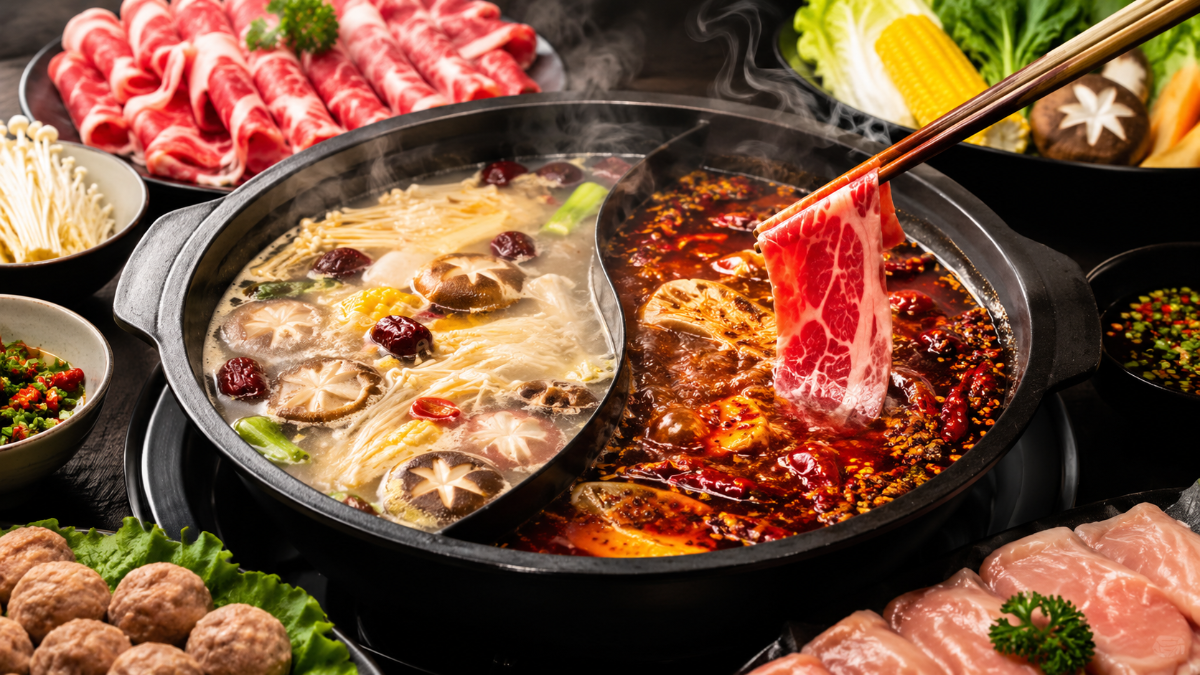
Hotpot is a communal table-cooking meal in which diners cook raw ingredients in a simmering pot of broth and eat them with individual dipping sauces. Chinese hotpot, or huǒguō (火锅), is best understood as a cooking and dining format shared by many regional cuisines, each with its own broth, ingredients, and sauce traditions .
This guide separates what’s well-documented from what’s disputed, covers the major regional styles individually, and answers the practical questions a first-time diner or home cook actually needs: what to buy, how much to buy, what order to cook things in, how to eat it at a restaurant, and how to do it safely.
Hotpot as a Format vs. Chinese Hotpot as a Cuisine
The format itself is simple: a heat source, a pot of broth, raw ingredients, and dipping sauces, with diners cooking their own food at the table. Chinese hotpot as a cuisine is where the depth lies. Regional traditions across China use that same format with markedly different broths, proteins, and etiquette, so understanding this dish well means understanding it region by region rather than as one uniform meal.
What We Actually Know About Hotpot’s History
The exact origin of this style of communal cooking is disputed, and popular accounts online often compress uncertain evidence into one tidy timeline. Bronze cooking vessels used by nobility during the Shang and Zhou dynasties (roughly 1600–256 BCE), and copper pots documented during the Three Kingdoms period (220–280 CE) for cooking sliced meat in individual portions, provide evidence of early communal or individual vessel cooking, but they do not establish a direct, unbroken line to the modern dish [web:20][web:28].
A widely repeated story credits Mongol cavalry, including soldiers under Genghis Khan and Kublai Khan, with cooking sliced meat in boiling water using their helmets when proper equipment wasn’t available. This account circulates frequently in food writing but rests on limited primary documentation, so it’s best treated as folklore commonly associated with the dish’s spread rather than an established historical fact [web:22][web:27].
A commonly cited account places the emergence of the spicy, offal-heavy Chongqing style among dock and boat workers along the Yangtze and Jialing rivers during the Qing period (1644–1911), often linked in popular accounts to the use of inexpensive offcuts of meat cooked in a shared pot of chili, Sichuan peppercorn, and ginger [web:25]. This should be understood as the most frequently repeated origin account for that regional style, not a definitively documented date or event.
Read More: Chitlins
Types of Chinese Hotpot
Chinese culinary tradition includes many regional variations, and no single style is universally considered “the original” or “most authentic” [web:34][web:38]. The styles below are among the best-known and most distinctive.
Chongqing Hotpot (重庆火锅)
Chongqing hotpot traditionally uses beef tallow as a major component of its spicy base, giving the broth a rich, oily character and a deep red color once the chili and doubanjiang are added [web:52]. It is widely associated with an intensely spicy and numbing flavor profile. Signature ingredients include beef tripe (毛肚), duck blood (鸭血), and huanghou (黄喉), a crisp beef or pork blood-vessel ingredient commonly associated with the aorta, often linked in popular accounts to the use of inexpensive offcuts by dock and river workers [web:25]. Traditional Chongqing presentations are strongly associated with single-broth pots, though restaurants can and do offer other pot formats [web:62].
Chengdu/Sichuan Hotpot (四川火锅)
Many Chengdu-style preparations use a lighter oil base than Chongqing’s, often blending vegetable oil with beef tallow, and may include ingredients such as fermented rice and rock sugar for a more layered flavor [web:64]. These preparations are often described as more aromatic and less aggressively hot than Chongqing versions, although spice level varies by restaurant. Divided yuanyang pots (half spicy, half clear or mild broth) are also common in Chengdu-style dining, especially when diners want different spice levels at the same table, and the meal is often paired with an elaborate sesame-paste dipping sauce with many optional mix-ins [web:62].
These are broad tendencies rather than strict rules: restaurants in both cities use different oil blends, pot formats, spice levels, and sauce combinations, and plenty of Chongqing restaurants also offer split pots.
Beijing-Style Hot Pot (老北京铜锅涮肉)
Traditional Beijing hotpot uses a tall, chimney-style copper pot heated by charcoal, with a simple broth of water, ginger, scallion, and sometimes dried shrimp [web:38]. The focus is on ingredient quality rather than broth complexity – thinly sliced mutton is the defining protein, eaten with a sesame paste-based dipping sauce, often combined with fermented bean curd [web:36][web:18].
Cantonese/Guangdong Hotpot (广东海鲜火锅 / 打边炉)
Guangdong-style hotpot uses a clear, fragrant broth, typically chicken or pork bone stock, seasoned lightly so it doesn’t compete with fresh seafood [web:36][web:38]. Squid, crab, fish balls, shrimp, and leafy greens are the focus, paired with soy-based or light dipping sauces rather than heavy sesame pastes.
Chaoshan Beef Hotpot (潮汕牛肉火锅)
Originating in the Chaoshan region of Guangdong (Chaozhou), this style centers on very thinly sliced beef, cooked briefly in a light beef bone broth until safely cooked through [web:34][web:40]. Its light broth and quick cooking of thin cuts can feel familiar to diners who know Japanese shabu-shabu, although it remains a distinct Chinese regional tradition with its own beef-cut conventions and dipping style. The emphasis sits on the quality and freshness of the beef itself over broth seasoning.
Yunnan Mushroom Hot Pot (云南滇味火锅)
Yunnan hotpot uses a mild broth built on mushrooms from the region, sometimes supplemented with fresh herbs and sour tomato notes [web:38][web:34]. It’s deeply umami without being spicy, reflecting the region’s culinary biodiversity rather than a chili-forward tradition.
Other Documented Regional Styles
A few additional traditions appear consistently across culinary references and are worth knowing beyond the most common exports:
- Guizhou sour hotpot – a fermented tomato broth with a tangy, sharp flavor profile.
- Hainan coconut chicken hotpot – a coconut-based broth with chicken, popular on the tropical island of Hainan.
- Jiangsu-Zhejiang chrysanthemum hotpot – a light chicken broth cooked with chrysanthemum petals, associated with Hangzhou and Suzhou.
Which Style Should You Try First?
| If you prefer | Try this style | What to expect |
| Intense spice and numbing heat | Chongqing | Thick, oily broth, often single-pot, offal-heavy |
| Spice with more balance | Chengdu/Sichuan | Lighter, more aromatic mala, often a divided pot |
| Mild, meat-focused simplicity | Beijing | Clear mutton broth, sesame dip |
| Fresh seafood | Cantonese/Guangdong | Clear stock, seafood-forward |
| Beef quality over seasoning | Chaoshan | Light broth, thin-sliced beef |
| Umami without heat | Yunnan | Wild mushroom broth |
How to Eat Hotpot for the First Time
This is the cooking and eating sequence once food is in front of you:
- Wait for the broth to return to a full boil before adding anything.
- Add ingredients in small batches so the broth temperature doesn’t drop.
- Retrieve cooked items with chopsticks or a small strainer once they’re done.
- Dip in your sauce and eat, then repeat with the next batch.
- Ask staff or a host to top up the broth if it runs low during a long meal.
What to Order for Your First Meal
A simple, balanced starting order for one or two people new to the dish:
- 1 broth (a yuanyang split pot if you’re unsure about spice tolerance)
- 1–2 thinly sliced beef or lamb options
- 2 vegetable items (one leafy green, one root vegetable)
- 1 mushroom variety
- 1 tofu or bean-product item
- 1 noodle or starch item
- 1–2 dipping sauce combinations to try side by side
Beginner Mistakes to Avoid
- Ordering far more food than the table can realistically eat before it goes cold or overcooks.
- Adding everything to the pot at once, which drops broth temperature and cooks food unevenly.
- Using the same chopsticks for raw meat and for eating.
- Judging doneness by time alone instead of checking thicker pieces are cooked through.
- Choosing a fully spicy mala broth without understanding how intense and numbing it can be.
- Forgetting to ask for more broth when the level runs low.
How to Order at a Restaurant
This covers the restaurant-specific decisions, separate from the cooking sequence above:
- Pot format: choose a single broth or a divided pot (yuanyang guo) if you want two spice levels at the same table.
- Broth/spice level: staff can usually explain mild, medium, and spicy options, and whether the base is tallow, clear stock, or another style.
- Ingredients: ordered à la carte or from a self-serve buffet, typically grouped by protein, seafood, vegetable, tofu, and starch.
- Sauce station: many restaurants offer a self-serve station with sesame paste, soy sauce, chili oil, garlic, cilantro, and other mix-ins so you can build your own dip.
- Utensils: ask for separate chopsticks or tongs for raw food if they aren’t already provided alongside your eating chopsticks.
- Billing format: some restaurants charge per ingredient ordered à la carte, others use a buffet or set-price format, so check before ordering freely.
Hotpot Ingredients Guide
A well-planned spread balances protein, vegetables, tofu, and starch so ingredients with different cooking times and richness levels complement each other.
Meat and Offal
- Very thinly sliced beef (brisket, ribeye) and lamb, cut thin for fast, even cooking
- Pork belly and marinated meats
- Beef tripe (mao du) and huanghou (黄喉), a crisp beef or pork blood-vessel ingredient commonly associated with the aorta, common in Sichuan and Chongqing hotpot
- Duck blood, another Chongqing/Sichuan staple, usually sold pre-set in cubes
Seafood
- Fish balls, shrimp balls, and beef balls
- Fish tofu, a processed fish-based ingredient with a tofu-like texture, distinct from actual bean-curd tofu
- Whole or sliced fish, shrimp, squid, scallops, clams, and mussels
Vegetables and Fungi
- Leafy greens: bok choy, chrysanthemum greens (tong hao), napa cabbage, ong choy
- Mushrooms: enoki, shiitake, oyster mushrooms
- Root vegetables: lotus root, daikon radish, potatoes
- Corn
Tofu and Bean Products
- Firm, silken, and frozen tofu, which absorb broth differently
- Tofu skin (dòufǔ pí) and bean curd sticks (yuba), both common in Cantonese and Sichuan spreads
- Konjac (a low-calorie jelly-like ingredient, often in noodle or block form)
Starches and Other Additions
- Glass/vermicelli noodles, udon, ho fun, and wide sweet-potato starch noodles
- Dumplings such as gyoza or potstickers
- Rice cakes and luncheon meat (common additions in some regional spreads)
- Quail eggs
Ingredient Substitutions for Home Cooks
- Sichuan peppercorn: there’s no exact substitute for its numbing (má) sensation, black pepper or chili adds heat but not the same numbing effect, so treat substitutions as an approximation rather than equivalent.
- Chinese sesame paste: tahini is a workable substitute, though slightly less roasted in flavor, toast it lightly or add a touch of sesame oil to compensate.
- Specialty noodles: udon, rice noodles, or standard vermicelli work as accessible alternatives to Chinese glass noodles or ho fun.
Planning Quantities at Home
Use this as a starting framework and adjust to your group’s appetite. Start with enough broth to cover the cooking area while leaving substantial headroom for bubbling and the ingredients you add, and keep extra broth or water on hand to top up as the level drops during cooking.
| Diners | Protein | Vegetables/Mushrooms | Tofu | Starch | Broth |
| 2 | 0.5–0.75 lb, 1–2 types | 3–4 items | 1 type | 1 item | 1.5–2 quarts |
| 4 | 1.5–2 lb, 2 types | 4–6 items | 1–2 types | 2 items | 3–4 quarts |
| 6 | 2.5–3 lb, 2–3 types | 6–8 items | 2 types | 2–3 items | 5–6 quarts |
These figures are approximate planning guidance, not fixed rules – appetite, meal length, and how many courses you serve alongside the main pot will shift the numbers.
Hotpot Broth Guide
| Broth Type | Base | Character | Common In |
| Mala, intense | Beef tallow, doubanjiang, dried chili, Sichuan peppercorn | Bold, oily, spicy and numbing | Chongqing |
| Mala, aromatic | Vegetable oil blended with tallow, doubanjiang, chili, herbs and spices | Lighter, layered heat | Chengdu |
| Clear/mutton | Water, ginger, scallion | Light, ingredient-forward | Beijing |
| Seafood/chicken | Chicken or pork bone stock | Mild, fragrant | Cantonese, Guangdong |
| Mushroom | Mushroom stock | Earthy, umami | Yunnan |
| Sour/fermented | Fermented tomato | Tangy, sharp | Guizhou |
| Coconut | Coconut water/milk with chicken | Sweet, aromatic | Hainan |
How to Make a Mala Broth at Home
- Melt beef tallow (or use a neutral oil for a lighter version) over medium heat.
- Add doubanjiang and stir for 2–3 minutes until the oil turns deep red.
- Add smashed garlic and sliced ginger, fry briefly until fragrant.
- Add dried chilies, whole Sichuan peppercorns, star anise, and cassia bark, toast until aromatic.
- Stir in fermented black beans and rock sugar.
- Add beef or chicken stock and bring to a boil, then reduce to a simmer for 20–45 minutes so the spices fully infuse [web:65][web:9].
Store-bought bases are widely used, even in China, as a shortcut for this multi-step process, and are a reasonable option for a first attempt at home [web:7].
Hotpot Dipping Sauce Guide
Dipping sauces let each diner personalize a shared broth, and regional conventions differ substantially rather than following one universal formula.
- Beijing-style: sesame paste thinned with water, combined with fermented bean curd, leek flower sauce, soy sauce, and sesame oil [web:18].
- Chongqing-style: often a simple dip based on sesame oil and minced garlic, designed to complement rather than compete with the spicy broth.
- Chengdu-style: a more elaborate sesame-paste base with numerous optional toppings such as chopped garlic, scallion, cilantro, fermented tofu, peanut crumb, and a touch of sugar [web:62].
- Cantonese-style: soy sauce with scallions and chili, or a peanut-based sauce for a nuttier profile.
There’s no single “classic” sauce – the right choice depends on which regional broth you’re pairing it with.
Equipment You’ll Need
- A pot suited for continuous simmering, ideally with a divider (yuanyang guo) if guests want two broths
- A portable induction burner or tabletop gas stove
- A ladle and mesh strainers or small baskets for retrieving cooked food
- Chopsticks or tongs dedicated to raw food, kept separate from those used for eating
- Individual sauce bowls per diner
- Plates or trays for organizing raw ingredients before cooking
Setting Up at Home
- Choose your broth style and prepare or purchase the base.
- Slice and portion proteins thinly, arrange on separate plates by type.
- Wash and cut vegetables, keep raw seafood on its own tray, physically separate from vegetables and cooked items.
- Set out individual sauce bowls with ingredients for guests to mix their own dip.
- Bring the broth to a full boil at the table before anyone starts cooking.
- Use separate utensils for handling raw food and eating cooked food to avoid cross-contamination.
| Item | Keep Separate Because |
| Raw seafood tray | Higher cross-contamination risk with vegetables |
| Raw meat tray | Should not touch cooked or ready-to-eat items |
| Raw-food tongs/chopsticks | Prevent transferring bacteria to eating utensils |
| Personal eating chopsticks | Used only for cooked food and your own bowl |
Cooking Order and Timing
Cooking order matters because ingredients need different amounts of time, and overcrowding the pot drops the broth temperature, leading to unevenly cooked food.
| Ingredient | Typical Approach |
| Very thin beef/lamb slices | Swish briefly until safely cooked through |
| Leafy greens | Add near the end, cook in under a minute |
| Mushrooms | Simmer until tender |
| Tofu | Add early, heat through over several minutes |
| Lotus root/daikon | Add early, simmer until tender |
| Noodles | Follow package directions, add last |
| Seafood (shrimp, fish, shellfish) | Cook thoroughly, times vary by type and size |
Cooking in smaller batches keeps the broth at a steadier simmer and produces more even results than dropping everything in at once.
Food Safety
Cooking time alone isn’t a reliable safety standard, since it depends on thickness, broth temperature, and the ingredient’s starting temperature. US federal food-safety guidance (FoodSafety.gov and the USDA Food Safety and Inspection Service) recommends cooking to these minimum internal temperatures, measured with a food thermometer [web:44][web:61]:
- Beef, pork, lamb, and veal (whole cuts): 145°F (63°C), with a 3-minute rest.
- Ground meats: 160°F (71°C).
- All poultry: 165°F (74°C).
- Fish: 145°F (63°C), measured with a thermometer where practical.
- Shellfish (shrimp, crab, lobster, scallops): cook until the flesh is opaque and reaches the applicable safe internal temperature, for clams, mussels, and oysters, cook until shells open and discard any that remain closed after cooking [web:51].
These are US guidelines, if you’re following different regional food-safety standards, check local guidance for any variation. Thin slices can cook quickly in simmering or boiling broth, but cooking time varies enough with thickness, quantity, and broth temperature that thicker pieces should be checked with a food thermometer rather than judged by a fixed number of seconds.
Additional practical safety habits:
- Use separate utensils for handling raw ingredients and for eating cooked food.
- Keep raw seafood separated from vegetables and other proteins before cooking.
- Maintain a steady boil, and avoid adding so much food at once that the broth temperature drops significantly.
- For hygiene, don’t return food to the shared broth once it has touched your mouth or personal bowl.
- Refrigerate leftover broth and ingredients promptly rather than leaving them at room temperature for extended periods.
Etiquette Tips
- It’s common to cook for others at the table, especially guests unfamiliar with the process.
- For hygiene, avoid returning cooked food to the shared broth once it’s touched your bowl or mouth.
- Add ingredients in small batches rather than all at once, both for etiquette and for even cooking.
- A divided pot is a common practical choice when diners at the same table have different spice preferences.
Restaurant vs. Home Cooking
| Factor | Home | Restaurant |
| Ingredient variety | Limited to what you buy | Usually wider selection |
| Control over broth/spice | Full control | Fixed options, though often adjustable |
| Preparation effort | Higher (shopping, slicing, setup) | Minimal |
| Sauce customization | Fully custom | Often a self-serve station |
| Food-safety responsibility | On the cook | Shared with kitchen staff |
| Cost | Generally lower per meal | Generally higher per meal |
Hotpot vs. Other Table-Cooking Meals
| Dish | Origin | Cooking Medium | Key Difference |
| Chinese hotpot | China | Seasoned broth | Broth flavor intensity varies widely by region, some diners drink it as soup toward the end |
| Japanese shabu-shabu | Japan | Light kombu broth | Thinner broth, emphasis on dipping in ponzu or sesame sauce |
| Japanese sukiyaki | Japan | Sweet soy-based broth | Sweeter, often includes a raw egg dip |
| Korean jeongol | Korea | Seasoned stock | Similar communal format, distinct spice profile |
| Fondue (Swiss tradition) | Europe | Oil, cheese, or chocolate | Non-broth medium, not typically consumed as soup |
Frequently Asked Questions
What is a hotpot?
It’s a communal meal built around a shared pot of simmering broth at the table, where diners cook raw meat, seafood, vegetables, and starches themselves and eat them with individual dipping sauces. Chinese variations differ in broth style, signature ingredients, and sauce traditions, from the intensely spicy Chongqing style to the mild, seafood-forward Cantonese style
What do you put in a hotpot?
Common ingredients include thinly sliced beef and lamb, seafood such as shrimp and fish balls, leafy greens, mushrooms, tofu and bean products, and noodles or dumplings. Regional specialties add further variety, such as beef tripe and huanghou in Sichuan and Chongqing hotpot, or coconut-based broths with chicken in Hainan.
What is the best meat for hotpot?
Thinly sliced beef is one of the easiest choices for beginners because it cooks quickly and works well with both spicy and mild broths. Lamb is especially associated with Beijing-style hotpot, while pork, seafood, and offal such as tripe or duck blood are also common depending on the regional style you’re eating.
What ingredients are best for hotpot?
A balanced spread includes 1–2 protein types (thinly sliced beef, lamb, or seafood), several vegetables and mushrooms, at least one tofu or bean product, and a starch like noodles. Offal such as beef tripe and huanghou are traditional in Sichuan and Chongqing versions for those wanting a more authentic spread, while milder styles lean on seafood and leafy greens instead.
How do you safely cook meat in the pot?
Time alone isn’t reliable since it depends on thickness and broth temperature. Whole cuts of beef, pork, and lamb should reach 145°F (63°C) with a 3-minute rest, ground meats need 160°F (71°C), poultry needs 165°F (74°C), and fish should reach 145°F. These are US food-safety guidelines, and a food thermometer is the most reliable way to check, especially for thicker pieces.
Can you cook this meal without a special pot?
Yes. Any pot capable of a continuous simmer works with a portable burner. A divided pot is a convenience for offering two broths at once, not a requirement for a basic setup.
What is a yuanyang (mandarin duck) pot?
It’s a pot divided into two sections by a metal partition, letting two broths, often one spicy and one mild, simmer side by side. It’s a common solution when guests at the same table have different spice tolerances, and it’s frequently the default recommendation for first-timers at Chengdu-style restaurants.
What’s the real difference between Chongqing and Chengdu styles?
Chongqing is traditionally associated with a heavier, tallow-based broth and single-pot presentation, giving an intensely spicy, numbing result. Chengdu typically uses a lighter oil blend and is commonly offered as a divided pot with a milder side, paired with a more elaborate sesame-paste sauce. These are general tendencies rather than fixed rules, since restaurants in both cities vary in oil blend, pot format, and spice level.
What’s the difference between this and Japanese shabu-shabu?
Both are table-cooking formats using a shared pot, but shabu-shabu typically uses a much lighter kombu-based broth and pairs cooked ingredients with dipping sauces like ponzu or sesame, rather than seasoning the broth itself heavily. Chinese broths, especially mala versions, are often bold enough to function as a flavor component on their own, not just a cooking medium.
Is this generally a healthy meal?
It depends heavily on broth and ingredient choices. A spread built around lean meats, seafood, tofu, and vegetables with a light broth can fit into a balanced diet, while a tallow-heavy mala broth paired with fatty meats and rich sesame sauces is considerably higher in fat and sodium. Portion size and ingredient selection matter more than the format itself.